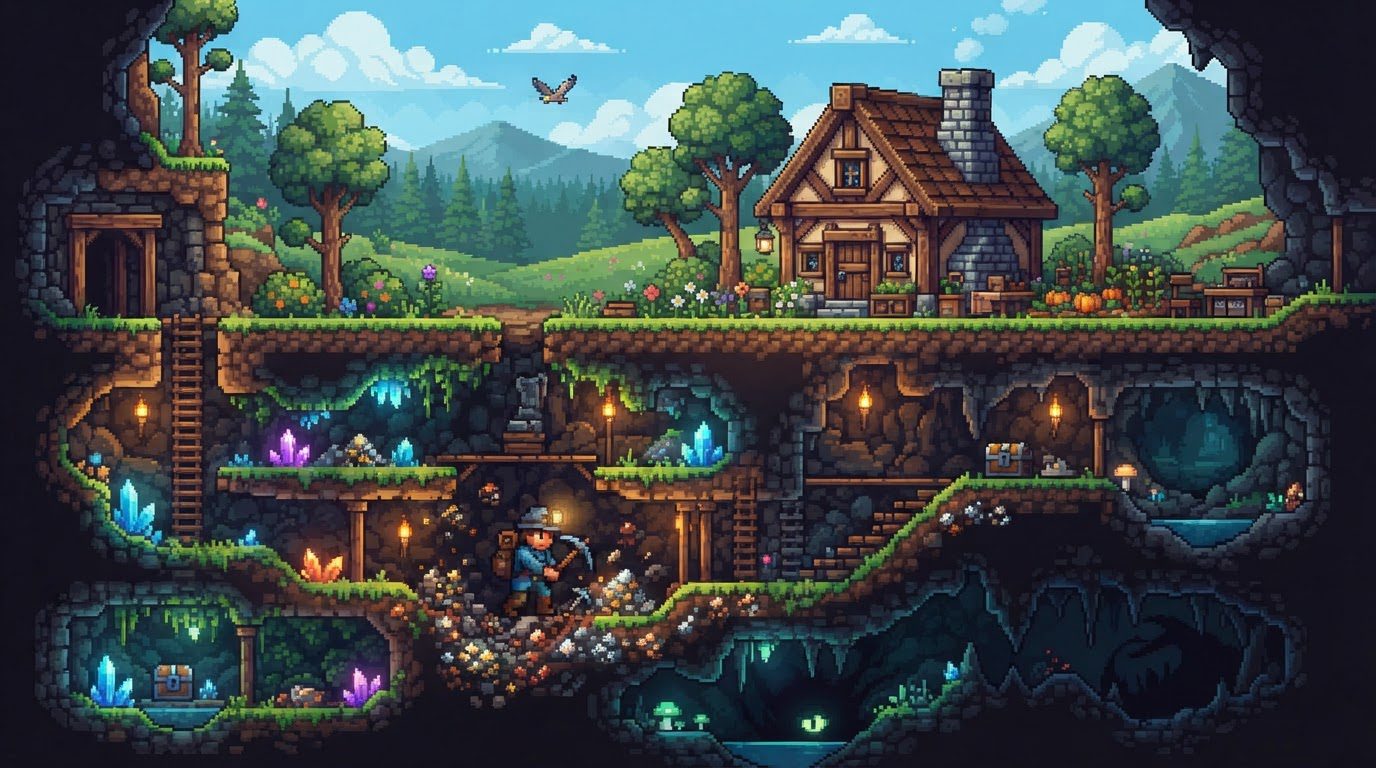
Terraria: building a world while preparing for its dangers
Terraria gives players a world they can change, with reasons to explore beyond the next building project. Digging produces resources, crafting turns discoveries into equipment and combat provides another reason to improve what a character can do.
Re-Logic and the original PC release
The Steam page names Re-Logic as developer and publisher and dates that release to 16 May 2011. This is the PC milestone, rather than a claim that every later console and mobile edition launched on the same day.
505 Games identifies Re-Logic as developer and supplies console purchase routes. Publishing information should therefore be attached to the relevant version instead of assuming that one storefront credit describes every edition.
Digging creates opportunities
The official description centres on digging, fighting, exploring and building. Generated worlds give those activities a changing setting, while underground areas provide places to seek treasure and raw materials.
The material gathered is useful because it changes what can be made. Exploration feeds equipment and construction, giving a journey a practical connection with the projects a player has chosen.
Construction is its own objective
Building can become the main focus of a session. The publisher describes creating a settlement for allies encountered along the way, alongside the freedom to shape personal structures.
A player can therefore pursue a design project without treating every action as a step through a fixed mission sequence. The world provides space for both useful structures and creative experiments.
Combat changes the preparation
The same world contains enemies that test equipment and combat choices. Seeking stronger foes gives progression a different purpose from collecting materials for a house.
These activities overlap without becoming identical. Someone interested in construction and someone pursuing combat goals can find different reasons to explore the environment.
Console and mobile versions need their own checks
505’s current page links PS4, Xbox One and Nintendo Switch editions. The Android listing describes mobile controls, controller support and its own multiplayer arrangements.
The publisher also announced Terraria+ for Apple Arcade on 1 October 2026, describing iPhone and iPad play with data synchronisation. That subscription edition should be distinguished from another store purchase.
Separate platform listings do not establish universal cross-play. Friends choosing versions should confirm that the specific editions and multiplayer arrangement fit their devices.
Read the PC requirements as published tables
Steam’s Windows minimum lists a 2 GHz CPU, 2.5 GB RAM, 128 MB video memory with Shader Model 2.0 support and DirectX 9.0c or later. Its recommended table specifies a dual-core 3 GHz CPU, 4 GB RAM and 256 MB video memory.
The table contains legacy operating systems and a 200 MB storage entry. Steam separately requires Windows 10 or later for its current client. The small storage figure is a published listing entry, not a freshly measured installation size.
Mac and Linux have separate requirements, while mobile compatibility is determined by the device listing. A desktop CPU figure cannot establish that a particular phone is supported.
Terraria’s attraction lies in combining an editable world with reasons to venture into it. Choosing a supported version allows the player to focus on the balance of construction, discovery and combat that interests them most.