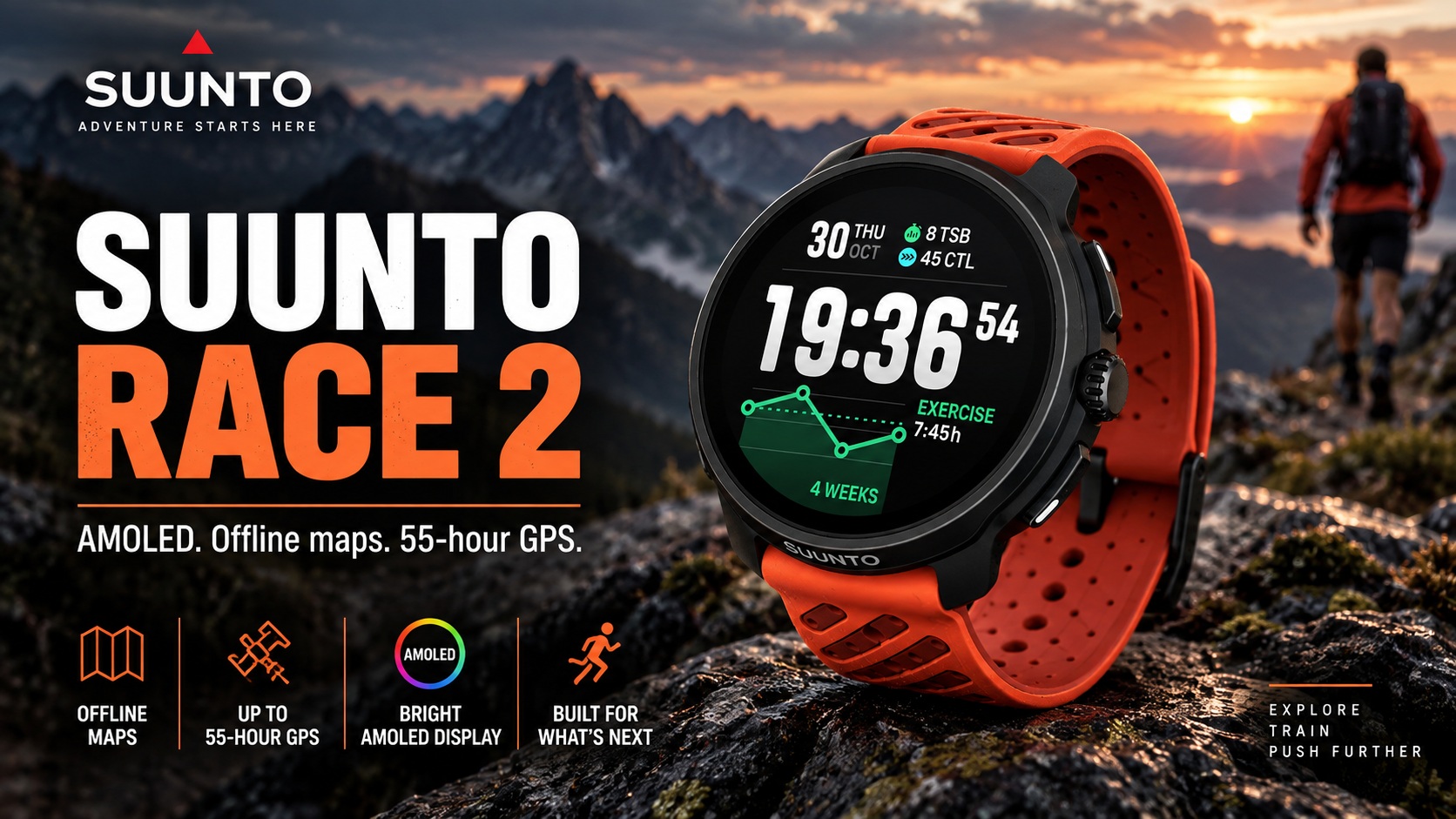
Suunto Race 2 brings a bigger AMOLED display, offline maps and up to 55 hours of GPS tracking
The Suunto Race 2 is built for people who want considerably more from a watch than step counting and smartphone notifications.
Its focus is training.
Running, cycling, hiking, swimming and other endurance activities sit at the centre of the experience. However, Suunto has also equipped the Race 2 with the features expected from a modern everyday sports watch.
The Coral Orange model combines a stainless-steel bezel with sapphire crystal, a bright 1.5-inch LTPO AMOLED display and a 49mm case. At 76g, it is not designed to disappear completely on the wrist. Instead, Suunto has prioritised a larger display, long battery life and serious navigation capability.
More importantly, this is not a watch Suunto launched and then left alone.
A fresh Race 2 software update began rolling out on 31 August 2026, improving overall stability and fixing an issue affecting pool-swimming distance and duration in certain situations.
For athletes looking at a premium training watch in 2026, that continuing software development may be almost as important as the hardware itself.
The Suunto Race 2 is designed around training
Suunto positions the Race 2 as a watch for training and racing rather than as a general smartwatch with a few exercise modes added afterwards.
That difference becomes clear from the feature list.
The watch supports more than 115 sport modes, alongside racing, pacing and nutrition tools. It also includes Suunto ZoneSense for real-time intensity tracking.
Those sport modes extend well beyond road running.
Trail running, mountain biking, ski touring and open-water swimming are among the activities Suunto specifically highlights.
As a result, the Race 2 makes more sense for someone who regularly trains across several activities than for someone who simply wants occasional workout tracking.
A larger 1.5-inch AMOLED display dominates the design
One of the main upgrades is the display.
The Suunto Race 2 uses a 1.5-inch LTPO AMOLED touchscreen with a resolution of 466 x 466 pixels.
It also supports an always-on display.
That larger screen matters on a training watch because information often needs to be read quickly.
During a run or ride, you may be checking heart rate, pace, distance or navigation while moving.
For outdoor navigation, meanwhile, the extra screen area gives maps more room to breathe.
Suunto says it made the panel both larger and brighter than before, while also redesigning the watch around a slimmer profile.
The Coral Orange model certainly does not try to disappear
The version featured here uses Suunto’s Coral Orange colourway.
It is not subtle.
That may be precisely the point.
Sports watches often spend their lives underneath jackets, covered in dust or sitting beside piles of black gym equipment. A bright strap makes the Race 2 much easier to spot.
The watch uses a 22mm silicone strap, while the stainless-steel model weighs 76g. Its case measures 49 x 49 x 12.5mm.
Therefore, this is still a relatively large sports watch.
People with smaller wrists should take that 49mm diameter seriously rather than choosing purely from photographs.
Suunto itself describes the smaller Race S as the option aimed more towards smaller wrists and everyday wear. By contrast, the Race 2 trades some compactness for a larger display, longer battery life and tougher materials.
Sapphire crystal is a welcome choice for an outdoor watch
The display is protected by sapphire crystal.
That is exactly the type of material we like to see on a watch designed for outdoor training.
The bezel is stainless steel, while the main case uses glass-fibre-reinforced polyamide.
This approach avoids making the entire watch from heavy metal while still protecting the areas most likely to take abuse.
Meanwhile, Suunto rates the Race 2 for 100 metres of water resistance.
That rating fits the watch’s support for swimming and outdoor activities far better than the light splash resistance found on some general-purpose smartwatches.
Battery life is one of the Suunto Race 2’s biggest strengths
AMOLED displays look excellent.
However, they can create a problem.
Battery life.
Suunto appears to have taken that issue seriously.
With multi-band GNSS operating at the best GPS accuracy, the Race 2 is rated for up to 55 hours of continuous training.
Moving through the lower-power GPS modes extends those figures considerably.
Suunto lists its training battery modes at approximately:
- 55 hours
- 65 hours
- 90 hours
- 200 hours
The maximum figure uses the power-saving Tour mode, which reduces GPS accuracy and disables heart-rate tracking.
Therefore, the 200-hour figure should not be confused with 200 hours of full-performance GPS tracking.
For normal daily use, Suunto claims up to 18 days with daily heart-rate tracking enabled and the display waking when the wrist is raised.
Turning daily heart-rate tracking off can extend that figure to up to 30 days.
Real-world battery life will naturally vary with GPS use, screen behaviour, notifications and other settings.
Even so, the claimed numbers give the Race 2 plenty of headroom for long training sessions and multi-day activities.
Dual-band GPS should matter to runners and hikers
Navigation is another major part of the Race 2.
The watch supports dual-band GNSS using L1 and L5 frequencies.
It can work with GPS, GLONASS, Galileo, QZSS and BeiDou satellite systems.
Dual-band positioning can be particularly useful in difficult environments where buildings, mountains or trees interfere with satellite signals.
However, GPS hardware is only half of Suunto’s navigation system.
The Race 2 also includes offline maps directly on the watch.
Free offline maps make the Race 2 much more useful away from mobile coverage
Suunto provides free offline maps, and the Race 2 includes 32GB of outdoor offline-map storage.
Routes can be planned through the Suunto app and transferred to the watch.
From there, the Race 2 offers features including waypoint navigation, route navigation, breadcrumb trails, estimated arrival information and altitude profiles.
There are also global heatmaps covering 20 sports.
These can help users find routes that other Suunto athletes frequently use.
Alternatively, someone exploring a quieter area can use the same information to avoid popular routes.
For South African runners, cyclists and hikers who spend time outside strong mobile coverage, offline mapping is particularly useful because the core navigation does not depend on maintaining a cellular connection.
Climb Guidance adds useful information on hilly routes
The navigation system also includes Climb Guidance.
Rather than showing only an overall elevation profile, the feature can help prepare athletes for upcoming climbs while following a route.
That becomes valuable during trail running, hiking or cycling because total distance tells only part of the story.
A 20km route across flat terrain is a very different physical problem from 20km involving repeated steep climbs.
The Race 2 also includes a barometric altimeter alongside GPS altitude.
Suunto’s FusedAlti technology combines GPS and barometric information, while the watch can track ascent, descent and vertical speed.
Heart-rate tracking has been redesigned
Optical heart-rate accuracy is important because so many training metrics eventually depend on it.
Suunto redesigned the back of the Race 2 and says the change improves wrist-based heart-rate measurement.
The watch also supports Bluetooth heart-rate belts for athletes who prefer an external sensor.
That is particularly relevant during structured training, where reliable heart-rate data can matter more than the convenience of optical measurement.
TechnologyBlog has also previously covered dedicated heart-rate hardware such as the Polar H10.
INTERNAL LINK: Link Polar H10 above to the existing TechnologyBlog Polar H10 article as related heart-rate training coverage. Do not frame this as a direct product comparison.
Suunto ZoneSense looks beyond basic heart-rate zones
The Race 2 includes Suunto ZoneSense, which focuses on workout intensity.
Suunto presents the system as a way to track intensity in real time rather than relying solely on traditional fixed heart-rate zones.
This fits the wider positioning of the Race 2.
The watch does not merely record that exercise happened.
Instead, Suunto wants it to help athletes understand how hard they are working and how that training affects recovery.
That becomes more useful when combined with longer-term training information.
Suunto Coach analyses training and recovery trends
Suunto Coach provides personalised training information based on the data gathered by the watch and Suunto app.
The system looks at areas such as training load, recovery and progress.
Athletes can also create and follow workout plans.
As a result, the Race 2 becomes more than a device that stores individual activities.
Its value comes from building a picture over time.
A single run tells you how that run went.
Weeks of training data can begin showing whether workload is increasing sensibly or whether recovery needs more attention.
Sleep and HRV tracking extend the watch beyond workouts
Training does not stop mattering when the workout ends.
The Race 2 includes sleep tracking with information covering sleep duration, wake periods, deep sleep, light sleep and REM sleep.
It can also monitor heart-rate variability during sleep.
Daily resource levels and stress-and-recovery status are also available.
Those metrics can help place a workout into a broader context.
For example, the same training session may affect someone differently after a good night’s sleep than it would after several nights of poor recovery.
Still, these metrics should be treated as training and wellness information rather than medical diagnosis.
Blood oxygen tracking is included
The Race 2 can also measure blood oxygen.
Suunto integrates this with features such as altitude acclimation.
That makes sense for a watch aimed partly at mountain and endurance sports.
However, as with other consumer wearable measurements, users should not treat the watch as a substitute for professional medical equipment or medical advice.
Its purpose remains sports and wellness tracking.
More than 115 sport modes cover far more than running
Running may be central to the Race 2’s identity, but Suunto lists more than 115 sport modes.
That broad selection is important for multisport athletes.
Someone may run during the week, cycle at weekends and swim as part of cross-training.
Others may alternate between hiking, mountain biking and gym sessions.
Instead of maintaining separate tracking systems, the Race 2 can keep those activities inside one training history.
Recent software development has also expanded Suunto’s multisport functionality.
Suunto continues improving multisport features through software
The Race 2 has received several software updates since launch.
Earlier updates introduced features such as improved morning reports, ground-contact time and vertical oscillation information for running logs.
Other releases improved wrist-heart-rate accuracy, navigation, swimming accuracy, altimeter behaviour and sensor management.
More importantly, Suunto continues updating the watch in 2026.
Software version 2.56.28 began its staged rollout on 31 August 2026.
That release focused on overall stability and fixed a problem that could cause incorrect pool-swimming distance and duration readings in certain situations.
For a sports watch, this continuing support matters.
The physical hardware may stay on your wrist for years.
Software determines whether the experience improves during that period.
Faster hardware gives Suunto more room for future updates
Suunto says the Race 2 uses faster hardware and significantly more memory than its predecessor.
The company specifically says those changes were made so the watch could accommodate future features and software updates.
That is an important design decision.
Sports watches are increasingly software platforms.
Mapping improves.
Training algorithms evolve.
New metrics appear.
Partner integrations expand.
A processor that feels adequate at launch can become a limitation several years later.
Building extra headroom into the Race 2 therefore makes sense if Suunto plans to support it over a long period.
The Suunto ecosystem extends beyond the watch
The Race 2 works with the Suunto app, which acts as the main platform for training data, route planning and watch management.
Suunto also says its ecosystem connects with more than 300 partner apps.
Named partners include services such as Strava and TrainingPeaks.
This is important because athletes rarely keep all their data inside one ecosystem forever.
A runner may use Strava socially.
A coach may work through TrainingPeaks.
Routes might come from another service.
The ability to move training information between platforms reduces the risk of the watch becoming an isolated data silo.
Smartwatch features are present, but they are not the main attraction
The Race 2 still handles everyday smartwatch functions.
It can display phone notifications, control media playback and provide alarms.
Android users can also send predefined replies to incoming messages from the watch.
However, anyone primarily interested in apps, messaging or smartphone-like features should understand the Race 2’s priorities.
This is a sports watch first.
Its biggest features revolve around GPS, navigation, training, recovery and battery endurance.
The smartwatch tools are useful additions rather than the reason to buy it.
The 49mm case will not suit everyone
There is one specification buyers should check carefully.
49mm.
That is the Race 2’s diameter.
Although Suunto redesigned the model to be slimmer and lighter, 49mm remains substantial.
The stainless-steel Coral Orange version weighs 76g.
Some athletes prefer a larger display during activity, especially when following maps.
Others want a watch that almost disappears on their wrist.
This is where Suunto’s own Race S becomes relevant.
Suunto describes the Race S as the smaller option, using a 45mm case and a 1.32-inch AMOLED display. The Race 2 moves up to 49mm and 1.5 inches while providing considerably more battery capacity.
Therefore, buyers should think about wrist fit rather than simply assuming bigger is better.
The rotating crown gives another way to navigate the interface
Touchscreens can become awkward during exercise.
Sweat, rain and gloves all make precise touch input harder.
The Race 2 therefore combines its touchscreen interface with physical controls, including Suunto’s digital crown system.
That gives athletes another way to move through menus or information screens without relying completely on touch.
For an outdoor training watch, that is a sensible approach.
Physical controls remain valuable when conditions are less than ideal.
Weather features support outdoor use
The Race 2 also includes several environmental tools.
Sunrise and sunset information is available.
There is a storm alarm.
Sea-level pressure can be displayed.
Temperature information is also supported.
Again, these features reinforce the difference between a general smartwatch and an outdoor sports watch.
A person running on a treadmill may rarely use them.
Someone hiking or trail running for several hours has a much stronger reason to care.
The Suunto Race 2 Coral Orange is officially listed in South Africa
The Suunto Race 2 Coral Orange has its own listing on Suunto’s South African website.
That gives local buyers an official South African product reference rather than forcing them to rely only on international specifications.
TechnologyBlog is not including South African pricing here because pricing can change and this article is focused on the product itself.
Readers can check the current model directly through the official Suunto Race 2 Coral Orange product page.
Suunto Race 2 specifications
The key hardware specifications for the stainless-steel Coral Orange model include:
Display: 1.5-inch LTPO AMOLED
Resolution: 466 x 466
Case size: 49 x 49 x 12.5mm
Weight: 76g
Bezel: Stainless steel
Glass: Sapphire crystal
Case: Glass-fibre-reinforced polyamide
Strap: 22mm silicone
Water resistance: 100m
Offline-map storage: 32GB
GNSS: Dual-band L1 + L5
Integrated heart rate: Yes
Blood oxygen: Yes
Always-on display: Yes
Sport modes: More than 115
Best multi-band GPS battery: Up to 55 hours
Maximum power-saving GPS: Up to 200 hours
Daily use with heart rate: Up to 18 days
Daily standby: Up to 30 days
Who is the Suunto Race 2 for?
The Race 2 makes the most sense for people who regularly train outdoors.
Runners immediately fit that description.
However, trail runners, cyclists, hikers, swimmers and multisport athletes can make equally strong use of the hardware.
Offline maps and dual-band GPS also make it attractive for people who explore routes away from reliable mobile coverage.
Meanwhile, the long GPS battery life matters for endurance events and long adventures.
Someone primarily interested in notifications, mobile apps and smartwatch entertainment may find much of this hardware unnecessary.
That is not a weakness.
It simply reflects what Suunto built the watch to do.
The Suunto Race 2 is a sports watch first
The Suunto Race 2 does not try to turn your wrist into a smaller smartphone.
That may be one of its strengths.
Instead, Suunto has concentrated on the areas that matter to serious training.
A large AMOLED display.
Long GPS battery life.
Dual-band positioning.
Offline maps.
Heart-rate and HRV tracking.
More than 115 sport modes.
Training-load and recovery information.
Navigation tools.
A durable sapphire display.
Continuous software development.
The Coral Orange version then adds something less technical but still important: personality.
It is bright enough to stand out without changing what sits underneath.
Most importantly, Suunto continues improving the platform.
The Race 2 received another software update at the end of August 2026, almost a year into its life.
That makes the Race 2 more interesting than a specification sheet frozen at launch.
For athletes considering a watch they may train with for several years, the combination of solid hardware and continuing software support is likely to matter far more.


