SAPPHIRE History: How Radeon Board Engineering Built a Specialist Graphics Brand
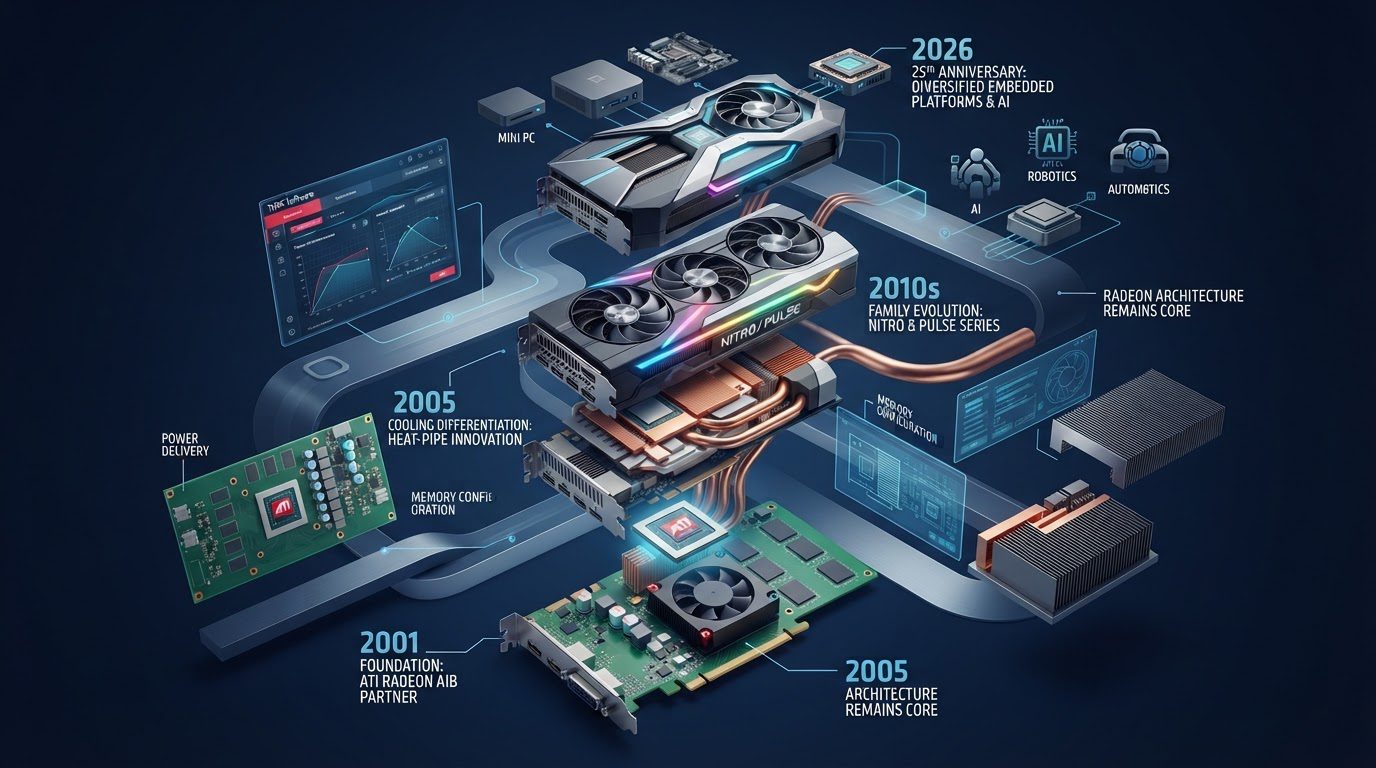
SAPPHIRE Technology has a deliberately narrow origin in PC graphics. The company says it was founded in 2001 as one of the early add-in-board partners supplying graphics cards based on ATI Radeon processors, before ATI itself was acquired by AMD. That relationship made Radeon hardware—not generic PC components—the foundation of the brand.
SAPPHIRE began as a Radeon board specialist
As an add-in-board company, SAPPHIRE's job was to turn ATI/AMD graphics processors into finished cards. That involved PCB design, memory configuration, power delivery, cooling, firmware and validation. The company could not change the underlying GPU architecture, so product differentiation had to happen around how the silicon was packaged and operated.
SAPPHIRE's own 20th-anniversary history identifies the ULTIMATE X800 XL in 2005 as an important cooling milestone, using a heat-pipe design, and notes the launch of TriXX software for monitoring and overclocking. Those products show two recurring themes in enthusiast graphics: reducing heat and noise, and giving users more control over clock speeds and fans.
Cooling and TriXX created room for differentiation
The company later built recognisable families such as NITRO and PULSE while remaining closely tied to AMD Radeon. By its 25th anniversary in September 2026, however, SAPPHIRE described a broader portfolio spanning Radeon graphics, motherboards, Mini PCs and specialised embedded platforms for AI, robotics and automotive uses. Consumer graphics remains central, but the current business is wider than a graphics-card-only description suggests.
SAPPHIRE's long relationship with ATI and later AMD is the key to understanding its place in graphics. It does not design the Radeon GPU architecture; it is an add-in-board specialist that turns those chips into finished cards for retail and professional customers. Products such as the passively cooled ULTIMATE X800 XL in 2005 show how a board partner could differentiate through thermal design, while TriXX software added tuning and monitoring around the hardware. That combination—taking a common GPU platform and competing through board engineering, cooling and enthusiast features—has remained central to the company's identity across successive Radeon generations.
SAPPHIRE's history is distinctive because its expansion has remained close to AMD-based computing rather than moving into unrelated consumer electronics. Radeon graphics remains the historical core, while the 2026 portfolio shows how the company has carried board and system engineering into motherboards, Mini PCs and embedded platforms. The GPU generations changed, ATI became part of AMD and the product scope broadened, but integrating AMD silicon into finished hardware remains the through-line.