Seagate History: How the ST-506 Helped Define PC Storage
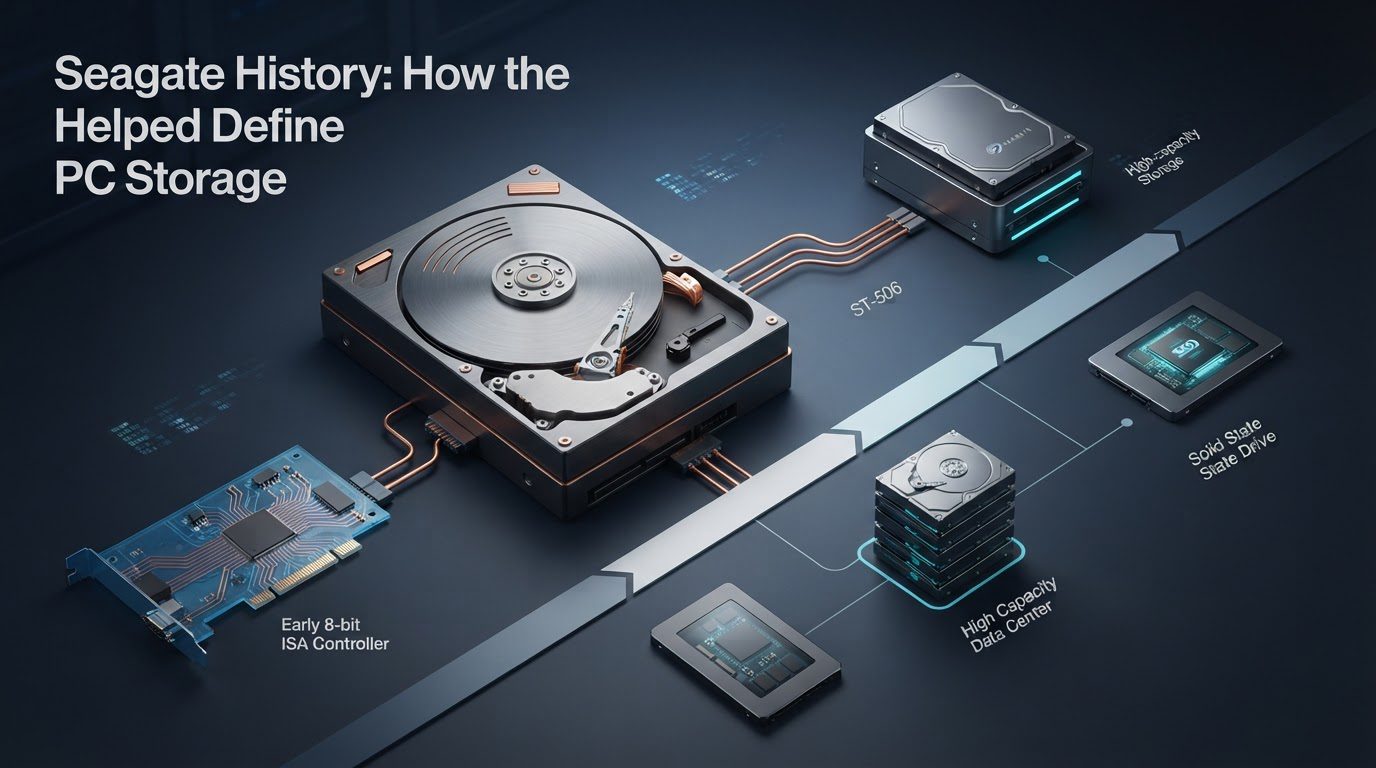
Seagate was founded in 1979 as Shugart Technology and entered the storage market just as personal computers were creating demand for smaller hard drives. Its ST-506, introduced in 1980, offered 5MB of capacity in a 5.25-inch form factor and became one of the products that helped establish hard-disk storage as practical equipment for early PCs.
The ST-506 helped make hard drives practical for PCs
The drive's importance grew through standardisation and OEM adoption. IBM used Seagate drives in the PC XT era, and the ST-506 interface became widely influential. The consequence was larger than one customer order: Seagate gained volume while PC makers gained a storage format that could be incorporated into a growing ecosystem of compatible systems.
Hard-drive engineering then became a race across areal density, mechanics, heads, controllers and manufacturing precision. Seagate expanded through product development and acquisitions as the industry consolidated, serving desktops, notebooks, servers and external-storage markets. The company survived transitions that eliminated many early disk-drive competitors.
Why magnetic storage still matters in data centres
Flash memory later changed the storage market by taking over many client-computing workloads, but hard drives retained an economic advantage for very large capacities. Seagate therefore shifted emphasis toward high-capacity data-centre and mass-storage applications while also selling SSD and hybrid products in parts of its portfolio.
Seagate's current emphasis on high-capacity storage follows directly from the economics of the medium. SSDs transformed laptops and many servers because flash offers low latency and no moving parts, but magnetic disks can still deliver enormous capacities at a lower cost per stored bit for many bulk-data workloads. That is why the company did not simply 'lose' the PC market and disappear. Instead, it increasingly serves data centres, cloud operators and other customers whose problem is storing vast quantities of information economically. The engineering frontier has moved toward areal density and technologies that push more bits onto each platter, but the commercial objective is recognisably descended from the ST-506 era.
The ST-506 remains a powerful starting point because it captures the company's enduring problem: store more data reliably in a standard physical envelope at an acceptable cost. The mechanisms and customers have changed—from early PCs to hyperscale data centres—but storage density and manufacturing at scale still define Seagate far more than generic 'technology brand' language does.