Razer History: From the 1999 Boomslang to Razer Inc.’s 2005 Founding
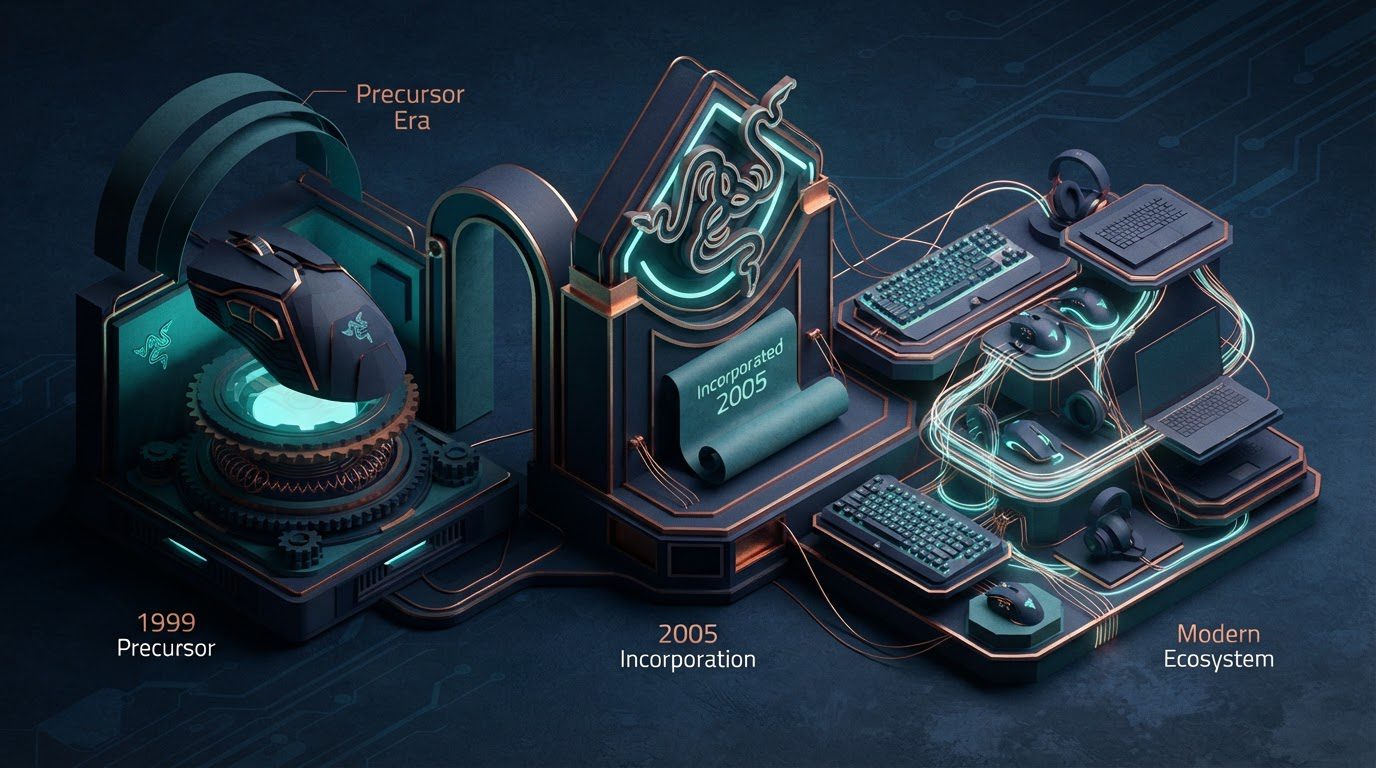
Razer's history has two distinct beginnings. The Boomslang gaming mouse appeared in 1999 under Karna, a precursor business. Razer Inc. itself was incorporated in 2005. Razer's own 20th-anniversary material now makes that distinction explicit, which corrects the common but misleading shorthand that treats the modern company as if it had been continuously operating since the mouse's original launch.
The Boomslang predates Razer Inc.
The Boomslang mattered because it was designed specifically around PC gamers at a time when most mice were office peripherals. Razer describes it as the first gaming mouse and points to its unusually high sensitivity and on-the-fly adjustment. That 'first' is Razer's historical claim and should be attributed, but the product's commercial role is clear: it made the mouse itself part of gaming performance culture.
After the 2005 incorporation, Razer expanded through mice such as DeathAdder and Naga, keyboards, headsets and eventually Blade gaming laptops. Software and RGB lighting linked those devices into a more recognisable ecosystem. The company also moved into fintech and other ventures at different points, but gaming hardware remained the brand's centre of gravity.
2005 created the modern Razer company
The product strategy repeatedly turned specialist gamer behaviour into dedicated hardware. Multi-button MMO mice, lightweight esports models and thin high-performance laptops are all examples of Razer trying to make design choices around a gaming use case rather than repackaging ordinary office equipment.
The split between 1999 and 2005 also improves how later milestones are interpreted. Boomslang establishes the product and brand heritage, while the 2005 incorporation marks the beginning of the current company that built the broader ecosystem. Those are different historical claims and both can be true. Treating them separately prevents a common error in technology histories, where a famous early product is used to imply continuous corporate existence. It also makes later expansion easier to assess: DeathAdder, Blade laptops, software and RGB systems belong to the modern Razer organisation, not simply to the original Karna-era mouse venture.
The most accurate Razer timeline therefore uses 1999 for the Boomslang heritage and 2005 for the current corporation. That split does not weaken the story; it clarifies it. The enduring idea is that input devices and PCs can be designed as gaming products in their own right, and Razer has spent two decades turning that idea into a broad lifestyle and hardware brand.