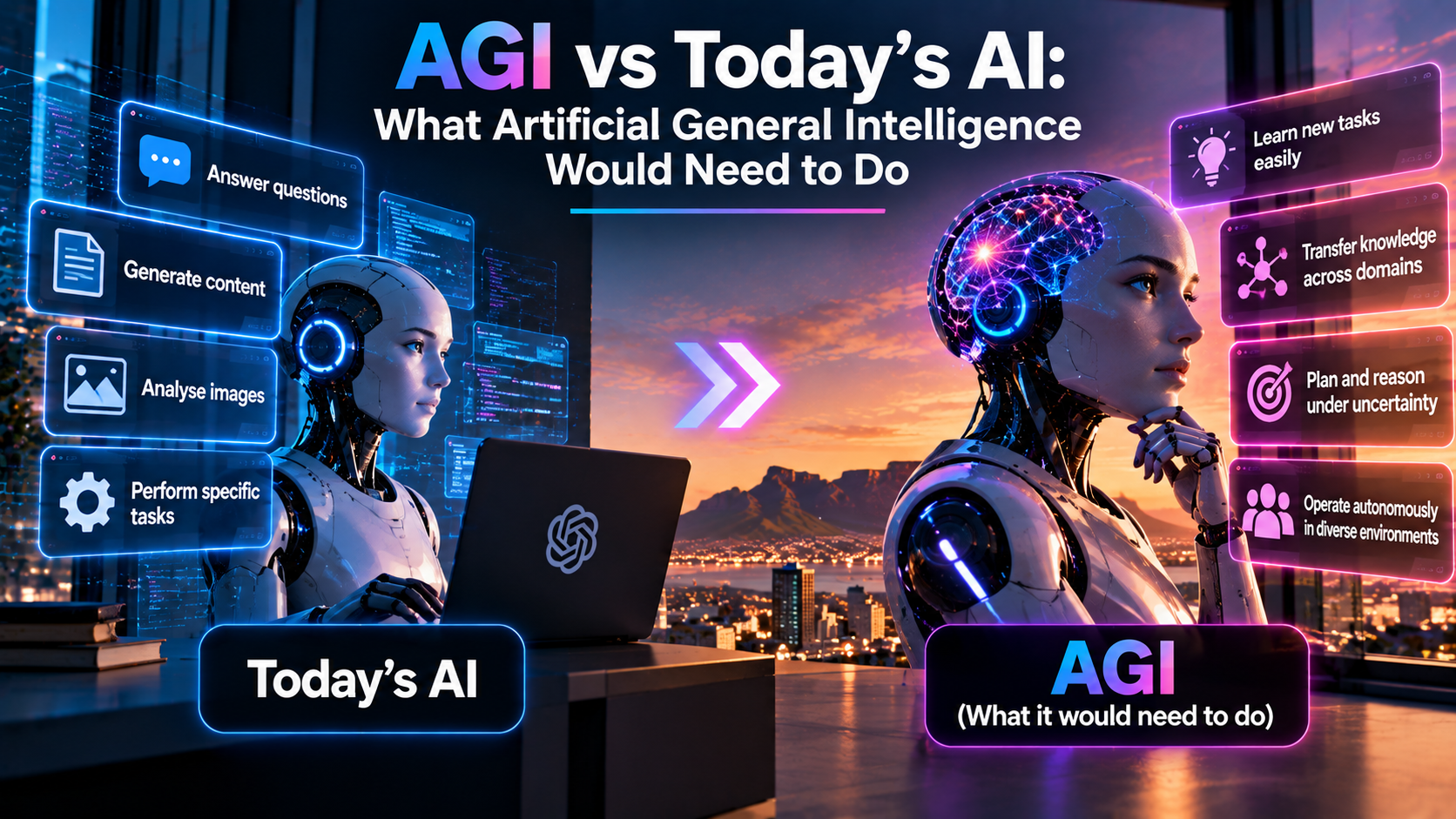
AGI vs Today’s AI: What Artificial General Intelligence Would Need to Do
Frontier AI has made the old “narrow AI” shorthand increasingly awkward. One system can now write software, analyse documents, interpret images and operate tools, yet still fail unpredictably on an unfamiliar task a person finds simple. That unevenness is the more useful boundary in the AGI debate: breadth of features is not the same as robust general intelligence.
AGI, by contrast, is usually framed as intelligence that transfers across tasks and domains with much greater reliability. The question is therefore not whether modern models look versatile. It is whether they can learn, reason and adapt across unfamiliar situations strongly enough to count as genuinely general.
For the definitions behind this debate, start with our complete AGI guide.
Today’s AI is broader than the old “narrow AI” label suggests
The phrase narrow AI can sound misleading in 2026 because one model can now perform many different jobs. A frontier language model may translate, code, summarise, plan and interpret images inside the same interface. Agent systems can combine those abilities with browsers, terminals and other software.
Yet this breadth is still shaped by training, prompting, scaffolding and tool design. The same system can be brilliant on one problem and unexpectedly weak on another that appears simpler to a human. Generality needs to account for that inconsistency.
AGI would need stronger transfer to unfamiliar problems
Humans routinely use experience from one setting in a new one. We infer rules, recognise analogies and learn from sparse examples. AGI is usually expected to show this kind of transfer without requiring a dedicated retraining cycle for every new domain.
ARC-AGI-3 is relevant precisely because its interactive environments do not provide instructions or explicit goals. An agent must experiment, infer how the world works and carry learning forward. That tests a different capability from recalling facts or following a familiar workflow.
The benchmark also shows why a score needs its evaluation conditions attached. ARC Prize reported in September that GPT-6 Astra reached 62.7% under its standard harness and 99.9% with OpenAI’s provider-adapter harness. That is major progress, but ARC Prize still does not treat saturation of this bounded benchmark as proof of AGI.
AGI would need reliability, not occasional brilliance
Benchmark records can make models look more dependable than they are. A system that solves a difficult reasoning problem 70% of the time can be impressive research while still being unsuitable for unsupervised control of an important real-world process.
For AGI, reliability becomes central because “general” implies use across a wide range of contexts, including contexts the developer did not enumerate in advance. Failure modes matter as much as peak performance.
Long-horizon work remains a useful stress test
METR’s time-horizon research measures the length and difficulty of software tasks at which frontier AI agents achieve a given success rate. It is not an AGI test, and METR explicitly warns against interpreting the metric as literal autonomous runtime. But the idea is useful: as tasks become longer, they require more planning, error recovery, state management and sustained coherence.
A general system should not merely answer well in short bursts. It would need to keep working when a task branches, a plan fails or new evidence appears.
Autonomy is not the same thing as general intelligence
A narrow system can be highly autonomous. A trading algorithm can operate continuously without being remotely general. Conversely, a very capable model can be restricted by design so that a human approves every meaningful action.
This is why Google DeepMind separates capability levels from deployment considerations. AGI discussions become confused when “can do many tasks” and “can act without supervision” are treated as the same axis.
Memory is not enough either
Giving an AI a larger context window or persistent memory can improve continuity, but memory alone does not create general intelligence. A system still needs to decide which information matters, reason about it, update beliefs and apply knowledge appropriately.
The distinction is similar to a library versus a researcher. Access to more information helps, but intelligence involves what happens with that information.
Today’s agents show why the boundary is getting blurry
Agentic AI is making the AGI debate more urgent because software can now combine models with tools, memory and planning loops. Current agents can complete multi-step tasks that would previously have required a person to move between applications manually.
TechnologyBlog’s AI in the Boardroom looks at the organisational consequences of that shift, while our Gemini agent coverage shows how consumer and enterprise assistants are increasingly framed around actions rather than only answers.
General intelligence would need to handle the world beyond clean benchmarks
Real environments are messy. Goals conflict, instructions are incomplete, people change their minds, tools fail and information can be false. Humans use social context and common sense to navigate that ambiguity, imperfectly but often effectively.
A convincing AGI claim would therefore need evidence beyond benchmark scores. Researchers would need to see robust performance across unfamiliar tasks, domains and conditions without hidden task-specific engineering doing most of the work.
Why there may never be one clean AGI moment
If capabilities improve gradually, society may not wake up to a single universally accepted “AGI day”. One group may use an economic definition and declare the threshold crossed when AI handles most valuable knowledge work. Another may demand human-level generality across cognitive tasks. A third may require stronger autonomy or continual learning.
Google DeepMind’s level-based framework reflects this possibility by treating AGI as a spectrum of performance and generality rather than a single binary switch.
What today’s AI still teaches us
The fact that current models are not universally accepted as AGI does not make them trivial. They are already changing software development, research, creative work and business processes. Waiting for an AGI label before taking AI seriously would be a mistake.
Likewise, calling every major model improvement “AGI” makes the term useless. The more disciplined approach is to describe the actual capability, the evidence for it and the remaining limitations.
The line between broad capability and general intelligence
Today’s frontier AI is best understood as increasingly broad but still uneven. AGI would require a level of generalisation, adaptation, reliability and transfer that holds across unfamiliar tasks, not only across a large collection of known ones.
That is why a “how to use AGI” article would still be misleading entering 2027. Powerful frontier AI products exist now; AGI remains the disputed threshold describing what a more general class of system would need to demonstrate. TechnologyBlog’s AGI measurement guide examines the tests, while 10 Capabilities an AGI Would Need to Demonstrate turns the debate into a practical evidence checklist.


