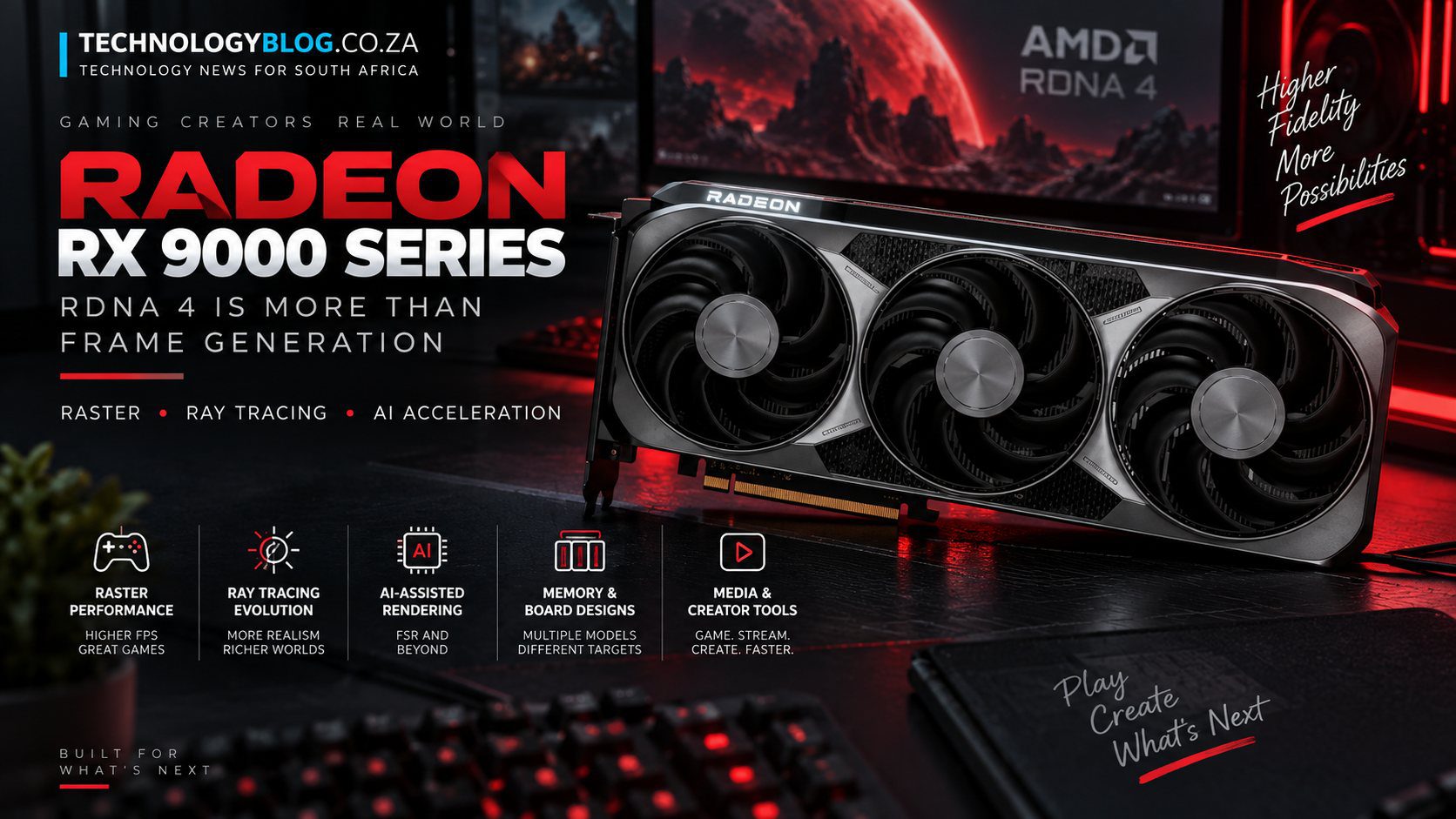
Radeon RX 9000 Series: RDNA 4 performance is more than frame generation
AMD’s Radeon RX 9000 generation shows how modern GPU performance has become a three-part story: conventional raster graphics, ray tracing and AI-assisted rendering. Radeon RX 9000 Series uses the RDNA 4 architecture, with stronger ray-tracing hardware, dedicated AI acceleration and updated media capabilities, but the family label covers different boards with different memory, power and cooling targets.
That makes “RDNA 4 is faster” too shallow an explanation. A buyer’s result depends on the game engine, resolution, image-quality setting and whether FidelityFX Super Resolution or frame-generation techniques are part of the rendering path.
Raster performance is still the baseline
Most game scenes still rely heavily on conventional rasterisation, even when selected effects use ray tracing. Strong shader throughput and memory bandwidth therefore remain foundational to how a Radeon card performs across a broad library.
This matters because software support varies. A card should not depend entirely on one reconstruction technique to feel competitive in games that do not implement it. Native and raster performance remain the common denominator across the largest number of titles.
RDNA 4 puts more emphasis on ray tracing
Ray tracing simulates the paths of light more directly for effects such as reflections, shadows and global illumination. The visual payoff can be significant, but the computation is expensive. AMD’s architecture work therefore has to improve how efficiently those rays and intersections are processed.
For gamers, the useful measure is not a ray-tracing feature badge. It is whether enabling the effects produces a worthwhile image improvement at a frame rate that still feels good on the target monitor.
AI acceleration is becoming graphics hardware
Dedicated AI resources are increasingly relevant to upscaling, frame generation and creative applications. Instead of rendering every output pixel conventionally, software can infer detail or motion from lower-resolution frames and game-engine information.
This changes the way GPU comparisons need to be read. A card may have one native-rendering result and a very different displayed frame rate once reconstruction and generated frames are enabled. Both can be useful, but they describe different workloads and latency characteristics.
FSR is part of the product experience
AMD’s FidelityFX Super Resolution technologies are designed to improve performance through upscaling and, in supported implementations, frame generation. The quality depends on the version, game integration and base frame rate.
Frame generation works best when the game is already running responsively enough for inserted frames to improve smoothness rather than conceal a sluggish input loop. A triple-digit displayed frame rate is not automatically equivalent to the same number of fully game-rendered frames.
Memory and board design separate the models
RX 9000 Series is not one card. Different models carry different memory capacities, bus configurations, cooler designs and power limits. Those differences influence target resolution and how comfortably a card handles large texture sets or demanding ray-traced scenes.
Partner boards add another layer through cooler size, acoustic tuning and factory power settings. Buyers building compact systems should pay as much attention to physical dimensions and power supply requirements as to benchmark charts.
Media engines matter outside games
Modern GPUs are also video devices. Hardware encode and decode capabilities affect streaming, recording and creative applications, particularly as newer codecs become more common. For a creator who also games, those blocks can be part of the purchase value.
Driver support matters across both workloads. Stability, game profiles and application compatibility can change over the life of the card, so a GPU generation is partly a software platform after the hardware reaches shelves.
Radeon RX 9000 Series is one part of a wider AMD stack
AMD’s wider portfolio gives Radeon RX 9000 Series a clearer frame. TechnologyBlog.co.za has previously covered EPYC 9005 Series, Ryzen 9000 Series and Ryzen Threadripper PRO. Those products reach into the wider product portfolio, while Radeon RX 9000 Series is being judged here through compute silicon and hardware architecture. The overlap can be commercially useful, but it does not erase the technical or product boundary between them.
That matters because the 2026 story here is rDNA 4 performance is more than frame generation. Other AMD releases can show the publisher’s platform strategy or technical direction, but they do not make one game or piece of gaming hardware a replacement for another. The useful comparison stays with the actual player experience, supported hardware and post-launch support.
The wider portfolio also helps track lifecycle. A function can migrate from one AMD product to another, a sibling can remain current after this product is superseded, and local availability can diverge even when the global brand page looks unified. Following EPYC 9005 Series and Ryzen 9000 Series and Ryzen Threadripper PRO alongside Radeon RX 9000 Series therefore gives readers a better view of what AMD is maintaining, expanding or leaving behind.
GeForce RTX 50 Series is the better benchmark than a generic feature list
RDNA 4 and Blackwell both combine raster hardware with stronger ray tracing and AI-assisted rendering. AMD’s Radeon story centres on FSR and value across the RX 9000 stack, while NVIDIA competes with DLSS, CUDA and a broader AI/creator ecosystem. Street price matters.
For players, the comparison should stay grounded in the actual experience: supported platforms, performance targets, controls, online population, progression and the cadence of updates. A marketing feature can matter, but only if it changes how Radeon RX 9000 Series feels after dozens of hours rather than only how the launch trailer reads.
Another AMD reference point
Ryzen Threadripper PRO adds a third piece of manufacturer context. It covers the wider product portfolio, whereas Radeon RX 9000 Series is centred on compute silicon and hardware architecture. The significance is not that a buyer should own both; it is that AMD’s roadmap is spreading across adjacent layers, so product names, bundles and support paths have to be read precisely.
That precision is especially valuable when older documentation remains searchable after a successor, rebrand or portfolio change. For Radeon RX 9000 Series, the current article’s lifecycle and regional position should therefore take precedence over an older family-level description.
South African value depends on street pricing
Local GPU pricing can reorder what looks like a simple international product stack. Exchange rates, inventory and distributor pricing determine whether an RX 9000 model competes with the card immediately above or below it in overseas reviews.
RDNA 4’s 2026 story is therefore broader than frame generation. AMD is trying to improve raster, ray tracing and AI-assisted rendering together, while individual RX 9000 boards still have to be judged by their memory, power, cooling and local price. The architecture is one layer; the actual card on the shelf is the product a South African buyer has to live with.
Primary source: official product information, checked 19 September 2026.


