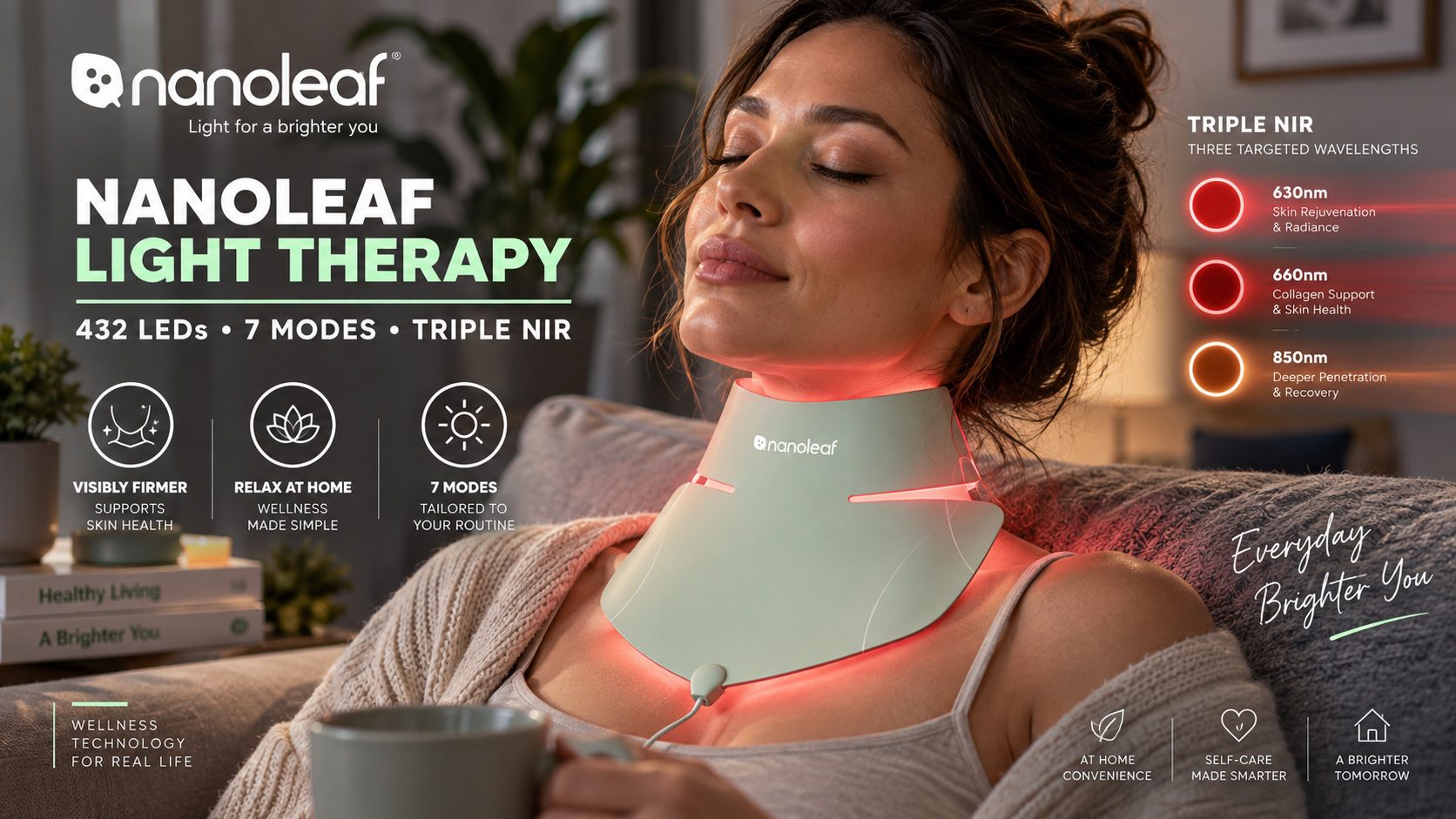
Nanoleaf takes its LED expertise into skincare with a 432-LED neck mask
The Nanoleaf Light Therapy Neck Mask takes a company best known for decorative smart lighting into a very different application for LEDs.
Officially called the Nanoleaf LED Light Therapy Neck & Décolletage Mask, the wearable device uses 432 LEDs across the neck and upper chest.
However, these lights are not designed to illuminate a room.
Nanoleaf combines visible red, green and blue light with three near-infrared wavelengths to create seven treatment modes aimed at different skincare concerns.
The system includes 850nm and 940nm near-infrared light alongside 12 dedicated 1072nm Deep NIR points.
Nanoleaf says those wavelengths allow the mask to target concerns including visible wrinkles, uneven tone, acne, redness, uneven texture and loss of firmness.
Those are Nanoleaf’s skincare claims rather than TechnologyBlog test results.
Nevertheless, the hardware itself is interesting because it takes technologies normally discussed in lighting specifications and applies them directly to wearable wellness technology.
Nanoleaf Light Therapy Neck Mask contains 432 LEDs
The Nanoleaf Light Therapy Neck Mask contains a total of 432 LEDs.
Nanoleaf arranges them across 114 LED bulbs.
Most bulbs contain four LEDs, while 12 dedicated locations contain two LEDs each.
Those 12 areas provide the mask’s 1072nm Deep NIR treatment.
This arrangement allows Nanoleaf to combine different wavelengths rather than relying on one type of light across the entire device.
As a result, changing treatment mode changes more than the visible colour of the mask.
Different modes activate different combinations of visible and near-infrared wavelengths.
Six wavelengths create seven treatment modes
The Nanoleaf mask uses six principal wavelengths.
Visible light operates at approximately 460nm for blue, 525nm for green and 640nm for red.
Near-infrared treatment adds 850nm, 940nm and 1072nm wavelengths.
Nanoleaf combines these into seven modes: Red, Green, Blue, Cyan, Yellow, Purple and White.
Each mode uses a different wavelength combination.
Therefore, selecting a colour is effectively selecting a treatment profile rather than simply changing the appearance of the mask.
Red Mode combines red light with Triple NIR
Red Mode combines 640nm red light with all three near-infrared wavelengths: 850nm, 940nm and 1072nm.
Nanoleaf associates this mode with visible wrinkles and firmness.
Importantly, the company bases its most prominent consumer-results claim on this setting.
Nanoleaf says an internal evaluation involving 128 participants used Red Mode for 10 minutes, four times each week for eight weeks.
According to the company, 78.2% reported visible improvement.
Individual results can vary, and the evaluation should not be interpreted as TechnologyBlog independently verifying the same outcome.
1072nm Deep NIR receives dedicated treatment zones
One of the mask’s most distinctive technical features is its use of 1072nm Deep NIR.
Nanoleaf places 12 dedicated 1072nm points across selected areas of the neck and décolletage.
The company says this wavelength penetrates deeper than conventional LED wavelengths.
However, 1072nm does not operate in every treatment mode.
It appears in Red, Yellow, Purple and White modes.
Green, Blue and Cyan use different wavelength combinations without the 1072nm component.
Nanoleaf says this is intentional because each mode has been configured around its intended skincare purpose.
Advanced Triple NIR combines three wavelengths
Nanoleaf describes the combination of 850nm, 940nm and 1072nm as Advanced Triple NIR.
Near-infrared light sits outside the visible portion of the spectrum.
Consequently, users should not expect every active LED wavelength to appear visibly illuminated.
The combination is designed to deliver different depths and patterns of light exposure.
Nanoleaf says this allows the mask to target visible signs of ageing across the neck and décolletage.
Again, the physiological outcome is a manufacturer claim.
The underlying hardware specification is clearer: three different NIR wavelengths operate alongside the visible LEDs.
Seven modes address different skincare goals
Nanoleaf assigns a different primary purpose to each treatment mode.
The company positions Red for wrinkles, Green for uneven tone and Blue for acne-prone skin.
Cyan targets soothing, while Yellow targets redness.
Purple is intended for uneven texture, and White focuses on firmness.
Several modes combine multiple visible wavelengths with NIR.
Therefore, the colour names are a simplified way of identifying relatively complex LED combinations.
Users can switch between them according to the concern they want to address.
Five intensity levels add control
Each mode provides five intensity levels.
That gives users another layer of adjustment beyond choosing a wavelength combination.
Treatment intensity can therefore change without requiring the user to select an entirely different mode.
Nanoleaf also publishes different power-density figures for each light mode.
These range from approximately 100.5mW/cm² for Yellow to 196.8mW/cm² for Cyan.
Power density describes how much light energy reaches a given area.
However, a higher number should not automatically be interpreted as a better skincare result.
The modes use different wavelength combinations and target different concerns.
Treatment takes around 10 minutes
Nanoleaf recommends a 10-minute treatment session.
The company suggests using the mask three to five times per week.
That makes the product relatively easy to incorporate into an existing routine.
Users can also change the timer.
The controller supports session times ranging from one to 30 minutes, although Nanoleaf’s standard recommendation remains 10 minutes.
Automatic shutoff ends the session once the selected timer expires.
Consistency is central to Nanoleaf’s recommended usage rather than unusually long individual sessions.
The mask covers the neck and décolletage
Unlike LED face masks, this product specifically targets the neck and décolletage.
The flexible treatment section measures approximately 309 × 224.4mm.
Nanoleaf designed the coverage area to extend across both the neck and upper chest.
Adjustable straps secure the device during treatment.
This approach addresses an area that conventional facial LED masks usually leave uncovered.
It also explains why Nanoleaf uses dedicated 1072nm points rather than distributing every wavelength uniformly.
App-free operation keeps treatment simple
Interestingly for Nanoleaf, the product is designed for app-free operation.
That is a notable departure from the company’s better-known connected smart-lighting products.
A physical controller handles treatment settings.
Users connect the mask to the controller, switch it on, choose a mode and adjust the intensity.
The controller also manages the timer.
This means users do not need a permanent Wi-Fi connection or smart-home platform simply to perform a treatment.
For a wellness device, that simplicity may be more useful than adding connectivity merely because the manufacturer already has an app ecosystem.
The controller has its own rechargeable battery
The system uses a 2,500mAh rechargeable battery.
Nanoleaf quotes approximately 80 minutes of operation per full charge.
Charging takes around 3.5 hours.
With the recommended 10-minute session length, the theoretical battery capacity provides several sessions before another charge becomes necessary.
Actual runtime can vary according to settings and battery condition.
Charging uses USB-C.
That is useful for a personal device because users do not need a proprietary charging connector for routine charging.
The mask itself weighs 209g
The flexible neck and décolletage mask weighs approximately 209g.
Its separate controller weighs 112g.
Keeping the light-emitting portion relatively light matters because the product needs to remain positioned against the neck and upper chest during treatment.
A heavy rigid device could quickly become uncomfortable.
The separate controller also keeps much of the electronics away from the wearable section.
Nanoleaf includes a pouch for storing the mask and accessories.
FDA clearance needs careful interpretation
Nanoleaf lists the device as FDA 510(k) cleared for at-home light therapy use.
That wording matters.
FDA clearance should not be rewritten as “FDA approved.”
The two terms have different regulatory meanings.
TechnologyBlog will therefore use Nanoleaf’s exact “FDA cleared” terminology rather than exaggerating the regulatory status.
Nanoleaf also lists CE, FCC, RoHS, WEEE and RCM SAA certifications or compliance markings for the product.
Consumers should still follow the supplied safety instructions and check whether light therapy is appropriate for their individual circumstances.
Light therapy is not conventional smart lighting
Nanoleaf built its reputation around LED lighting.
Products such as Shapes, Lines and smart bulbs use LEDs primarily for illumination, ambience and entertainment.
The Nanoleaf Light Therapy Neck Mask uses the same broad semiconductor-lighting principle for a completely different purpose.
Wavelength becomes more important than visual appearance.
Light placement becomes part of treatment coverage.
Power density matters differently from the brightness figures normally associated with household lighting.
The result is still LED technology, but the engineering priorities have changed considerably.
Nanoleaf is expanding into wellness technology
The neck mask forms part of a wider Nanoleaf Wellness range.
That is strategically interesting for the company.
Nanoleaf’s experience with LED hardware gives it a logical technical foundation for entering light-therapy products.
However, wellness also introduces a higher evidentiary bar.
Claims about brighter room lighting can be evaluated relatively easily.
Claims involving skin appearance require controlled testing and careful language.
For that reason, consumers should distinguish between the product’s confirmed technical specifications and Nanoleaf’s claimed skincare outcomes.
Internal testing found reported improvement after eight weeks
Nanoleaf provides consumer-evaluation data for the mask.
The company says 78.2% of participants noticed visible improvement after eight weeks.
The evaluation involved 128 participants.
They used Red Mode for 10 minutes per session, four times each week.
This is useful supporting information, but its origin matters.
Nanoleaf describes it as an internal consumer evaluation.
TechnologyBlog has not independently replicated the trial or verified the individual participant results.
Therefore, the figure should be treated as manufacturer-provided evidence rather than an independent clinical conclusion.
Nanoleaf Light Therapy Neck Mask specifications
| Specification | Nanoleaf Light Therapy Neck & Décolletage Mask |
|---|---|
| Product type | LED light therapy device |
| Target area | Neck and décolletage |
| Total LEDs | 432 |
| LED bulbs | 114 |
| Treatment modes | 7 |
| Intensity levels | 5 per mode |
| Visible wavelengths | 460nm, 525nm, 640nm |
| NIR wavelengths | 850nm, 940nm, 1072nm |
| 1072nm treatment points | 12 |
| Recommended session | 10 minutes |
| Adjustable session time | 1–30 minutes |
| Recommended frequency | 3–5 times per week |
| Battery | 2,500mAh |
| Battery life | Approx. 80 minutes |
| Charging time | Approx. 3.5 hours |
| Charging | USB-C |
| Product power | 5W |
| Mask dimensions | 309 × 224.4mm |
| Mask weight | 209g |
| Controller weight | 112g |
| App required | No |
| FDA status | 510(k) cleared |
| South African availability | Not confirmed |
South African availability remains unclear
The Nanoleaf Light Therapy Neck Mask page supplied to TechnologyBlog is Nanoleaf’s US store.
We have therefore not confirmed official South African retail availability for this exact product.
That distinction matters, particularly for a wellness device.
Potential South African buyers should confirm local availability, warranty coverage, certification and support before importing the product.
TechnologyBlog is also not including converted US pricing.
Local pricing should only be published once an official South African price or reliable authorised retail listing becomes available.
Nanoleaf Light Therapy Neck Mask shows a different future for LEDs
The Nanoleaf Light Therapy Neck Mask represents an unusual but logical expansion for Nanoleaf.
The company already understands LEDs.
Now it is applying that expertise to wellness rather than home lighting.
Its 432 LEDs deliver six wavelengths across seven treatment modes.
Three NIR wavelengths extend beyond visible light, while 12 dedicated 1072nm points provide more targeted coverage.
Five intensity levels and adjustable treatment times give users additional control.
Yet the most important distinction is between the technology and the promised outcome.
Nanoleaf can objectively specify the wavelengths, LED count, treatment modes and power densities.
Claims about smoother, firmer or more even-looking skin depend on user results and supporting evidence.
Keeping that distinction clear makes the product more interesting, not less.
It shows how sophisticated consumer LED technology has become — and why wellness technology deserves more careful scrutiny than another colourful smart light.


