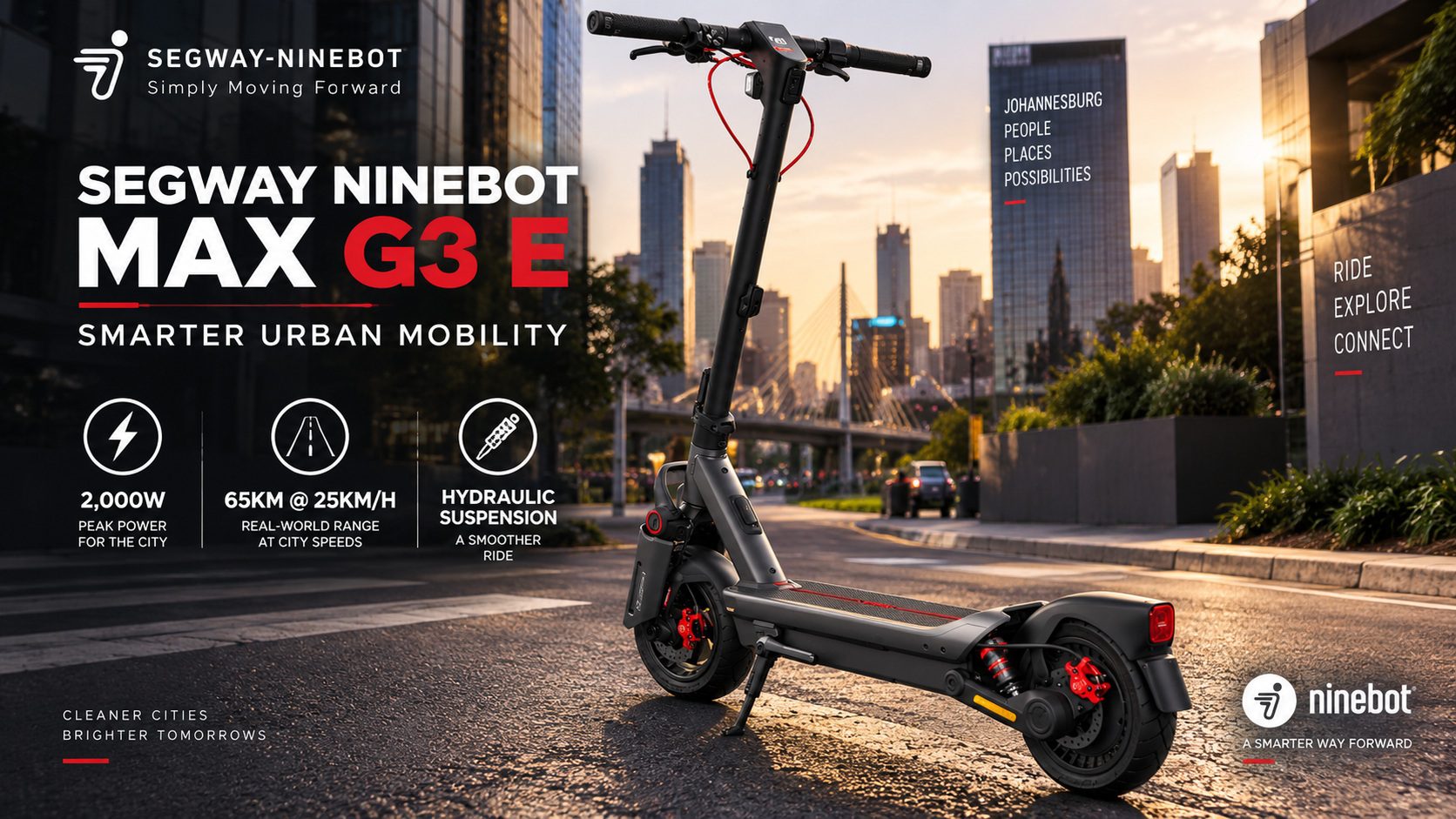
Segway Ninebot MAX G3 E brings 2,000W power and smarter control to urban riding
The Segway Ninebot MAX G3 E takes Segway’s long-running MAX eKickScooter concept and gives it considerably more technology.
Its rear-wheel-drive motor delivers 700W of nominal power and can reach a maximum output of 2,000W.
A 597Wh battery provides the energy, while Segway’s SegRange technology targets longer distances.
However, the MAX G3 E is not simply about motor output and battery capacity.
Dual hydraulic suspension, dual disc brakes, 11-inch self-sealing tyres, traction control and a stability enhancement system target the actual riding experience.
Meanwhile, a smart TFT display, Apple Find My, Segway AirLock and app connectivity bring connected technology into the package.
The result is an eKickScooter designed to make daily urban riding more capable without abandoning the folding format that makes personal electric mobility useful in the first place.
Segway Ninebot MAX G3 E reaches 2,000W maximum power
The Segway Ninebot MAX G3 E uses a rear-wheel-drive motor with 700W of nominal power.
Maximum output reaches 2,000W.
Those two numbers describe different things.
Nominal power represents the motor’s normal rated output, while maximum power reflects the higher output available under appropriate conditions.
That extra output becomes useful when accelerating or dealing with inclines.
Segway claims the MAX G3 E can handle a maximum climbing slope of approximately 30% under its specified test conditions.
However, rider weight, battery level, surface conditions and gradient length can all affect real-world climbing performance.
Maximum speed is approximately 25km/h
Segway specifies a maximum speed of approximately 25km/h for the MAX G3 E.
That positions it firmly as an urban personal-mobility device rather than a high-speed electric motorcycle.
Nevertheless, 25km/h is substantial when standing on two relatively small wheels.
Speed therefore needs to be considered alongside braking, tyre grip, road conditions and rider protection.
The MAX G3 E includes several systems intended to improve control, but technology cannot eliminate the risks associated with inappropriate speed or poor riding conditions.
A suitable helmet and responsible riding remain important.
Range reaches 65km at maximum speed
The Segway Ninebot MAX G3 E has two particularly important range figures.
At its maximum 25km/h speed, Segway claims approximately 65km of range.
That test uses a fully charged new battery, a rider load of 75kg ±5kg, controlled ambient conditions and a flat paved surface.
Real-world range will vary.
Rider weight, hills, wind, temperature, tyre pressure, acceleration and braking behaviour can all influence energy consumption.
Consequently, buyers should treat 65km as a manufacturer test figure rather than a guaranteed commuting distance.
The 80km claim requires a lower speed
Segway also advertises a maximum range of approximately 80km.
However, that figure applies at 15km/h.
This distinction matters.
Someone seeing “80km range” in marketing material could reasonably assume the scooter will travel that distance while riding normally at its maximum speed.
Segway’s own specifications show otherwise.
At 25km/h, the published figure is 65km.
At 15km/h, the claimed range increases to 80km.
Both figures are useful, but they represent different riding conditions.
An external battery can extend range further
Segway also supports an optional 468Wh external battery.
When fitted, Segway says range at 25km/h can increase from 65km to as much as 105km.
At 15km/h, the company advertises up to 140km.
The external battery is sold separately.
That gives owners a potential upgrade path without requiring them to replace the entire scooter.
For riders with relatively short daily journeys, the standard 597Wh battery may already provide sufficient range.
Longer-distance users can add more capacity later.
SegRange technology targets efficiency
The Segway Ninebot MAX G3 E uses Segway’s proprietary SegRange technology.
The company says the system improves range efficiency.
That becomes particularly relevant because simply fitting an increasingly large battery has disadvantages.
More battery capacity generally adds cost and weight.
Improving how efficiently the scooter uses available energy can therefore contribute to range without relying entirely on a larger battery pack.
TechnologyBlog has not independently tested SegRange efficiency.
Accordingly, the published range figures remain Segway test results rather than our own measurements.
The 597Wh battery uses a management system
The standard MAX G3 E battery stores 597Wh of nominal energy and operates at 46.8V.
Segway also includes a battery management system.
A BMS monitors battery conditions and provides protective management during charging and operation.
That is important in an electric scooter because the battery regularly experiences changing loads, charging cycles and environmental conditions.
The battery pack carries an IPX7 rating.
Meanwhile, Segway rates the scooter body at IPX6.
These ratings provide meaningful water-resistance information, but they do not mean riders should deliberately submerge the scooter or ignore Segway’s operating guidance.
Charging takes approximately 3.5 hours
Segway quotes approximately 3.5 hours for a standard charge.
The MAX G3 E also supports a dual-charging configuration that can reduce the quoted charging time to around 2.5 hours.
Charging speed matters for a commuter vehicle.
A scooter with substantial range becomes considerably less convenient if replenishing the battery requires most of a day.
A roughly three-and-a-half-hour standard charge allows the MAX G3 E to recover between common commuting periods.
Actual charging conditions can still affect the time required.
Dual hydraulic suspension targets rougher surfaces
The Segway Ninebot MAX G3 E uses hydraulic suspension at both ends.
At the front, Segway installs a double hydraulic suspension system.
The rear receives double adjustable hydraulic suspension.
That is a significant feature for a standing electric scooter.
Small wheels transfer road imperfections directly toward the rider, particularly on uneven urban surfaces.
Suspension can reduce the impact transmitted through the frame and handlebars.
It does not transform damaged roads into smooth surfaces, but it can improve control and comfort over imperfections.
For South African roads, that is a particularly relevant part of the MAX G3 E’s design.
Ground clearance reaches 131mm
The MAX G3 E provides 131mm of ground clearance.
Ground clearance matters when dealing with ramps, uneven surfaces and transitions between road and pavement.
However, an eKickScooter should not be treated like an off-road motorcycle simply because it has suspension and useful clearance.
Wheel size remains relatively small, and potholes can pose a serious hazard.
Riders should therefore avoid assuming that suspension technology makes every road surface safe.
Its real value lies in giving the scooter more ability to manage normal urban imperfections.
11-inch self-sealing tyres reduce puncture concerns
Segway equips the MAX G3 E with 11-inch tubeless self-sealing tyres.
Larger tyres can improve the way a scooter rolls across smaller imperfections.
The self-sealing design also aims to reduce the inconvenience associated with minor punctures.
That is useful for a commuter.
A puncture several kilometres from home can turn a convenient journey into a difficult one very quickly.
However, self-sealing does not mean puncture-proof.
Tyre pressure and condition still require regular attention.
Damage beyond the sealing capability of the tyre will still need repair.
Dual disc brakes handle stopping
The Segway Ninebot MAX G3 E uses disc brakes at both ends.
Segway specifies double-action piston disc brakes on the front and rear.
That gives the scooter mechanical braking at both wheels.
Braking capability becomes particularly important when a scooter can travel at 25km/h and carry a rider weighing up to 130kg.
Stopping distance still depends on several factors.
Speed, rider mass, tyre grip, road surface and weather all influence how quickly the scooter can stop.
Therefore, dual disc brakes add capability but cannot override basic physics.
Traction Control System manages wheel grip
The MAX G3 E includes a Traction Control System, or TCS.
Traction control is intended to help manage wheel slip when available grip becomes limited.
Loose surfaces and wet conditions can reduce tyre traction considerably.
A powered rear wheel can also lose grip if torque exceeds what the tyre can transfer to the road.
Electronic control can intervene to manage that behaviour.
Again, the system should be treated as assistance rather than permission to ride aggressively on slippery surfaces.
Available mechanical grip remains fundamental.
Segway adds a Stability Enhancement System
Segway also equips the MAX G3 E with a Stability Enhancement System.
The feature sits alongside traction control as part of the scooter’s electronic riding assistance.
This represents an interesting development in personal mobility.
Electronic systems once associated primarily with larger vehicles are increasingly moving into smaller electric transport.
However, the rider remains responsible for balance, steering and judgement.
Electronic assistance can support stability.
It cannot compensate for every pothole, obstacle or inappropriate manoeuvre.
Intelligent Riding Assist adds another electronic layer
The Segway Ninebot MAX G3 E also includes Intelligent Riding Assist.
Together with traction control and stability enhancement, this gives the scooter several systems working beyond basic throttle control.
That is part of what distinguishes the MAX G3 E from a simple motor-and-battery scooter.
Segway is increasingly treating software and electronic control as part of the riding experience.
The value of these systems ultimately depends on how naturally they operate in real-world conditions.
TechnologyBlog has not independently ridden the MAX G3 E, so we cannot assess their intervention or feel.
Smart TFT display moves beyond basic speed information
The smart TFT display gives the MAX G3 E a more sophisticated rider interface.
A scooter display traditionally needs to communicate basic information such as speed and battery status.
Segway expands that role.
The MAX G3 E supports navigation and incoming-call notifications through its connected system.
This reduces the need to repeatedly reach for a phone while riding.
However, riders should still avoid allowing display information to become a distraction.
Navigation is useful precisely because it can reduce phone interaction, not because the scooter should become another screen demanding constant attention.
Navigation can appear on the scooter
Navigation support is one of the MAX G3 E’s more interesting connected features.
When used with the Segway Mobility App, the scooter can provide navigation information through its display.
For urban commuting, this makes practical sense.
A rider exploring an unfamiliar route does not necessarily want a smartphone mounted prominently on the handlebars.
Integrating guidance into the scooter itself keeps essential information closer to the main controls.
Availability and functionality can depend on region and connected services, so users should check local app support.
Segway AirLock enables Bluetooth unlocking
The Segway Ninebot MAX G3 E supports Segway AirLock technology.
This provides Bluetooth-based unlocking.
The idea is straightforward.
Instead of treating the scooter as an entirely standalone mechanical device, the user’s connected phone becomes part of the access system.
That can make daily use more convenient.
However, electronic unlocking should form only one part of theft prevention.
An expensive scooter left unattended in public still benefits from appropriate physical security.
Apple Find My adds location support
Segway also integrates Apple Find My.
For iPhone users, that gives the scooter access to Apple’s device-finding ecosystem.
This can help locate the MAX G3 E if its position becomes unknown.
Again, location technology should not be confused with guaranteed theft recovery.
Its value lies in providing another way to determine where the scooter may be.
Combined with AirLock and physical locking, Find My becomes one part of a broader security approach.
Lighting covers visibility and signalling
The Segway Ninebot MAX G3 E uses a 6W front light.
It also includes turn indicators, a rear brake light and certified reflectors.
Lighting is particularly important on an eKickScooter because the vehicle occupies relatively little visual space on the road.
Turn indicators also give riders a way to communicate direction without relying entirely on hand signals.
However, visibility depends on more than fitted lighting.
Rider clothing, ambient conditions and the behaviour of surrounding traffic remain important.
A 200mm footboard provides standing space
Segway gives the MAX G3 E a 200mm-wide footboard.
The scooter also uses a curved ergonomic handlebar and multifunction controls with a customisable button.
These details may appear less impressive than a 2,000W motor, but they influence every kilometre ridden.
A rider interacts continuously with the deck, handlebar and controls.
Ergonomics therefore play a major role in whether a powerful scooter remains comfortable during longer journeys.
The MAX G3 E weighs 24.6kg
The Segway Ninebot MAX G3 E weighs approximately 24.6kg.
That is portable in the sense that the scooter folds and can be moved.
However, it is not lightweight.
Carrying almost 25kg repeatedly up stairs or onto public transport could become difficult.
This is an important trade-off.
The large battery, substantial frame, dual suspension and braking hardware all contribute capability.
They also add mass.
Buyers planning multimodal commuting should therefore consider where the scooter will need to be carried, not simply where it will be ridden.
Maximum payload is 130kg
Segway specifies a maximum payload of 130kg.
That provides a relatively broad rider-weight range.
However, payload affects more than structural suitability.
A heavier total load can influence acceleration, climbing performance, braking and battery range.
Segway’s published range testing uses a rider load of approximately 75kg.
Someone significantly heavier should therefore not expect identical range under otherwise similar conditions.
The same applies when carrying a backpack or other cargo.
The scooter folds in one step
Despite its size, the MAX G3 E retains a folding mechanism.
Segway describes it as an easy one-step fold requiring a hand.
Folded dimensions are approximately 1,218 × 590 × 592mm.
Unfolded, the scooter measures approximately 1,218 × 590 × 1,299mm.
That makes storage easier than a fixed-frame vehicle.
Nevertheless, the 24.6kg weight means buyers should think of folding primarily as a storage and transport feature rather than assuming the MAX G3 E is effortless to carry.
Segway Ninebot MAX G3 E specifications
| Specification | Segway Ninebot MAX G3 E |
|---|---|
| Model | 051601E |
| Maximum speed | Approx. 25km/h |
| Range at 25km/h | Approx. 65km |
| Maximum range at 15km/h | Approx. 80km |
| Maximum power | 2,000W |
| Nominal power | 700W |
| Drive | Rear wheel |
| Maximum climbing slope | Approx. 30% |
| Battery energy | 597Wh |
| Nominal voltage | 46.8V |
| Standard charging | Approx. 3.5 hours |
| Dual charging | Approx. 2.5 hours |
| Front suspension | Double hydraulic |
| Rear suspension | Double adjustable hydraulic |
| Front brake | Double-action piston disc |
| Rear brake | Double-action piston disc |
| Tyres | 11-inch tubeless self-sealing |
| Traction control | Yes |
| Stability enhancement | Yes |
| Intelligent Riding Assist | Yes |
| Display | Smart TFT |
| Navigation | Yes |
| Apple Find My | Yes |
| Segway AirLock | Yes |
| Segway Mobility App | Yes |
| Front light | 6W |
| Turn indicators | Yes |
| Brake light | Yes |
| Body water resistance | IPX6 |
| Battery water resistance | IPX7 |
| Ground clearance | 131mm |
| Footboard width | 200mm |
| Maximum payload | 130kg |
| Weight | Approx. 24.6kg |
| Recommended age | 16+ |
Why the MAX G3 E is interesting for South African riders
The Segway Ninebot MAX G3 E combines several characteristics that make sense for local urban mobility.
Range is one.
Even after ignoring the slower 80km maximum-range figure, Segway’s claimed 65km at 25km/h provides substantial theoretical commuting distance.
Suspension is another.
Dual hydraulic suspension and 11-inch tyres become particularly relevant when road surfaces are less than perfect.
Then there is the motor.
A 2,000W maximum output and claimed 30% climbing capability could matter in hillier parts of Johannesburg and other South African cities.
However, prospective riders also need to investigate the rules governing where and how electric scooters may legally be used locally.
Product capability and legal road use are separate questions.
Segway MAX G3 E combines mechanical and digital technology
The Segway Ninebot MAX G3 E shows how far the eKickScooter has moved beyond the original idea of attaching a battery and motor to a folding scooter.
Its mechanical hardware is substantial.
There is dual hydraulic suspension, dual disc braking, 11-inch self-sealing tyres and a rear motor capable of reaching 2,000W maximum output.
Then Segway layers software and connected technology on top.
Traction control and stability enhancement assist the ride.
The TFT display handles information and navigation.
AirLock provides Bluetooth unlocking, while Apple Find My adds location support.
Most importantly, the core specifications remain focused on transport.
The standard battery offers a claimed 65km at the scooter’s 25km/h maximum speed, while slower riding can extend the figure to 80km.
That combination of useful range, stronger chassis technology and connected features makes the MAX G3 E an interesting example of where personal electric mobility is heading.


