The history of BenQ: from Acer roots to a business built around screens
BenQ’s history includes an ambitious break from Acer, a costly mobile-phone venture and a growing focus on how different people use displays—from competitive players to photographers.
In 2005, BenQ made a bid for a much bigger place in consumer electronics. The Taiwanese company announced it would acquire Siemens’ mobile-phone business, taking on a recognised European name, engineering expertise and an international operation. The announcement presented the combination as a route to becoming the world’s fourth-largest handset maker.
Within little more than a year, its German mobile-phone operation was heading into insolvency.
That reversal belongs in the history of BenQ just as much as the monitors and projectors that now define much of its public identity. The company’s development was neither a straight ascent nor a sequence of successful launches. It involved expansion, failure and changes to the business behind the name.
Its display story offers a different thread: the gradual development of products for audiences whose expectations of a screen can be sharply different.
Before BenQ, there was Acer
BenQ traces its corporate origins to 21 April 1984, within the group that became Acer. Acer’s own historical timeline identifies the peripherals business established that year as the predecessor of BenQ.
The BenQ name came later.
On 5 December 2001, Acer Communications & Multimedia announced that it would adopt the BenQ identity and operate as a brand independent of Acer. It introduced 22 BenQ-branded devices intended to reach the market in the first half of 2002.
The distinction between those dates explains why accounts of the company sometimes appear to disagree. Its industrial roots reach back to 1984; its separate brand identity dates to December 2001.
K.Y. Lee, then president of BenQ, emphasised continuity in the launch announcement: the management and people would remain in place. The organisation was bringing an existing manufacturing and engineering business to consumers under a new name.
That name drew on “Bringing Enjoyment ’N’ Quality to Life”, a statement of ambition broad enough to encompass considerably more than computer monitors.
An electronics brand with wide ambitions
The 2001 announcement identified opportunities across mobile phones, networking, monitors, projectors, storage and imaging. BenQ’s early identity was that of a broad digital-electronics business.
Displays were already part of its capabilities. So were products outside the categories for which many readers recognise it today. The company’s archive includes optical drives, scanners and Joybook notebooks, reflecting an era when several Taiwanese manufacturers were working to establish consumer brands alongside their production businesses.
Building a brand brought a different commercial challenge. Manufacturing expertise could support the product, but customers still needed a reason to choose the name on the casing.
BenQ initially pursued that opportunity across several markets. Its move into Siemens’ handset business was the boldest expression of those ambitions.
The Siemens deal and its consequences
BenQ announced the Siemens acquisition on 7 June 2005, with the transaction scheduled to take effect on 1 October.
The agreement included rights to use the Siemens name on phones and longer co-branding rights for BenQ-Siemens. It offered BenQ an accelerated route to international recognition in a demanding consumer market.
The operation did not deliver the sustainable business envisaged in the announcement. In September 2006, BenQ stopped financing its German handset subsidiary, which entered the insolvency process.
Eurofound’s European Restructuring Monitor records a workforce of about 3,000 in the German operation that autumn. The consequences extended to employees in Munich, Kamp-Lintfort and Bocholt, as well as suppliers affected by the collapse.
This was the German mobile subsidiary’s insolvency—not the disappearance of the entire BenQ business. That distinction matters to understanding what followed: the handset venture failed, while other parts of the company continued.
Qisda changes the corporate structure
In 2007, the business separated its branded activities from its manufacturing operations.
The listed company adopted the Qisda name, while the BenQ brand business continued through a separate subsidiary. BenQ’s corporate reporting identifies 1 September 2007 as the effective date of the separation. Its 2024 sustainability report describes BenQ Corporation as wholly owned by Qisda.
The restructuring created two identities that still complicate a casual reading of the history. Qisda carries the corporate lineage of the former listed BenQ business; BenQ remains the name customers encounter on products.
It also means that the BenQ consumer brand, BenQ Corporation and the wider group should not be treated as interchangeable.
Finding an audience in competitive gaming
One of BenQ’s more revealing display developments arrived in 2010, with the XL2410T.
According to the company’s account, BenQ engineers worked with the original ZOWIE team and experienced Counter-Strike players on the monitor. Its 120Hz panel served a particular purpose: competitive play, including the lower resolutions and display proportions preferred by some players.
The significance was in the audience. The design started with how those players used a screen, rather than assuming that the same priorities applied to every monitor buyer.
BenQ’s relationship with ZOWIE subsequently became formal ownership. It acquired the brand in 2015, and that December announced ZOWIE as the identity for its future esports products.
The move gave competitive equipment a distinct place within the business. It also made the relationship between BenQ displays and ZOWIE peripherals more coherent.
The underlying distinction remains relevant across the industry. As our LG UltraGear 27GP850-B analysis explains, a capable gaming monitor can offer broad colour coverage while still having different priorities from a professional colour-critical display.
Different screens for different work
Photography provided another audience with exacting requirements.
BenQ’s SW240, introduced in regional markets in 2018, was positioned around colour management, Adobe RGB coverage and hardware calibration. Those features addressed a different task from competitive gaming: making dependable decisions about an image.
A player tracking movement and a photographer preparing a print may both spend hours looking at a monitor. What they need from it is not identical.
That distinction helps explain BenQ’s specialist display ranges. A single headline specification cannot capture every use, and the company has developed products around different working habits and environments.
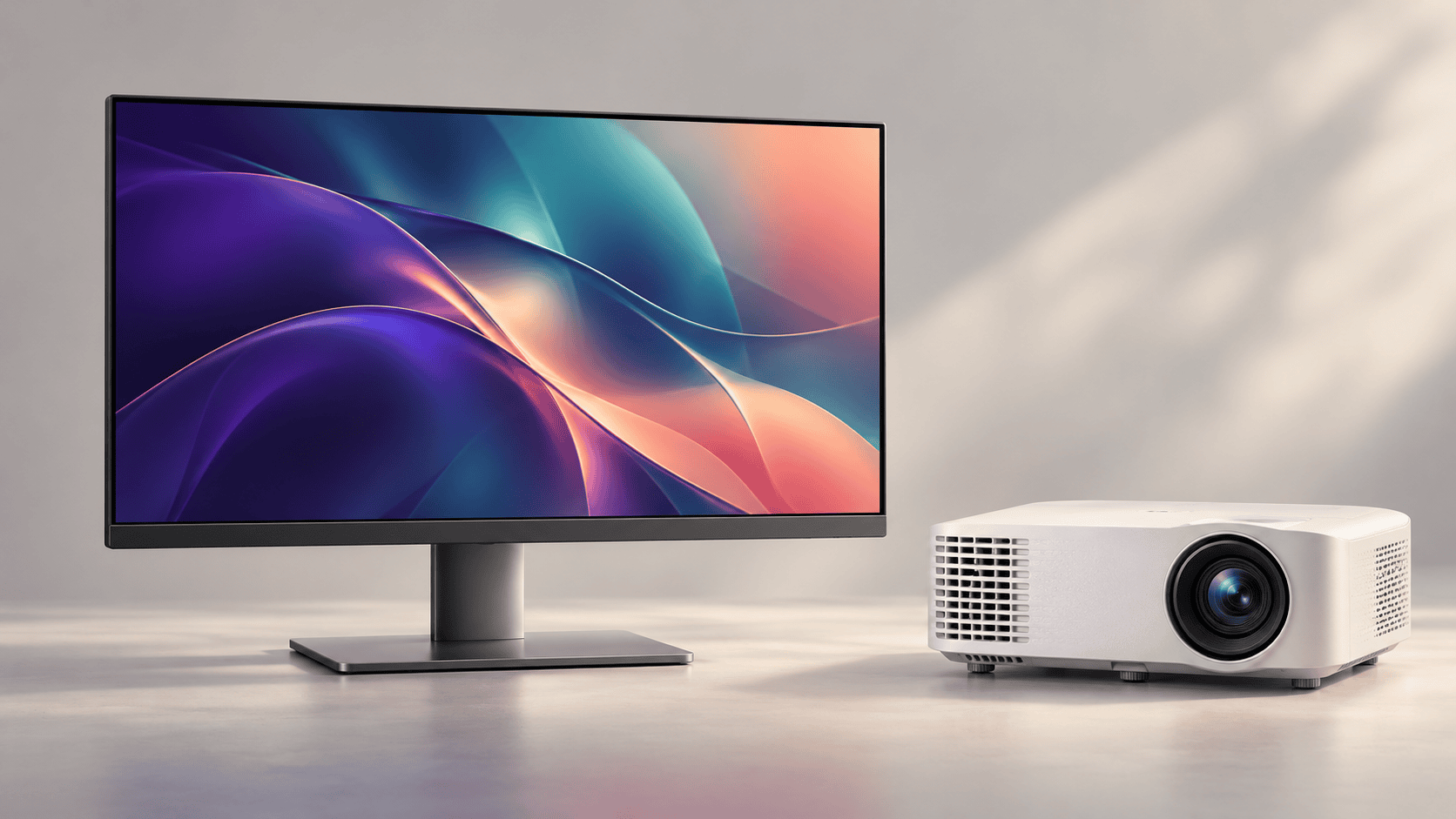
Projection and education extend that approach beyond the desk. BenQ’s portfolio includes home and business projectors, interactive education displays and commercial screens. Projection was already identified as a core capability when the brand launched in 2001, giving it a longer history within the business than its newer product families might suggest.
What BenQ’s history tells South African readers
For South African gamers, photographers, schools and businesses, the useful context is the variety behind the name.
BenQ’s history does not establish that any particular model is the right purchase. It explains why the company produces equipment with such different priorities—and why a gaming display, photography monitor and classroom screen should be judged against the job each is intended to perform.
Its development also resists an uncomplicated success story. The Acer connection supplied its industrial foundation. The 2001 launch established a separate identity. The Siemens venture exposed the risks of rapid expansion. The Qisda restructuring changed the corporate framework, while specialist display products gave the brand more clearly defined audiences.
BenQ began with broad ambitions for digital life. Its more enduring display story has emerged through specific uses: following movement in a competitive match, judging colour in a photograph, projecting a film or presenting a lesson. The screen is the common product. The person in front of it determines what it needs to do.
