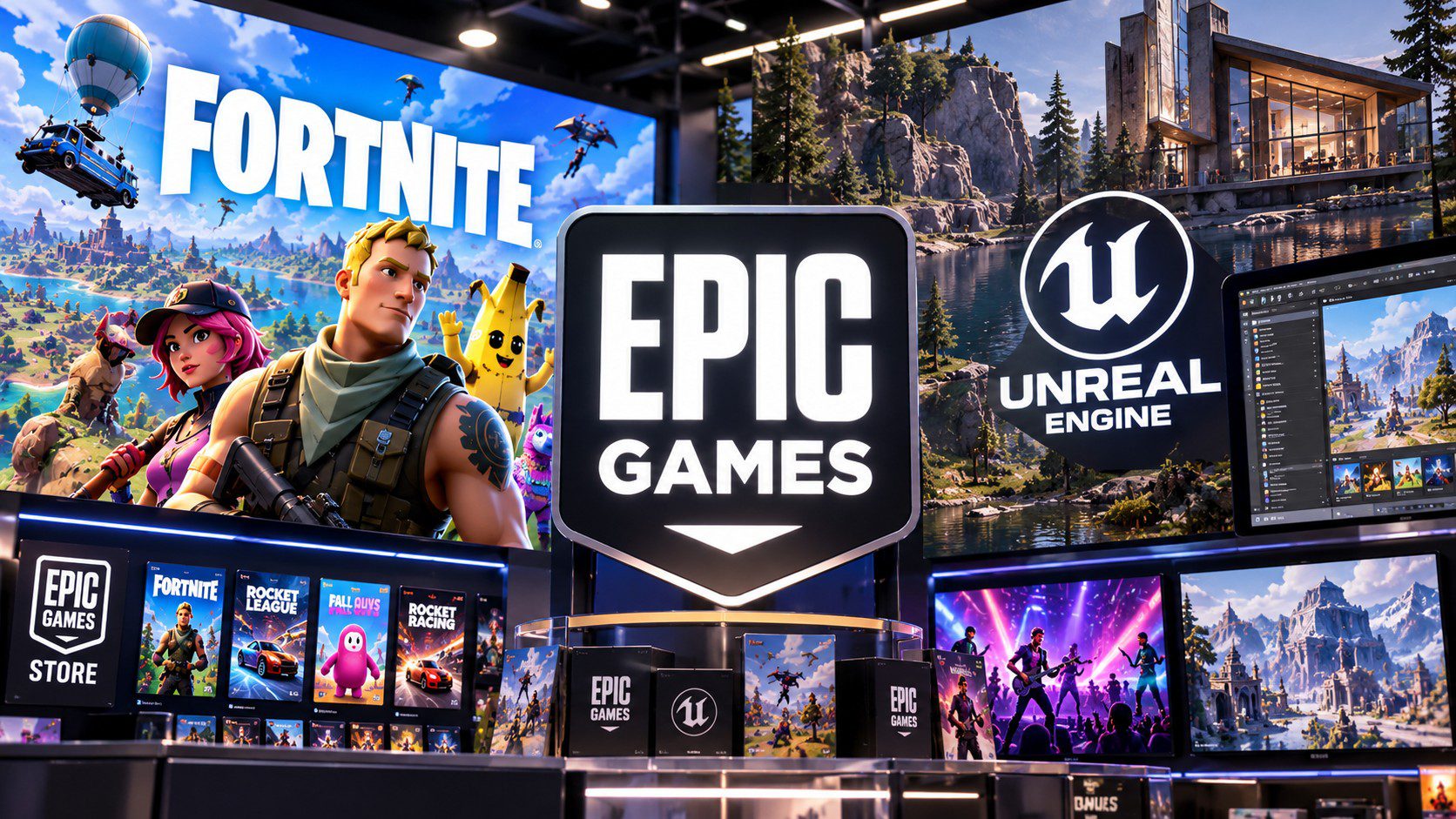
Epic Games built Fortnite, but its influence reaches far beyond gaming
Epic Games is best known to millions of players as the company behind Fortnite. Yet its influence reaches into games that have nothing to do with battle royale, building mechanics or colourful character outfits.
A player might spend the evening exploring Fortnite, then launch a completely different game developed by another studio. Both experiences could depend on technology created by Epic.
That relationship explains what makes the company unusual.
Epic develops games, licenses Unreal Engine, operates a digital storefront and provides services that help other developers build online experiences. Its products reach players directly, but much of its work happens behind the scenes.
The company has spent more than three decades moving between those two worlds. Fortnite made Epic a major entertainment brand, while Unreal Engine helped establish it as one of the industry’s most influential technology providers.
In 2026, those businesses are becoming increasingly connected.
Epic Games began long before Fortnite
Tim Sweeney founded the company in 1991 under the name Potomac Computer Systems. Its early history belongs to a very different period of PC gaming, when small developers could build and distribute games without the enormous production teams associated with modern releases.
One of Sweeney’s earliest projects was ZZT, a text-based adventure and creation game that allowed players to build their own worlds.
That creative element would eventually become an important theme in Epic’s history.
The company adopted the Epic MegaGames name before later becoming Epic Games. During the 1990s, it published and developed PC titles including Jazz Jackrabbit and Epic Pinball.
These projects helped establish the business, but its next major technological achievement would change its direction.
Unreal gave Epic Games a new identity
Released in 1998, Unreal was an ambitious first-person shooter that attracted attention for its environments, graphics and technology.
The game also introduced the technology that became Unreal Engine.
Instead of using the engine exclusively for its own projects, Epic developed it into a product that other studios could license.
That decision was transformative.
A successful game might generate sales for several years. A widely adopted engine could support an entire industry of projects across different genres and platforms.
Unreal Engine became one of Epic’s most important long-term businesses, giving the company an identity that extended beyond its own catalogue.
Unreal Tournament established Epic’s competitive roots
Epic followed Unreal with Unreal Tournament in 1999.
The game concentrated on fast-paced multiplayer combat, distinctive weapons and competitive arena design.
Its appeal came from movement, map knowledge and the ability to react quickly during chaotic encounters.
The franchise became closely associated with PC multiplayer gaming, while later entries demonstrated further developments in Epic’s engine technology.
Although the company’s modern identity is dominated by Fortnite, its history with competitive shooters stretches back decades.
That experience provided a foundation for future multiplayer projects, even when their design philosophies differed considerably.
Gears of War demonstrated the power of Unreal Engine
In 2006, Epic released Gears of War for Xbox 360.
The third-person shooter introduced a distinctive cover-based combat system, heavy weapons and a cinematic presentation.
It also became an important showcase for Unreal Engine 3.
The relationship between the game and the technology was significant. Epic could demonstrate the engine’s capabilities through its own development work while offering that technology to other studios.
The original Gears trilogy helped establish Epic as a developer capable of producing major console releases.
Microsoft subsequently acquired the Gears of War franchise in 2014.
Epic’s involvement with those earlier games remains an important part of its history, but the franchise is no longer an Epic-owned property.
Fortnite changed the scale of Epic Games
Fortnite originally launched in 2017 through Save the World, a cooperative survival experience involving construction, combat and resource gathering.
Its Battle Royale mode followed later that year.
The free-to-play competitive format quickly became the company’s defining commercial success.
Fortnite combined accessible shooting, a colourful visual identity and building mechanics that allowed players to change the battlefield during combat.
However, the game did not remain fixed around its original design.
Epic introduced new seasons, changing maps, additional movement systems, collaborations and alternative modes. Zero Build subsequently removed construction from the battle royale formula, creating another way to play.
The result was a game capable of serving different audiences without requiring a conventional sequel.
Epic Games transformed Fortnite into a wider platform
Fortnite’s continued expansion eventually moved beyond competitive survival.
Epic introduced experiences such as LEGO Fortnite, Fortnite Festival and creator-developed islands.
These additions changed how the company presented the product.
Fortnite was no longer only a game with several modes. It was becoming a platform containing different games and interactive experiences.
A player could enter a Battle Royale match, then move into a creator-made obstacle course or a music activity.
Each experience could have different rules and objectives.
For Epic, that transformation created an opportunity to support a broader ecosystem rather than relying exclusively on content produced by its internal teams.
Our previously completed Fortnite game profile examines how Battle Royale, Zero Build and creator experiences fit into that expanding identity.
Unreal Editor for Fortnite gave creators more control
Epic’s ambitions became clearer with Unreal Editor for Fortnite, commonly called UEFN.
The development environment allows creators to build experiences using tools connected to Unreal Engine.
Developers can construct environments, create gameplay systems and use the Verse programming language to implement interactive behaviour.
This provides considerably more flexibility than simply arranging objects inside a traditional game editor.
Creators can experiment with different genres and publish their work within Fortnite’s ecosystem.
However, the tools also introduce more demanding development responsibilities.
Performance, player experience, progression systems and ongoing maintenance still require careful planning.
Epic provides the platform, but creators must build experiences that people want to play.
Epic Games expanded its creator tools in 2026
Epic continued developing UEFN throughout 2026.
The October 1 update, version 42.30, introduced a conversational character template for creating AI-powered non-player characters. It also added analytics benchmarks, content pre-checks and additional development resources.
The conversational template demonstrates how creators can experiment with characters that respond to player actions rather than relying exclusively on predetermined dialogue.
However, these tools also raise questions about moderation, reliability and the practical usefulness of AI-generated interactions.
For Epic, the update represents another step towards making Fortnite a development environment rather than merely a destination for players.
The company is increasingly investing in technology that allows other people to create content inside its ecosystem.
Epic Developer Community
Unreal Engine became much bigger than gaming
Unreal Engine remains central to Epic’s business.
The technology provides tools for developing interactive 3D environments, rendering complex scenes and building experiences across supported platforms.
Although gaming remains a major application, Unreal Engine is also used in film production, television, architecture, automotive design and simulation.
These industries benefit from real-time visualisation.
A production team might use virtual environments during filming. An architect could explore a proposed building before construction, while a manufacturer might visualise a product in development.
Epic’s official company profile identifies these industries as part of Unreal Engine’s wider adoption.
Epic Games
That reach distinguishes Epic from developers whose businesses depend entirely on their own games.
Unreal Engine 5 strengthened Epic’s technology business
Unreal Engine 5 introduced major technologies intended to improve visual detail and development workflows.
Nanite supports highly detailed virtualised geometry, while Lumen provides dynamic global illumination and reflections.
These systems can help developers create more visually complex environments.
However, the technology does not eliminate the need for optimisation.
Different games have different performance requirements, and developers must balance visual quality against the hardware available to their audiences.
Unreal Engine 5 also supports tools used outside traditional game development.
Epic’s challenge is therefore to serve projects with very different technical requirements while maintaining a coherent development platform.
Epic Games is already developing Unreal Engine 6
In June 2026, Epic confirmed that Unreal Engine 6 is in development.
The company described a long-term goal of combining the capabilities of Unreal Engine 5 with a next-generation development pipeline being developed through Fortnite.
The ambition is to let creators develop experiences that can reach traditional gaming platforms, Fortnite and other connected ecosystems through more unified workflows.
That is an important strategic direction.
Instead of treating Fortnite and Unreal Engine as separate products, Epic wants the technology supporting them to become more closely connected.
However, Unreal Engine 6 remains a development project. Epic’s June announcement did not establish a final release date.
Epic Games
The Epic Games Store challenged established PC distribution
Epic entered another part of the industry when it launched the Epic Games Store in December 2018.
The storefront allows developers and publishers to distribute PC games directly to customers.
Epic initially attracted attention through its revenue-sharing model, exclusive releases and regular free-game promotions.
The company positioned the store as an alternative to established digital distribution platforms.
However, attracting players involves more than offering favourable terms to developers.
Customers also expect reliable downloads, useful library management, convenient purchasing and features that support their existing gaming habits.
Epic has continued developing the store while competing for the attention of PC players.
The business demonstrates another part of the company’s wider strategy: controlling more of the technology and services involved in bringing games to market.
Epic Online Services supports developers beyond Fortnite
Epic also offers Epic Online Services.
These tools help developers implement online features such as account systems, multiplayer functionality and cross-platform services.
They allow studios to use selected parts of Epic’s infrastructure without necessarily developing their own equivalents from scratch.
This is particularly relevant for smaller teams that want to build multiplayer experiences but lack the resources to create every supporting system.
Online services are rarely the most visible part of a game.
However, reliable connectivity, account management and matchmaking can strongly influence the experience.
Epic’s technology business therefore extends from the game engine itself into systems that help games operate after release.
Rocket League and Fall Guys expanded Epic’s portfolio
Epic’s wider gaming business also includes properties that originated outside the company.
Psyonix developed Rocket League before Epic acquired the studio in 2019.
Mediatonic developed Fall Guys, which became part of Epic’s portfolio following the acquisition of Tonic Games Group in 2021.
These distinctions matter because Epic did not originally create either game.
Instead, the acquisitions expanded the company’s portfolio and connected additional communities to its wider services.
Both properties also demonstrate the value Epic places on accessible multiplayer experiences with recognisable identities.
Their success depends on different gameplay systems, but they fit within the company’s broader interest in connected online entertainment.
Epic Games challenged mobile app-store rules
Epic’s ambitions have also brought it into conflict with major technology companies.
Its disputes with Apple and Google centred on app-store payment requirements, distribution restrictions and competition.
The disagreements led to legal proceedings and changes affecting Fortnite’s availability on mobile platforms.
Epic has argued that developers should have more freedom over distribution and payment systems.
Apple and Google have defended aspects of their platform rules on grounds including security, privacy and the operation of their marketplaces.
The legal and regulatory outcomes have varied by company and jurisdiction.
The broader issue extends beyond Fortnite.
It concerns how much control platform owners should exercise over software distribution and the commercial relationships between developers and customers.
Epic’s ecosystem creates opportunities and dependencies
Epic’s connected businesses offer practical advantages.
A developer can build a game with Unreal Engine, use Epic Online Services and distribute it through the Epic Games Store.
A Fortnite creator can develop an island with UEFN and publish it to an established audience.
These connections can reduce the need to assemble tools and services from unrelated providers.
However, they also create dependencies.
Developers must consider licensing terms, platform policies, discoverability and the long-term direction of the services they use.
For Fortnite creators, changes to recommendations or monetisation rules can affect the visibility and commercial performance of their work.
Epic therefore has responsibilities that extend beyond maintaining its own games.
It also influences the working environment of developers who depend on its technology.
Epic Games faces a balancing act in 2026
Epic’s businesses are connected, but they do not all serve the same audience.
Fortnite players want enjoyable content, fair competition and reliable performance.
Independent developers need stable tools, clear documentation and reasonable commercial terms.
Unreal Engine customers require dependable technology, while Epic Games Store users expect a convenient purchasing experience.
Meeting those expectations simultaneously is difficult.
New creator tools can introduce possibilities while also creating moderation challenges. Advanced rendering technology can improve visual quality but increase development complexity.
Meanwhile, the company’s efforts to challenge established distribution systems bring legal and commercial uncertainty.
Epic’s future depends on managing those competing priorities without allowing the scale of its ambitions to undermine the products that made them possible.
Why Epic Games matters beyond Fortnite
Epic Games has spent more than three decades expanding what it does.
It began with small PC games, established a major engine business through Unreal and developed successful franchises such as Unreal Tournament and Gears of War.
Fortnite then transformed the company’s public identity.
However, Epic’s influence is not limited to its own games.
Unreal Engine supports projects across gaming and other industries. Epic Online Services provides infrastructure, while the Epic Games Store offers another route to customers.
UEFN has also turned Fortnite into a place where independent creators can develop and publish experiences.
The company’s announcement of Unreal Engine 6 suggests that these activities will become more closely connected.
That is the central story of Epic Games in 2026.
Fortnite made the company famous.
The technology behind Fortnite may ultimately prove just as important to its legacy.


