LG’s 2026 OLED evo TVs bring brighter panels, 165Hz gaming and deeper AI integration to South Africa
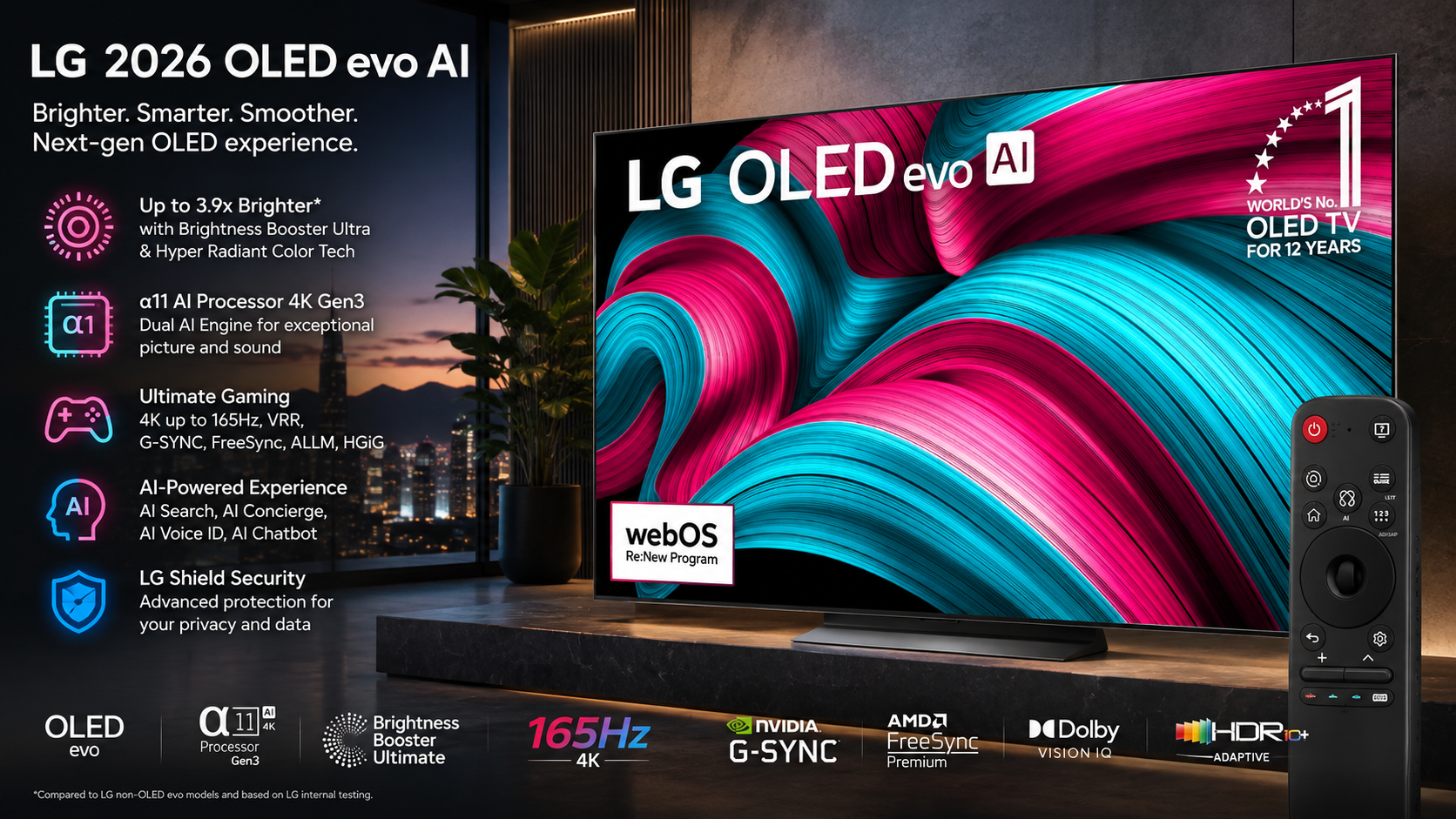
LG’s 2026 OLED evo television range brings a new generation of OLED technology to South Africa, led by the OLED evo AI G6 and C6 models. The new televisions combine LG’s Hyper Radiant Color Tech and α11 AI Processor Gen3 with improved brightness, advanced AI features and gaming support reaching up to 165Hz on compatible models.
LG’s South African website currently lists multiple 2026 OLED evo models, including the 55-inch, 65-inch and 83-inch C6, as well as 65-inch and 77-inch G6 models.
The important change this year is not simply another OLED television generation. LG is combining improvements to brightness and reflection handling with a more deeply integrated AI platform, while continuing to target gamers with high refresh rates, VRR and HDMI-based 4K high-frame-rate support.
LG’s OLED evo G6 is the flagship
The OLED evo G6 sits at the top of the new range and introduces LG’s Hyper Radiant Color Tech, which the company describes as its next-generation OLED technology.
LG says the G6 can achieve up to 3.9 times higher peak brightness through its Brightness Booster Ultra system and α11 AI Processor Gen3.
That claim needs some context.
The 3.9x figure is a manufacturer comparison rather than a universal statement that the television is 3.9 times brighter than every other OLED television. LG’s product documentation identifies the comparison basis and uses its own internal specifications. Consumers should therefore treat it as a technology-generation comparison rather than a guarantee of a particular real-world brightness level in every scene.
The G6 also incorporates Reflection Free Premium, designed to reduce reflections while maintaining OLED’s characteristic black levels. LG says the G6 combines this with Perfect Black and Perfect Color for viewing in different lighting conditions.
That could be particularly relevant in living rooms where windows and other light sources can make a glossy television panel harder to view during the day.
The α11 AI Processor Gen3 gets a second AI engine
Processing is another major part of LG’s 2026 OLED evo strategy.
The G6 uses the α11 AI Processor 4K Gen3 with Dual AI Engine. LG says the processor can analyse sharpness and texture simultaneously while processing the television’s 8.3 million self-lit OLED pixels.
LG also lists AI-based picture processing features including AI Picture Pro, AI Super Upscaling 4K, AI Genre Selection, Dynamic Tone Mapping Pro and AI HDR Remastering.
The practical reason this matters is that not everything South African viewers watch will arrive as native 4K content.
Streaming services, broadcast television, older movies and games can all involve different resolutions and image formats. Upscaling and picture processing therefore remain important even on a television with a 4K panel.
LG says its AI HDR Remastering system can analyse SDR content and adjust colour, brightness and contrast to produce an HDR-like presentation.
That should be viewed as processing rather than converting the original source into genuine HDR content.
The C6 brings many of the new technologies to a lower tier
The OLED evo AI C6 is the other major 2026 model family listed by LG South Africa.
The C6 also uses the α11 AI Processor 4K Gen3 and Hyper Radiant Color Tech, while LG lists Brightness Booster technology, Perfect Black and Perfect Color.
The C6 is available in several screen sizes in South Africa, including 55-inch, 65-inch and 83-inch versions on LG’s local website.
That gives consumers a wider choice than simply moving to the flagship G6.
The difference between the G6 and C6 is therefore not simply screen size. The G6 incorporates higher-end technologies such as Brightness Booster Ultra and Reflection Free Premium, while the C6 focuses on bringing the newer OLED evo processing and brightness improvements into the C-series range.
Gaming is a major part of the proposition
LG is continuing to treat its premium OLED televisions as gaming displays rather than just home-cinema screens.
The new G6 and C6 support up to 165Hz at 4K, with LG listing compatibility with NVIDIA G-SYNC and AMD FreeSync on the relevant models.
The televisions also include features such as VRR, ALLM, HGiG and Game Optimizer/Game Dashboard.
For PC gamers with hardware capable of driving high frame rates, the 165Hz capability gives the displays an advantage over conventional 120Hz televisions.
Console gamers should be more cautious about interpreting the number. Current consoles generally do not deliver 4K gameplay at 165 frames per second, so the higher refresh-rate capability is more relevant to high-end PC gaming.
LG also lists 4K at 120fps through HDMI and USB on its detailed specifications for the C-series product page.
AI is moving into the television interface
LG’s 2026 OLED evo models also expand the role of AI beyond image processing.
The company’s AI Hub brings together functions including Multi AI Search, AI Concierge, AI Voice ID with My Page, AI Chatbot, AI Picture Wizard and AI Sound Wizard.
LG says Multi AI Search works with services including Google Gemini and Microsoft Copilot, while the 2026 televisions are also covered by LG Shield security technology.
This represents a broader shift in smart televisions. AI is no longer being used only to improve an image; manufacturers increasingly want the television itself to become an interface for search, recommendations, voice interaction and personalised settings.
Whether consumers actually use those features regularly will depend heavily on how well the services work with local accounts, languages, applications and content.
webOS remains at the centre
The new OLED evo televisions use LG’s webOS smart-TV platform.
LG describes its 2026 television experience as an AI-powered version of webOS, with the AI Hub providing access to the various personalised functions.
A network connection and LG Account are required for network-based smart services and streaming applications, according to LG’s South African product documentation.
That is worth remembering when evaluating a modern smart television. The screen itself may continue to work with external HDMI devices without the full online ecosystem, but many of the advertised smart features depend on internet connectivity and account access.
For South African households, this makes the television’s smart platform part of the ownership experience rather than merely an additional feature.
The G6 is also designed for wall mounting
LG has continued the gallery-style approach with the OLED evo G6.
The 2026 G6 is designed around a Flush Fit Gallery Design, allowing the television to sit close to the wall when installed appropriately. LG’s product material presents this as a zero-gap wall-mounted installation.
This is more than a cosmetic feature for buyers who intend to build a television into a living-room or home-theatre environment.
However, installation requirements and the final appearance will depend on the wall, mounting hardware and installation method, so consumers should not assume that every installation will automatically reproduce LG’s promotional images.
South African availability
LG South Africa has product pages for the new 2026 OLED evo G6 and C6 models, including 55-inch, 65-inch, 77-inch and 83-inch variants depending on the model.
The company also continues to list older OLED evo models on its South African website, meaning buyers should pay close attention to the model number and generation when comparing prices.
This is particularly important during promotional periods, when a discounted previous-generation OLED can potentially overlap with the pricing of a newer model.
South African pricing varies by model and retailer and should be checked against the specific model number before purchase.
LG OLED evo 2026 at a glance
| Feature | OLED evo G6 | OLED evo C6 |
|---|---|---|
| Generation | 2026 | 2026 |
| OLED | Yes | Yes |
| Hyper Radiant Color Tech | Yes | Yes |
| Processor | α11 AI Processor Gen3 | α11 AI Processor Gen3 |
| AI Engine | Dual AI Engine | Dual AI Engine |
| Maximum listed refresh rate | Up to 165Hz | Up to 165Hz |
| VRR | Yes | Yes |
| NVIDIA G-SYNC | Yes | Yes |
| AMD FreeSync | Yes | Yes |
| AI Hub | Yes | Yes |
| Google Gemini / Microsoft Copilot integration | Yes | Yes |
| Reflection Free Premium | Yes | Not listed as a G6 feature |
| Brightness technology | Brightness Booster Ultra | Brightness Booster |
| Available South African sizes found | 65″, 77″ | 55″, 65″, 83″ |
Specifications and feature availability can vary by model and region. The table reflects LG South Africa’s published information for the 2026 G6 and C6 models checked for this article.
What South African buyers should consider
The 2026 OLED evo range is aimed at consumers who want more than simply a large 4K television.
The G6 in particular combines OLED’s self-lit pixel architecture with higher brightness, reflection handling, high refresh rates and a more extensive AI platform. That makes it a particularly interesting option for households using one screen for movies, sport, streaming, gaming and general smart-TV use.
But the most expensive model is not automatically the best choice for every buyer.
Someone primarily watching Netflix, DStv, Showmax and ordinary broadcast content may not benefit as much from a 165Hz refresh rate as a PC gamer would. Likewise, a buyer with a dark home-theatre room may place less value on Reflection Free Premium than someone whose television sits opposite large windows.
The C6 could therefore be the more sensible option for consumers who want the new 2026 OLED evo platform without necessarily moving to the flagship G6.
LG is making AI part of the TV rather than a feature on the box
The bigger story behind LG’s 2026 OLED evo range is arguably the changing role of the television itself.
Picture processing has used increasingly sophisticated algorithms for years. What is different now is the extent to which AI is being integrated into the interface, search, voice controls, recommendations, picture settings and sound processing as well.
LG’s 2026 OLED evo televisions illustrate that transition particularly clearly, with the G6 and C6 combining AI picture processing with an AI Hub and third-party AI services.
For South African consumers, the important question is therefore no longer simply whether a television has AI.
It is which AI features are actually available locally, how useful they are with the services people already use, and whether they provide enough practical benefit to justify paying more for the latest generation.