Yealink SIP-T73W brings Wi-Fi 6 and Bluetooth 5.0 to a 12-account business desk phone
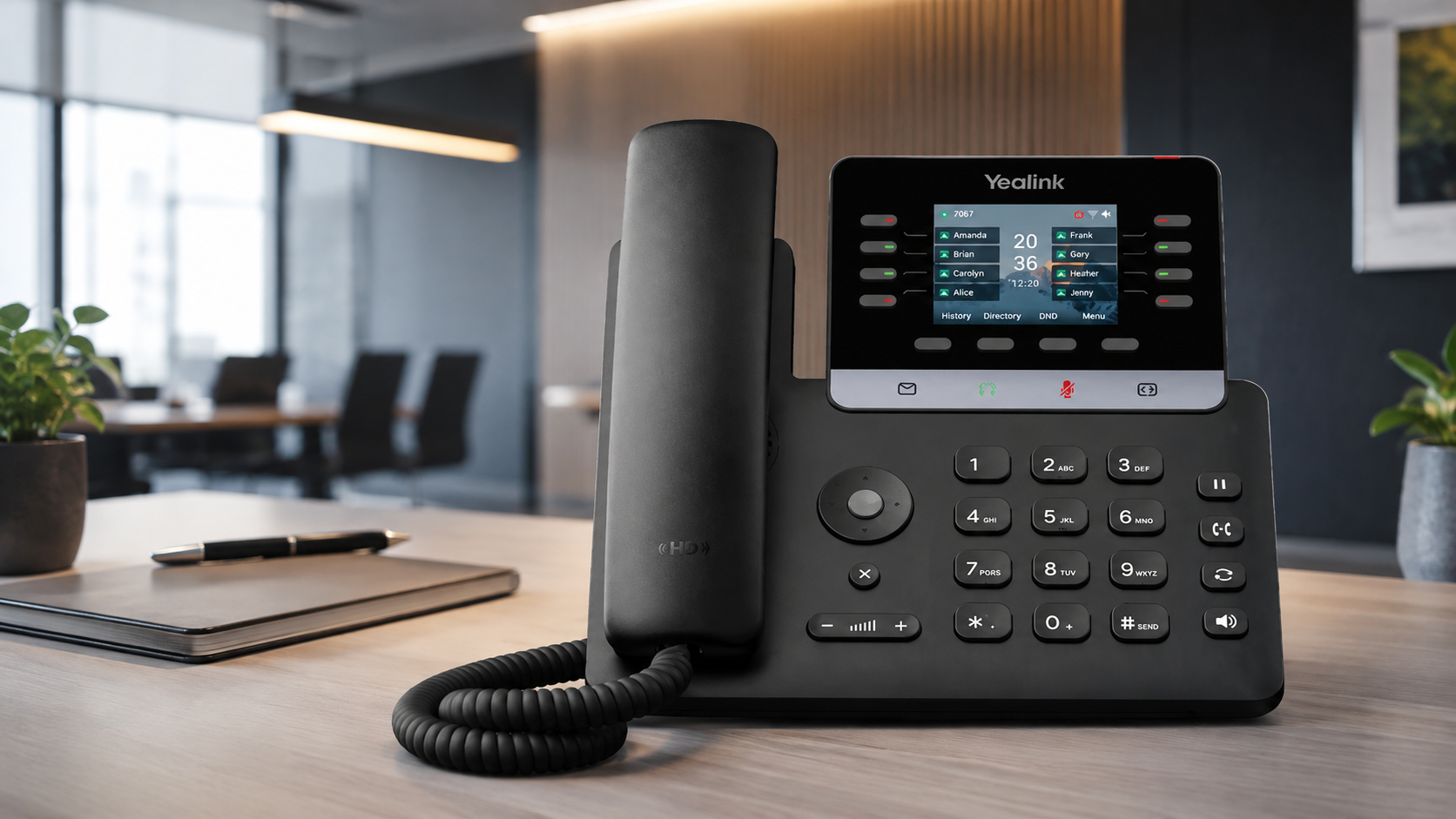
Yealink’s SIP-T73W is a business IP desk phone that combines wired Gigabit Ethernet with built-in Wi-Fi 6 and Bluetooth 5.0. It supports up to 12 SIP accounts and uses a 2.8-inch colour display, positioning it for offices that need more flexibility than an entry-level VoIP handset.
The phone forms part of Yealink’s newer T7 series and targets general business users rather than functioning as a basic two-line desk phone. South African buyers can already find the SIP-T73W through local retailers, although prices vary between suppliers.
TechnologyBlog.co.za has not tested the Yealink SIP-T73W. This article therefore focuses on its verified specifications, connectivity and practical deployment considerations rather than providing a performance review.
Built-in Wi-Fi 6 gives offices more installation options
One of the SIP-T73W’s most useful features is its built-in dual-band Wi-Fi 6 connection, which supports both 2.4GHz and 5GHz networks. Bluetooth 5.0 is also integrated, allowing compatible Bluetooth headsets and other supported devices to connect without requiring a separate wireless module.
Wired networking remains available through two Gigabit Ethernet ports. This arrangement can be particularly useful at a conventional office desk because one network connection can serve the phone while the second Ethernet port can provide connectivity to another nearby device, such as a PC.
The phone also supports Power over Ethernet. A compatible PoE network switch can therefore carry network traffic and power over the same Ethernet cable, reducing the number of power adapters required around office desks. Switch Telecom separately lists a 5V/2A power adapter as included when customers buy the handset directly from it, so buyers should check what their chosen supplier includes in the box.
Up to 12 SIP accounts and 40 programmable functions
The SIP-T73W supports up to 12 SIP accounts. That makes it suitable for users who need several extensions, identities or VoIP services registered on one handset, although the exact configuration will depend on the organisation’s PBX or hosted VoIP platform.
Eight physical line keys can provide as many as 40 programmable functions across five pages. Standard calling functions include hold, forwarding, call waiting, transfer, redial, auto-answer and direct IP calling.
Businesses that need substantially more programmable keys can add Yealink EXP55 colour-screen expansion modules. The T73W supports up to three EXP55 units, which could make the phone more practical for receptionists, switchboard operators and other staff managing large numbers of extensions. The expansion modules are optional accessories rather than part of the standard phone.
2.8-inch colour display keeps the phone compact
Yealink equips the T73W with a 2.8-inch 320 × 240-pixel colour screen with a backlight. The stand supports two adjustable viewing angles, while the user interface includes icons, soft keys, call and message notifications, and light and dark display themes.
The display is considerably smaller than the large touchscreens found on premium executive IP phones. That distinction matters for buyers: the T73W concentrates on conventional desk-phone controls and business calling rather than trying to behave like a tablet-style communications terminal.
Yealink also provides a 3W speaker and its Acoustic Shield and Smart Noise Filtering features. These are intended to reduce distracting background noise during calls, although TechnologyBlog.co.za has not independently tested their effectiveness in a busy office.
USB and headset support
A USB 2.0 port expands the T73W beyond its built-in Bluetooth connectivity. Yealink lists support for USB headsets, USB recording, its EHS40 wireless-headset adapter and the EXP55 expansion module through the USB interface. Separate RJ9 connections are provided for the handset and a wired headset.
This gives businesses several headset options. Users can choose traditional wired models, compatible USB headsets or supported Bluetooth devices depending on their work environment.
Security features target managed business deployments
Yealink’s T7 series introduces several security mechanisms that are relevant when phones connect to corporate networks. The company lists secure boot, firmware protection, a Trusted Execution Environment, 802.1X authentication, WPA3 wireless security, TLS 1.3 and SRTP media protection among the T73W’s security capabilities.
Those features do not make a VoIP deployment automatically secure. Administrators still need to configure the phone, PBX, network, user credentials and remote-management systems correctly. Firmware maintenance and network access controls also remain important.
Yealink SIP-T73W specifications
| Specification | Yealink SIP-T73W |
|---|---|
| Display | 2.8-inch colour LCD |
| Resolution | 320 × 240 pixels |
| SIP accounts | Up to 12 |
| Line keys | 8 |
| Programmable functions | Up to 40 across five pages |
| Ethernet | Dual Gigabit Ethernet |
| Wi-Fi | Built-in dual-band Wi-Fi 6 |
| Wi-Fi bands | 2.4GHz and 5GHz |
| Bluetooth | Built-in Bluetooth 5.0 |
| PoE | Yes |
| USB | 1 × USB 2.0 |
| Headset connections | Bluetooth, USB and RJ9 |
| Speaker | 3W |
| Expansion support | Up to three Yealink EXP55 modules |
| Stand | Two adjustable angles |
Specifications are based on Yealink documentation and current South African retailer listings.
How the T73W differs from the T73U
Yealink sells both SIP-T73W and SIP-T73U models in the same T7 family. They share the 2.8-inch display and much of the same business-phone design, but wireless connectivity is an important distinction.
The T73W integrates Wi-Fi 6 and Bluetooth 5.0. Yealink’s documentation for the T73U instead lists Wi-Fi connectivity through the optional WF50 adapter and references USB Bluetooth accessories. For businesses planning wireless installations or Bluetooth-headset deployments, the T73W therefore removes the need for some additional dongles.
What South African businesses should check before buying
The SIP-T73W is not a replacement for a complete telephone service. Businesses still need a compatible SIP-based hosted VoIP service or IP PBX, network connectivity and the necessary configuration before the handset can make normal business calls.
Power resilience also deserves attention in South Africa. PoE can simplify backup power because the phone can draw electricity from a UPS-backed network switch. However, keeping the handset powered achieves little if the router, fibre ONT, network switch or VoIP service loses connectivity during a power outage.
For buyers who need a conventional business desk phone with multiple SIP accounts, Gigabit Ethernet, integrated Wi-Fi and Bluetooth headset support, the T73W covers considerably more connectivity than a basic VoIP handset. Its smaller 2.8-inch display keeps it firmly in traditional desk-phone territory, while the optional EXP55 modules provide an upgrade path for staff who need many programmable extension or call-management keys.