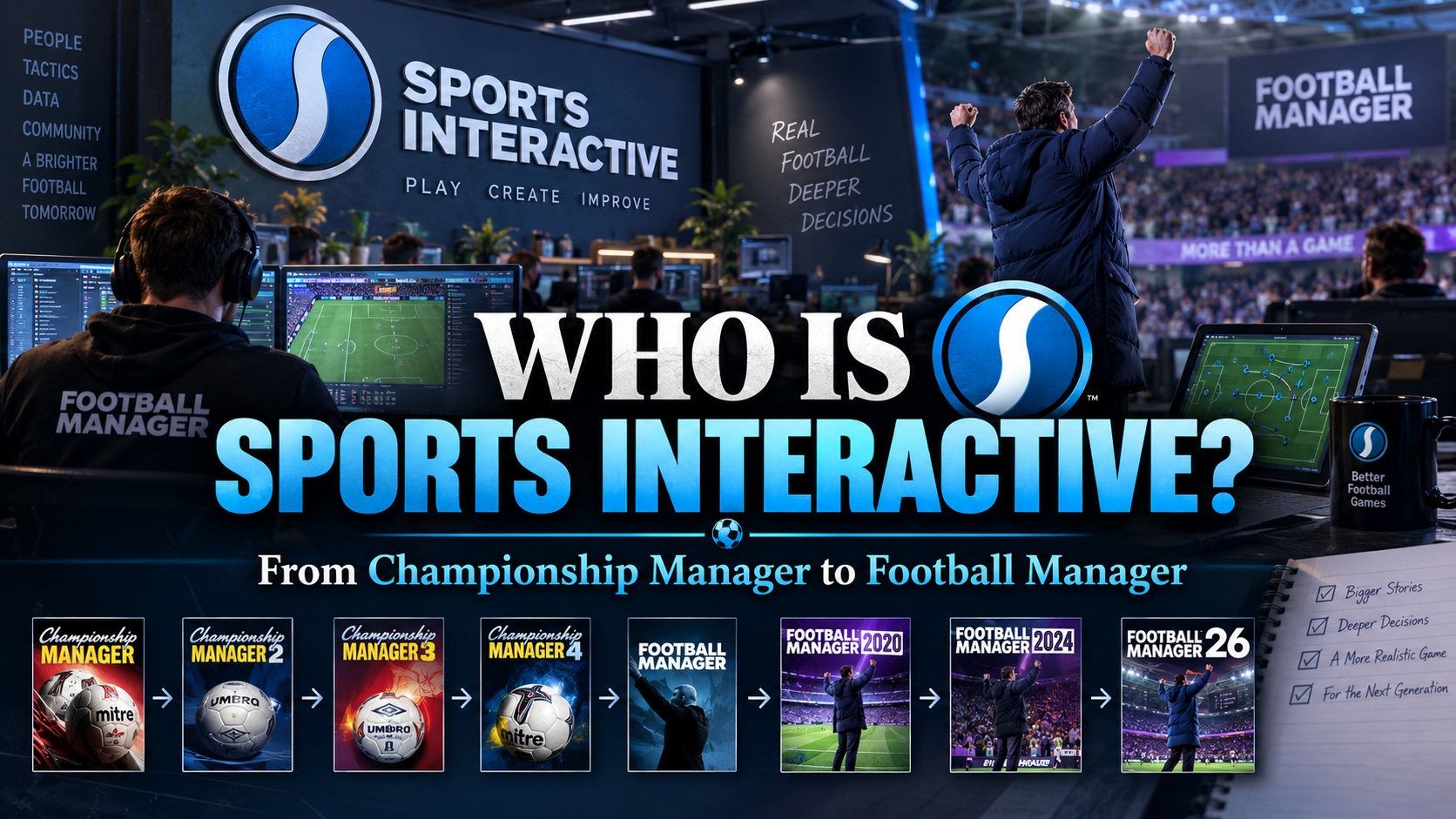
Who is Sports Interactive? The studio that turned Football Manager into a global obsession
Some developers build games about football.
Sports Interactive built a game that became part of football.
The London studio is best known as the developer of Football Manager, one of the most detailed sports-management simulations ever created.
Yet its influence extends far beyond people sitting at computers trying to win the Champions League with a club from the lower divisions.
Football Manager’s enormous player database has become part of football culture.
Players have become famous among Football Manager fans before becoming famous on the pitch.
Football terminology, scouting and tactical ideas spread through the game.
Meanwhile, the company behind it has gradually developed closer relationships with professional football organisations and technology providers.
In 2026, Sports Interactive took that relationship even further by launching FMDB Pro, a professional recruitment platform designed for real football organisations.
That represents a remarkable transformation.
Sports Interactive began with two brothers.
Today, its London studio employs nearly 300 people and sits inside SEGA.
However, its journey has not always been straightforward.
The studio survived the end of its Championship Manager era.
It rebuilt its flagship series under the Football Manager name.
Then, decades later, it faced perhaps its biggest development crisis when Football Manager 25 was cancelled entirely.
FM26 eventually completed the transition to Unity, but its reception demonstrated how difficult rebuilding a game played by millions can be.
Now Sports Interactive is preparing Football Manager 27 for November 2026.
So how did a football-management game created by two brothers become one of the most enduring simulations in gaming?
Sports Interactive was founded in 1994
Sports Interactive officially formed in 1994.
Brothers Paul and Oliver Collyer founded the studio after already developing their first football-management games.
Sports Interactive describes its origins as two brothers making games from a bedroom in Shropshire before establishing a formal studio.
That modest beginning is important.
Football Manager did not originate from a huge publisher deciding that the market needed another annual sports franchise.
It grew from an obsession with football management.
The Collyer brothers wanted to simulate what happens behind the matches.
Transfers.
Team selection.
Tactics.
Players.
Results.
Development.
Statistics.
For people who wanted to imagine themselves managing a football club rather than controlling footballers directly, the idea proved enormously compelling.
Championship Manager came before Football Manager
Before Football Manager, there was Championship Manager.
The original game predates Sports Interactive’s formal establishment as a studio.
However, the series became the foundation on which SI built its reputation.
Rather than controlling footballers during matches, players became the manager.
You selected the squad.
Bought players.
Sold players.
Changed tactics.
Then you watched the consequences.
It sounds ordinary now because management simulations have existed for decades.
At the time, however, the obsession came from the depth underneath those apparently simple decisions.
One more match could become another hour.
Then another season.
Then another transfer window.
That basic Football Manager problem began long before the game carried the Football Manager name.
Sports Interactive understood the power of data
Graphics were never Championship Manager’s main attraction.
Data was.
Players became numbers.
Attributes represented abilities.
Statistics helped managers decide who belonged in their squad.
Large databases gave users access to footballers they had never previously encountered.
That created one of the most important characteristics of Sports Interactive’s games.
Discovery.
A young player might be largely unknown in real football.
Inside Championship Manager, however, he could become the centre of someone’s team for a decade.
Eventually, players began associating certain names with the game itself.
That relationship between football data and player discovery would become fundamental to Football Manager.
The studio grew alongside its audience
Sports Interactive’s official 30th-anniversary history shows how the company expanded physically as its games grew.
Its first three offices were in North London:
Compton Terrace: 1994–1997
Upper Street: 1997–2006
Old Street: 2006–2018
The studio then moved to Here East in Stratford, where it remains today.
Each move reflected a larger company.
What began as a small development operation eventually became one of London’s established game studios.
Sports Interactive now describes its Here East headquarters as home to nearly 300 team members.
That is a very different organisation from the one Paul and Oliver Collyer established in 1994.
Yet one product remains at its centre.
Football Manager.
Miles Jacobson has been part of SI almost from the beginning
Another important figure in Sports Interactive’s history is Miles Jacobson.
He joined in 1994, initially working as a QA tester before becoming increasingly involved with the business side of the studio.
Today, Sports Interactive lists Jacobson as its Studio Director.
His public profile has also made him closely associated with Football Manager.
For longtime players, Jacobson frequently became the person explaining new features, discussing development decisions and communicating major changes.
That became especially important during difficult periods.
The FM25 cancellation would eventually put that relationship with the community under considerable pressure.
However, first Sports Interactive had to survive an earlier transformation.
The Championship Manager era eventually ended
For years, Sports Interactive developed Championship Manager while working with publisher Eidos.
Then the relationship ended.
The consequences were unusual.
The Championship Manager name did not remain with Sports Interactive.
SI instead continued its football-management work under a new identity.
That could have been disastrous.
Brand recognition matters enormously.
Championship Manager already had an established audience.
Starting again meant convincing those players that the developer mattered more than the name printed on the box.
Sports Interactive partnered with SEGA.
The result was Football Manager 2005.
Football Manager 2005 began a new era
Sports Interactive’s own retrospective describes Football Manager 2005 as the beginning of a new chapter following years of success with Championship Manager.
SEGA became its publishing partner.
The game launched in November 2004.
More importantly, the database remained enormous.
Sports Interactive says around 2,500 researchers worldwide contributed to FM2005.
The resulting database allowed players to manage more than 5,300 teams across 158 divisions in 51 league countries.
Those numbers help explain why the transition worked.
The Championship Manager name had changed.
The underlying obsession with football detail had not.
Players followed Sports Interactive.
Football Manager became bigger than the name it replaced
The Football Manager brand quickly established itself.
Each annual release expanded the simulation.
Scouting developed.
Training evolved.
Player interactions became more complicated.
Media systems appeared.
Tactics became increasingly detailed.
Matches eventually moved from simple representations into increasingly sophisticated 3D simulations.
Meanwhile, the database continued growing.
Football Manager became more than a replacement for Championship Manager.
It became Sports Interactive’s defining product.
Eventually, the new brand became so established that an entire generation of players knew Football Manager without having played the older Championship Manager games.
SEGA acquired Sports Interactive in 2006
The relationship with SEGA also became permanent.
In 2006, Sports Interactive became a wholly owned subsidiary of SEGA Europe.
That ownership remains important today.
Sports Interactive develops Football Manager.
SEGA publishes it.
Therefore, SEGA and Sports Interactive should not be described interchangeably.
The Football Manager website currently identifies the game as:
Developed by Sports Interactive Limited
Published by SEGA Europe Limited.
Sports Interactive consequently benefits from being part of a major international gaming company while maintaining a strong individual studio identity.
Football Manager became famous for discovering players
Few games have created the same relationship between virtual scouting and real football.
Football Manager players regularly discover prospects before they become widely known.
That does not mean the game magically predicts the future.
Real players develop unpredictably.
Injuries happen.
Transfers fail.
Coaches change.
Young talent sometimes disappears.
However, Sports Interactive’s extensive research network gives the game enormous depth.
A footballer does not need to play for Real Madrid or Manchester United to appear meaningfully in the database.
Players can scout clubs around the world.
That changes how fans interact with football.
Someone may recognise a name during a real transfer because they signed that player three years earlier in Football Manager.
The database became part of football culture
This phenomenon helped Football Manager escape the boundaries of a normal game.
Its database became widely discussed.
Football fans debated player ratings.
Potential wonderkids became famous inside the community.
Managers discovered clubs and leagues they previously knew almost nothing about.
For some players, Football Manager became a way of learning football geography.
A save could begin in England and eventually lead someone to Scandinavia, South America, Asia or Africa.
Suddenly, teams that rarely appeared on television became meaningful.
That global perspective remains one of the series’ strongest qualities.
Football Manager also influenced how fans discuss tactics
Football tactics existed long before Football Manager.
However, the game gave millions of ordinary fans a vocabulary for experimenting with them.
Roles matter.
Shape matters.
Pressing matters.
Tempo matters.
Width matters.
Player instructions matter.
A fan who once thought only in terms of defenders, midfielders and strikers could begin thinking about inside forwards, mezzalas, inverted full-backs and different pressing structures.
The simulation is not a replacement for professional coaching.
However, it encourages players to think about why teams behave differently.
That makes watching real football more interesting for many Football Manager players.
Football Manager creates stories without writing them
Sports Interactive’s greatest achievement may not actually be its database.
It may be emergent storytelling.
Football Manager does not need to write a dramatic story about a young player becoming a club legend.
The systems create one.
You sign a teenager.
He develops.
He scores an important goal.
Years pass.
Bigger clubs make offers.
You refuse.
Eventually, he becomes captain.
Then, perhaps fifteen seasons later, he retires.
That story belongs to one player.
Another Football Manager user may never experience anything similar.
That is why people become emotionally attached to databases and numbers.
The numbers begin representing memories.
Losing can become more memorable than winning
Football Manager also understands something important about sport.
Failure creates stories.
A cup-final defeat can become motivation.
Missing promotion can shape the following season.
A failed signing can damage finances.
An injury can ruin a carefully constructed squad.
A player can demand a transfer at exactly the wrong moment.
Those problems create decisions.
Decisions create consequences.
Consequences create stories.
Consequently, winning becomes more satisfying because the simulation allows things to go wrong.
A Champions League trophy means more when the journey began several divisions lower.
Sports Interactive built a remarkably loyal audience
By 2024, Sports Interactive had reached a milestone the studio once considered a long-term ambition.
More than 11 million people played Football Manager 2024.
That figure demonstrates how dramatically the audience expanded.
Football Manager was no longer simply a PC game for deeply committed football-statistics enthusiasts.
Different versions reached different platforms.
Console editions expanded accessibility.
Touch editions provided another route.
Subscription services introduced new players.
Meanwhile, the core PC experience remained the most detailed version.
Sports Interactive had successfully taken an extremely complex simulation and expanded its audience without completely abandoning its roots.
Then Sports Interactive decided Football Manager needed rebuilding
Success created another problem.
Football Manager had evolved through years of annual releases.
Systems accumulated.
Technology aged.
The user interface carried years of history.
Sports Interactive eventually decided that incremental updates were no longer enough.
A major technical transition was required.
The centre of that transition was Unity.
The new engine promised improved visual presentation and a technical foundation capable of supporting Football Manager’s future.
However, changing the foundations of a decades-old simulation proved far more difficult than simply switching an engine setting.
FM25 became Sports Interactive’s biggest crisis in years
Football Manager 25 was supposed to introduce the new era.
Instead, development struggled.
The game was delayed.
Then delayed again.
Finally, on 6 February 2025, Sports Interactive announced that Football Manager 25 had been cancelled entirely.
The studio acknowledged the disappointment directly.
Players had already waited through two release-date changes.
Some had pre-ordered the game.
Sports Interactive and SEGA ultimately decided to abandon the release and move resources to the next Football Manager instead.
For an annual franchise, this was extraordinary.
There would be no FM25.
Cancelling FM25 was painful but probably necessary
Releasing a game simply because the calendar demanded it could have created even larger problems.
Football Manager players often spend hundreds of hours inside each edition.
A technically unfinished release would not simply disappoint players for a weekend.
Problems would affect entire long-term saves.
Sports Interactive therefore made an unusually difficult decision.
It sacrificed a full annual release.
That bought more development time.
However, it also placed enormous pressure on Football Manager 26.
FM26 now had to deliver two years of expectation while proving that cancelling FM25 had been worthwhile.
Football Manager 26 finally completed the Unity transition
Football Manager 26 launched on 4 November 2025.
It represented one of the largest changes in the series’ history.
Unity powered the new technical foundation.
Match presentation improved.
Animation changed.
The interface was redesigned.
Tactical systems evolved.
Women’s football became integrated into the wider Football Manager ecosystem.
Sports Interactive also partnered with Hawk-Eye Innovations to incorporate skeletal volumetric data from professional football into FM26’s animation system.
This was not simply another database update.
Sports Interactive was rebuilding how Football Manager looked and behaved.
Hawk-Eye shows how seriously SI takes football data
The Hawk-Eye partnership illustrates Sports Interactive’s increasingly sophisticated relationship with real football technology.
Hawk-Eye’s in-stadium systems collect movement data from actual football.
For FM26, Sports Interactive used skeletal volumetric data alongside its own motion-capture work to improve player animation.
That means Football Manager’s visual simulation increasingly draws from real movement.
The goal is not simply prettier footballers.
Better animation should help the match engine communicate what players are actually doing.
A run needs to look like a run.
A tactical movement needs to be understandable.
Positioning needs to communicate football.
For a management simulation, visual clarity supports tactical understanding.
FM26 also brought women’s football into the main ecosystem
Another major milestone arrived with women’s football.
Rather than creating a completely separate game, Sports Interactive integrated women’s competitions into Football Manager’s broader structure.
That required years of research.
New players.
New clubs.
New competitions.
Different financial structures.
Different data.
The result expanded what a Football Manager career could be.
Players could discover another enormous part of global football through the same systems that had introduced generations of FM players to unfamiliar men’s leagues.
However, the FM26 transition divided the community
The technical achievement did not automatically produce universal approval.
As our Football Manager 26 in 2026 feature explains, the redesigned interface became one of the biggest sources of criticism.
INTERNAL LINK: Link Football Manager 26 in 2026 above to the TechnologyBlog FM26 article.
Veteran players had spent years developing extremely efficient habits.
They knew where information lived.
They knew how many clicks an action required.
They understood Football Manager almost instinctively.
FM26 changed much of that.
For a game where menus are effectively part of the gameplay, disrupting navigation matters enormously.
Sports Interactive discovered the danger of changing something people use for hundreds of hours
Football Manager is not a normal interface.
Players may interact with it for 500 hours.
Or 1,000.
Some spend even longer inside individual editions.
Small inefficiencies therefore multiply.
One unnecessary click performed twice might not matter.
Perform it hundreds of times and it becomes frustrating.
That helps explain why the FM26 UI debate became so intense.
Sports Interactive was not merely changing what the game looked like.
It was changing a workflow some players had used for decades.
Yet Sports Interactive continued working on FM26
The studio did not stop at launch.
Updates addressed bugs, stability, contracts, reports, tactical controls and interface behaviour.
Meanwhile, the new technical foundation remained in place.
That distinction is important.
Sports Interactive did not reverse the Unity transition.
Instead, it began refining the new Football Manager around player feedback.
Current studio hiring provides another indication of where the company is investing.
Sports Interactive is recruiting in graphics, animation, UI/UX, game design and match simulation.
One current Match AI & Simulation position specifically says the goal is to help take Football Manager’s match engine to the next level.
The Unity transition is still continuing
Sports Interactive’s current technical hiring also shows that FM26 was not the end of the transition.
A 2026 Senior Animator vacancy describes the studio as entering a new phase following its move to Unity, with a focus on raising the quality of animation systems and overall visual output.
Meanwhile, graphics engineering remains an active recruitment area.
That tells us something important about FM26.
The game established a foundation.
Sports Interactive is still building on it.
Therefore, judging the entire Unity project solely by FM26 may eventually prove premature.
The more important test will be what the studio does with that foundation over several releases.
Football Manager 27 will arrive in November 2026
The next test is already approaching.
On 27 August 2026, Sports Interactive confirmed that Football Manager 27 will launch in November 2026.
The exact release date and confirmed platforms have not yet been announced.
Sports Interactive also revealed something particularly important about its design direction.
FM27 will evolve the current design while restoring ideas and behaviours that players valued in previous editions.
That is a significant statement.
It suggests the studio understands that modernising Football Manager does not require discarding everything that worked before.
FM27 may become the real test of the new Football Manager
FM26 had an almost impossible job.
It needed to complete the transition that caused FM25 to collapse.
It introduced a new engine.
A new interface.
New animation.
Women’s football.
Different tactical concepts.
Numerous structural changes arrived simultaneously.
FM27 has a different task.
Refinement.
Sports Interactive now has the foundation.
It also has a year of player feedback.
Therefore, FM27 may tell us more about the future of Football Manager than FM26 did.
If the studio can combine the technical improvements of the new era with the efficiency players valued in older games, the difficult transition may ultimately make sense.
Sports Interactive is also changing how it communicates with players
The studio appears to have learned another lesson from the FM25 and FM26 period.
Communication matters.
For FM27, Sports Interactive plans feature deep dives and gameplay first looks beginning in September 2026.
An official Football Manager Discord server is also planned for September.
That gives players another direct community channel.
For a game with such a knowledgeable and opinionated audience, that relationship is important.
Football Manager players often understand individual systems exceptionally well.
Some have played for decades.
Listening to that community can provide information that conventional testing cannot always reproduce.
Sports Interactive’s ambitions now extend beyond video games
Perhaps the most interesting 2026 development has little to do with selling another Football Manager.
Sports Interactive has launched FMDB Pro.
The platform is designed for professional football recruitment.
That represents a major strategic shift.
Instead of creating a database solely so gamers can pretend to scout players, SI is now developing tools intended to support actual football recruitment.
In July 2026, Sports Interactive announced an exclusive partnership with Hudl to support the platform and future Football Manager editions.
FMDB Pro brings the database into professional recruitment
FMDB Pro is designed to support the earliest stage of identifying players and staff.
The Hudl partnership connects that process with Hudl Wyscout.
Sports Interactive says recruitment teams can move from FMDB Pro’s human-led qualitative player evaluations directly into video analysis through a player’s Wyscout profile.
The partnership also involves two-way data sharing.
Hudl provides event data and physical metrics.
Meanwhile, Sports Interactive’s information can contribute to the wider data relationship.
That is an extraordinary evolution of the Football Manager concept.
The database is no longer simply supporting a game about football recruitment.
It is becoming part of football recruitment itself.
Sports Interactive is becoming a football technology company
That may ultimately be the biggest change happening at SI.
Sports Interactive still makes Football Manager.
That remains its core identity.
However, FMDB Pro moves the company into professional football technology.
The distinction matters.
Football Manager simulates scouting.
FMDB Pro supports real scouting.
Football Manager lets someone sitting at home identify a promising midfielder.
FMDB Pro is intended to help professional recruitment teams begin identifying actual players and staff.
The knowledge developed across decades of building Football Manager is therefore creating another business opportunity.
The relationship between real football and Football Manager now runs both ways
For years, Sports Interactive studied football to improve Football Manager.
Researchers evaluated players.
Professional data improved the simulation.
Clubs and leagues provided licences.
Technology partnerships improved presentation.
Now the relationship is becoming reciprocal.
Football Manager’s data infrastructure can contribute to professional football tools.
Hudl information can improve future Football Manager editions.
That creates a loop.
Real football improves Football Manager.
Football Manager’s infrastructure contributes to football technology.
Football technology then feeds information back into future Football Manager development.
Few sports games have developed that kind of relationship with the sport they simulate.
SI’s research network remains one of its greatest assets
Technology changes.
Graphics improve.
Interfaces are redesigned.
However, Sports Interactive’s research remains fundamental.
A football management game needs players.
Not merely famous players.
Thousands upon thousands of them.
Those players need positions.
Attributes.
Histories.
Contracts.
Potential.
Clubs need information.
Competitions need rules.
Promotions and relegations need to function.
Transfer systems need context.
That enormous body of football information makes Football Manager possible.
It is also extremely difficult to reproduce quickly.
The database represents decades of accumulated expertise.
Sports Interactive is now nearly a 300-person studio
The modern company is substantially larger than many players may realise.
Sports Interactive says its Here East studio is home to nearly 300 team members.
That workforce covers far more than programmers.
Football Manager requires:
- game design
- match simulation
- graphics
- animation
- UI and UX
- production
- quality assurance
- data and analytics
- football research
- marketing
- communications
- partnerships
- platform development
Current job listings show Sports Interactive hiring across several of those disciplines.
The image of two brothers building a football management game has therefore evolved into a significant specialist development organisation.
The studio remains based in London
Sports Interactive’s home is Here East in Stratford, East London.
The location sits inside Queen Elizabeth Olympic Park.
Sports Interactive describes it as being close to Hackney Marshes, an area strongly associated with grassroots football.
That location feels appropriate for a company built around football culture.
The studio also operates a hybrid working model.
Recent vacancies generally specify two to three days per week in the studio, although arrangements vary by position.
Despite Football Manager being a global product, Sports Interactive therefore remains strongly rooted in London.
Sports Interactive refreshed its identity before the Unity era
The studio also changed how it presented itself publicly.
In May 2024, Sports Interactive unveiled a new logo and brand identity.
It was the company’s first major brand update in more than twenty years.
The timing was deliberate.
SI was approaching its 30th anniversary and preparing for what it described as an important new chapter.
The updated branding uses blue and red tones associated with sporting rivalry.
More importantly, the company wanted the Sports Interactive identity itself to become more visible.
That makes sense.
Football Manager is much more famous than the developer behind it.
Sports Interactive increasingly appears interested in changing that.
Football Manager remains bigger than Sports Interactive as a consumer brand
Ask many players who makes Football Manager and they will know.
Ask casual football fans and they may not.
The game became the brand.
That is not necessarily a problem.
However, Sports Interactive now has reasons to strengthen its own identity.
FMDB Pro carries the company’s football expertise into another market.
Partnerships connect SI with football technology companies.
Its refreshed branding gives the developer a clearer identity.
Meanwhile, the FM25 cancellation put the studio itself under greater public scrutiny.
Sports Interactive is therefore becoming more visible at exactly the moment its ambitions are expanding.
Sports Interactive has something most annual sports developers do not
Football Manager looks like an annual sports franchise.
Every year brings updated players.
Transfers change.
Competitions change.
Football itself moves forward.
However, Football Manager behaves differently from most annual sports games.
The core fantasy is not being a footballer.
It is building something.
A squad.
A club.
A career.
A dynasty.
Players may spend hundreds of hours in one save.
That changes the relationship with each release.
Sports Interactive is not simply selling updated teams.
It is asking players to abandon one football universe and begin another.
Therefore, each new edition needs to provide enough reason to start again.
This makes annual development unusually difficult
A conventional sports game can benefit immediately from graphical improvements.
Football Manager has another challenge.
Changing something can make it worse for experienced users even if the new system appears more modern.
The FM26 interface demonstrated that.
Sports Interactive needs to modernise a game whose most dedicated players may actively prefer established workflows.
That creates constant tension.
Innovation versus familiarity.
Accessibility versus depth.
Presentation versus speed.
New audiences versus veteran players.
The studio has to satisfy all of them with essentially the same simulation.
That is an extraordinarily difficult design problem.
Football Manager players notice everything
The community makes that challenge even harder.
Football Manager players analyse details.
They notice transfer behaviour.
Match-engine patterns.
Contract logic.
Player development.
Tactical weaknesses.
Database mistakes.
Competition rules.
UI changes.
A feature that would barely register in another game can generate enormous discussion in Football Manager.
That scrutiny exists because people care.
However, it also means Sports Interactive has little room to hide mistakes.
Millions of simulated seasons will eventually expose almost any weakness.
Why Sports Interactive matters to gaming
Sports Interactive occupies an unusual place.
It does not create cinematic action games.
There are no enormous boss fights.
Players do not directly score spectacular goals.
Most of the experience involves information.
Menus.
Numbers.
Decisions.
Yet Football Manager can create stronger personal stories than many scripted games.
That happens because the player owns the decisions.
Sports Interactive provides the systems.
The player creates the history.
A club that means nothing to one person can become another player’s greatest gaming memory.
That is difficult to manufacture through conventional storytelling.
Football Manager achieves it through simulation.
Why Sports Interactive matters to football
Its impact extends beyond gaming.
Football Manager helped generations of fans discover players, clubs and leagues.
It encouraged tactical curiosity.
Its research operation became widely recognised.
Professional football organisations became increasingly aware of the data surrounding the game.
Now FMDB Pro makes that relationship explicit.
Sports Interactive is no longer only recreating football culture inside a game.
It is participating in football technology outside the game.
That may become one of the most important parts of the company’s next decade.
The FM25 crisis may ultimately strengthen Sports Interactive
Cancelling Football Manager 25 was a failure in one sense.
Sports Interactive did not deliver the product it had planned.
Players were disappointed.
Development schedules had gone badly wrong.
However, the decision also demonstrated something important.
The studio was willing to miss an annual release rather than force the game out.
FM26 then completed the technical transition.
Its reception exposed new problems.
Now FM27 is explicitly being shaped around lessons from those problems.
The process has been painful.
Nevertheless, Sports Interactive may emerge with a stronger technical foundation and a clearer understanding of what its players value.
Football Manager 27 is therefore more important than another annual update
FM27 arrives in November 2026.
Normally, another Football Manager release would be predictable.
Updated squads.
New features.
Another season.
This time, the context is different.
FM27 needs to demonstrate that the Unity transition is beginning to pay off.
Sports Interactive says it is restoring valued ideas and behaviours while evolving the new design.
If that balance works, FM26 may eventually be remembered as the difficult first step.
If it does not, questions about the direction of the series will continue.
Either way, November will be significant.
Sports Interactive has survived reinvention before
There is an interesting historical symmetry here.
Sports Interactive once lost the Championship Manager name.
That could have ended its dominance of football management games.
Instead, it created Football Manager.
Two decades later, the studio faced another forced reinvention.
This time, the challenge was technical rather than contractual.
The old Football Manager foundation could not continue forever.
Sports Interactive attempted something new.
Again, the transition became painful.
The difference is that this time the studio has millions more players watching.
From two brothers to a football institution
Sports Interactive’s history is ultimately a story about specialisation.
The company did not try to become everything.
It became exceptionally focused on one idea.
What if you could manage a football club?
That question led from the Collyer brothers’ early games to Championship Manager.
Then Football Manager.
Then a global research network.
Then millions of players.
Then sophisticated animation partnerships with Hawk-Eye.
Now it has led to FMDB Pro and professional football recruitment technology.
The company itself has changed dramatically.
The obsession has not.
Why Sports Interactive matters in 2026
Sports Interactive enters the final months of 2026 at a fascinating point in its history.
It is more than 30 years old.
Its London studio has grown to nearly 300 people.
It remains wholly owned by SEGA Europe.
Football Manager reaches millions of players.
The Unity transition has created both opportunities and serious criticism.
FMDB Pro is pushing the company’s football database into professional recruitment technology.
Meanwhile, Football Manager 27 arrives in November.
That makes Sports Interactive more interesting today than it has been for years.
The company is no longer simply asking how to make the next Football Manager.
It is asking what Football Manager should become.
At the same time, it is discovering that decades of building one of gaming’s most detailed sporting databases may have applications beyond gaming entirely.
Sports Interactive began with two brothers making football-management games.
More than three decades later, it is still building them.
The difference is that now the football world itself is starting to use what Sports Interactive has built.