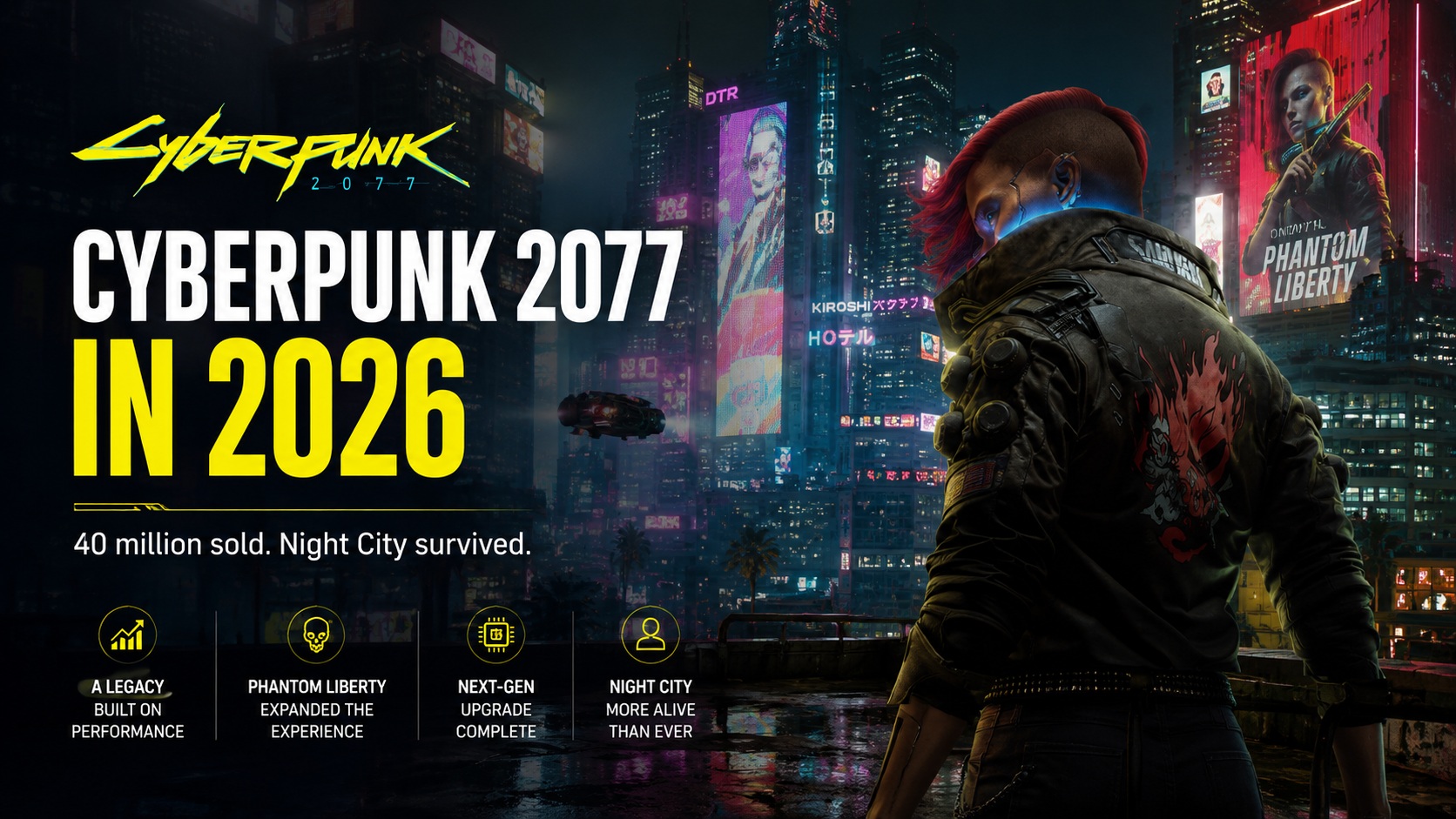
Cyberpunk 2077 has sold 40 million copies – nearly six years after its disastrous launch
Cyberpunk 2077 has become one of the most remarkable recovery stories in modern gaming.
CD Projekt Red released its futuristic open-world RPG in December 2020 after years of extraordinary anticipation. The launch should have reinforced the reputation of the studio behind The Witcher 3. Instead, severe technical problems, particularly on older consoles, quickly dominated the conversation.
Nearly six years later, Cyberpunk 2077 exists in a very different position.
CD Projekt confirmed on 2 September 2026 that the game has sold more than 40 million copies, while the Phantom Liberty expansion has passed 15 million sales.
Meanwhile, tens of thousands of Steam players continue returning to Night City. Recent Steam reviews are also overwhelmingly positive compared with the reaction surrounding the original release.
Cyberpunk 2077 did not simply survive its launch.
CD Projekt spent years rebuilding it.
The result is a game whose current reputation looks almost unrecognisable beside the one it carried in December 2020.
Cyberpunk 2077 began with enormous expectations
Cyberpunk 2077 is an open-world action RPG developed and published by CD Projekt Red.
The game places players in the role of V, a mercenary trying to establish a reputation in Night City.
That ambition quickly becomes complicated after V becomes involved in the theft of an experimental biochip known as the Relic.
The chip contains a digital construct of Johnny Silverhand, played by Keanu Reeves.
Johnny soon begins appearing inside V’s mind.
Unfortunately, his presence is not simply an inconvenience. The Relic is gradually rewriting V’s consciousness.
That gives the story a personal deadline.
V wants to survive.
Johnny has unfinished business.
Their relationship changes throughout the game depending on how the player responds to him.
Sometimes they cooperate.
Sometimes they barely tolerate each other.
That conflict becomes one of the strongest parts of the narrative.
Night City became one of Cyberpunk 2077’s greatest strengths
Night City is more than a backdrop.
It is one of the game’s central characters.
Massive corporate towers dominate parts of the skyline. Advertising covers buildings and streets. Wealth exists beside extreme poverty, while gangs, corporations and private security groups compete for influence.
Different districts also have their own identities.
Some feel polished and expensive.
Others are densely packed with markets, apartments and industrial infrastructure.
Beyond the city lies the Badlands, where the atmosphere changes again.
Cyberpunk 2077 uses these environments to reinforce one of its main themes.
Night City constantly sells people a dream.
Better technology.
More money.
More fame.
More power.
Yet the city repeatedly destroys people who believe those promises.
The Cyberpunk 2077 launch became the story
Cyberpunk 2077 launched on 10 December 2020.
The technical condition of the game immediately dominated coverage.
Players encountered crashes, visual glitches, broken AI and other bugs.
Performance on older consoles became a particularly serious problem.
The controversy grew so large that discussion about the game’s characters, missions and world often disappeared behind arguments about its technical state.
That was disastrous for CD Projekt Red.
The studio had spent years building extraordinary expectations around the game.
Cyberpunk 2077 was not simply another RPG release.
It had become one of the most anticipated games of its generation.
When those expectations collided with the launch build, the reaction was severe.
There was still an ambitious RPG underneath the problems
One reason the recovery became possible is that Cyberpunk 2077 had a strong foundation underneath its technical issues.
Night City was visually ambitious.
The main story contained memorable characters.
Combat offered several distinct approaches.
Players could use conventional firearms, blades, stealth or cyberware.
Netrunning provided another option by allowing V to manipulate enemies and electronic systems through quickhacks.
Character progression also supported different builds.
These systems were not perfect at launch.
However, there was enough underneath the problems for CD Projekt Red to improve rather than completely replace the game.
That distinction matters.
Fixing a broken technical foundation is extremely difficult.
Fixing an ambitious game whose systems need refinement is still difficult, but it gives developers something worth rebuilding.
Cyberpunk 2077 kept changing after launch
The comeback did not happen through one miracle patch.
CD Projekt Red spent years updating the game.
Technical fixes addressed crashes and bugs.
Performance improved.
Artificial intelligence received attention.
Balance changed.
Gameplay systems evolved.
Eventually, the studio moved beyond repairs.
Update 2.0 redesigned major parts of Cyberpunk 2077 shortly before the launch of Phantom Liberty.
Character perks changed.
Cyberware changed.
Police behaviour was reworked.
Vehicle combat became more important.
Progression felt substantially different.
At that point, Cyberpunk 2077 was no longer simply the launch game with fewer technical problems.
Several of its fundamental systems had changed.
Phantom Liberty completed the transformation
Cyberpunk 2077: Phantom Liberty launched in September 2023.
The expansion introduces Dogtown, a militarised district controlled by Kurt Hansen.
V becomes involved in a political and espionage story connected to the New United States of America.
One of the main new characters is Solomon Reed, portrayed by Idris Elba.
Another central figure is Songbird, whose situation becomes increasingly important as the story develops.
The expansion adopts a spy-thriller tone while retaining the darker moral ambiguity associated with Night City.
However, Phantom Liberty mattered for more than its story.
It arrived during the same period as the broader Cyberpunk 2077 overhaul.
Together, Phantom Liberty and Update 2.0 became the point where many players began reassessing the game.
Phantom Liberty has sold 15 million copies
CD Projekt confirmed in September 2026 that Phantom Liberty has now sold more than 15 million copies.
That is a substantial number for an expansion that requires the base game.
It also shows that players continued buying Cyberpunk content long after the initial recovery period.
The expansion helped reinforce Cyberpunk as an ongoing franchise rather than a damaged one-off release.
For official information about the game and expansion, readers can visit the official Cyberpunk 2077 website.
Cyberpunk 2077 has now sold more than 40 million copies
The larger milestone belongs to the base game.
CD Projekt confirmed on 2 September 2026 that Cyberpunk 2077 has sold more than 40 million copies.
That figure changes the way the game’s commercial history needs to be viewed.
Its launch was disastrous in important ways.
However, it was not a permanent commercial failure.
Instead, Cyberpunk 2077 continued selling for years.
New platforms, the Ultimate Edition, Phantom Liberty and continued updates all extended its lifecycle.
That turned one of gaming’s most notorious launches into a major long-term success.
Cyberpunk 2077 still attracts tens of thousands of Steam players
Sales tell only part of the story.
Steam activity shows that players are still spending significant amounts of time in Night City.
When TechnologyBlog checked in September 2026, tens of thousands of Steam users were playing Cyberpunk 2077 simultaneously.
Daily peaks regularly climbed considerably higher.
That is strong activity for a primarily single-player RPG approaching its sixth anniversary.
The game’s all-time Steam peak remains more than one million concurrent players from its launch period.
Current numbers are obviously far below that.
However, comparing a six-year-old single-player RPG with its launch-day peak misses the more useful point.
Cyberpunk 2077 still has a substantial active audience.
Steam also represents only one platform.
TechnologyBlog therefore will not pretend those figures represent the complete player base across PC and consoles.
Readers can check the current PC listing and user-review status on Cyberpunk 2077’s Steam page.
Steam reviews tell another part of the comeback story
The change in player sentiment may be even more revealing than sales.
Recent Cyberpunk 2077 Steam reviews are overwhelmingly positive.
That contrasts sharply with the controversy surrounding the original launch.
It does not mean the events of 2020 should be forgotten.
They remain an important part of the game’s history.
However, someone deciding whether to play Cyberpunk 2077 in 2026 is not buying the December 2020 version.
The current build has benefited from years of patches, system changes and additional content.
Those versions need to be judged differently.
Cyberpunk 2077 Update 2.3 added more features
CD Projekt continued improving the game even after many players assumed major work had ended.
Update 2.3 arrived in July 2025.
It added four additional vehicles, AutoDrive, Delamain taxi services, vehicle-related jobs and expanded Photo Mode features.
AutoDrive allows owned vehicles to travel automatically towards selected destinations.
Players can also use Delamain taxis to move around Night City.
These additions did not fundamentally redesign the game like Update 2.0.
Instead, they refined how players interact with the city.
The official details remain available in the Cyberpunk 2077 Update 2.3 patch notes.
Cyberpunk 2077 reached new platforms years after launch
The game’s lifecycle also expanded through new hardware.
Cyberpunk 2077: Ultimate Edition launched for compatible Apple silicon Macs in July 2025.
The game also reached Nintendo Switch 2.
That is particularly notable considering the game’s history.
Cyberpunk 2077 was originally criticised heavily for its performance on older consoles.
Years later, CD Projekt was still bringing the game to new platforms.
That does not erase what happened at launch.
However, it demonstrates how far the technical state of the game evolved.
Patch 2.31 refined the newer systems
Patch 2.31 arrived later in 2025 and focused on refining features introduced by Update 2.3.
AutoDrive behaviour improved.
Photo Mode received additional changes.
Several bugs were addressed.
These updates are far smaller than the sweeping redesign represented by Update 2.0.
That is actually significant.
Cyberpunk 2077 no longer requires fundamental reconstruction.
Instead, it has moved into a more mature maintenance phase.
The core game is now largely complete.
Cyberpunk 2077 is no longer defined by technical repairs
For several years, every Cyberpunk update came with an obvious question:
Is the game finally fixed?
That question is less useful in 2026.
The development conversation has moved on.
Cyberpunk 2077 is now discussed more often in terms of builds, characters, Night City, Phantom Liberty and the future of the franchise.
That alone demonstrates how dramatically its reputation changed.
The game no longer needs every update to prove that it works.
Instead, players are discussing whether they want to return.
Night City gives players a reason to return
Cyberpunk 2077 has an advantage that cannot be created through patches alone.
Night City remains memorable.
The architecture is distinctive.
The districts feel different.
Corporate excess sits beside poverty.
Advertisements constantly compete for attention.
Body modification is normalised.
Violence is commercialised.
Technology is everywhere.
The city can look glamorous from a distance.
Living there is much less appealing.
That contradiction is central to Cyberpunk.
Night City sells everyone the idea that they can become special.
Then it repeatedly shows how disposable people are.
The side stories contain some of the strongest writing
The main story receives most of the attention, but several optional questlines provide some of Cyberpunk 2077’s strongest character moments.
Panam Palmer’s story develops through the Aldecaldos.
Judy Alvarez becomes connected to some of Night City’s darker systems of exploitation.
River Ward introduces another perspective on law enforcement.
Johnny Silverhand’s past reveals more about the person behind the legend.
These stories give the city emotional weight.
Players are not simply moving between combat encounters.
They are gradually building relationships.
Those relationships can also influence how the later stages of V’s story unfold.
Cyberware became far more important
Cyberware should be one of the defining systems in a Cyberpunk RPG.
Later updates made it considerably more meaningful.
Players can now build V around different combinations of mobility, survivability, offensive capability and specialised cyberware.
That reinforces the fiction.
V becomes more powerful by replacing or augmenting parts of the human body.
The gameplay system therefore supports one of the central ideas of the Cyberpunk universe.
Technology provides extraordinary capability.
It also raises questions about how far people are willing to modify themselves in pursuit of power or survival.
Different builds give Cyberpunk 2077 replay value
One Cyberpunk 2077 playthrough does not necessarily show everything the combat systems can offer.
A firearms-focused build can feel very different from a blade-based character.
Stealth changes encounters substantially.
Netrunning allows players to manipulate opponents and systems without approaching them directly.
Heavy cyberware can create extremely aggressive close-range builds.
Different dialogue choices and relationships provide further variation.
The game’s narrative does not branch infinitely.
However, there is enough mechanical and story variation to justify another trip through Night City.
Phantom Liberty adds another difficult set of choices
The expansion gives returning players an additional reason to come back.
Its story revolves around competing loyalties involving Songbird, Reed and the organisations surrounding them.
There is no comfortable decision that solves everything neatly.
That fits Cyberpunk particularly well.
Night City rarely provides clean moral answers.
People have conflicting motivations.
Governments behave like corporations.
Corporations behave like governments.
Individuals caught between them try to survive.
Phantom Liberty understands that ambiguity.
Cyberpunk: Edgerunners expanded the audience
One of the biggest changes in the wider franchise happened outside the game.
Cyberpunk: Edgerunners introduced another audience to Night City.
The anime tells its own story rather than adapting V’s campaign directly.
That allowed the Cyberpunk universe to expand without simply repeating the game.
The success of Edgerunners also helped demonstrate that Cyberpunk could exist across more than one medium.
The franchise is therefore bigger than Cyberpunk 2077 itself.
That matters because CD Projekt is already building its future.
Cyberpunk 2 is already in development
CD Projekt initially referred to the follow-up to Cyberpunk 2077 as Project Orion.
It is now publicly referred to as Cyberpunk 2.
The project moved into pre-production after completing its conceptual phase.
Development involves CD Projekt Red teams in North America and Poland.
The sequel is also being built with Unreal Engine 5 rather than the REDengine technology used for Cyberpunk 2077.
CD Projekt has not announced a release date.
TechnologyBlog will therefore not speculate about one.
The important point is simpler.
Cyberpunk 2077 successfully recovered strongly enough for CD Projekt to commit to another major game in the universe.
Cyberpunk has become one of CD Projekt’s core franchises
For years, CD Projekt was primarily associated with The Witcher.
That has changed.
Cyberpunk is now one of the company’s central franchises.
A sequel is in development.
The Edgerunners branch continues expanding the universe.
Cyberpunk 2077 remains commercially active.
Phantom Liberty continues selling.
That would have seemed considerably less certain during the chaos of December 2020.
The comeback therefore matters beyond one game.
It preserved the future of the entire Cyberpunk franchise.
South African players do not depend on competitive servers
Cyberpunk 2077 also has an advantage for South African gamers.
It is fundamentally a single-player game.
Your main experience does not depend on local competitive multiplayer servers or international matchmaking latency.
Hardware performance still matters.
Download size matters.
System requirements matter.
However, network routing does not determine whether V’s combat feels responsive.
That makes Cyberpunk 2077 easier to evaluate locally than an online-only title.
Players can experience the core campaign without depending on a distant multiplayer infrastructure.
Cyberpunk 2077 and Baldur’s Gate 3 show another kind of longevity
TechnologyBlog recently looked at another major single-player RPG that continues attracting substantial Steam activity years after launch in our Baldur’s Gate 3 in 2026 feature.
INTERNAL LINK: Link Baldur’s Gate 3 in 2026 above to the published TechnologyBlog article.
The two games achieve longevity in very different ways.
Cyberpunk 2077 benefited from years of reconstruction, a major expansion and continued updates.
Baldur’s Gate 3 relies heavily on replayability, branching choices and player experimentation.
The relevant connection is not which game is better.
It is that large single-player RPGs can maintain active communities long after launch without relying on conventional competitive live-service structures.
Cyberpunk 2077 in 2026 is not the game released in 2020
This is the most important point for players who abandoned Cyberpunk 2077 around launch.
The game changed considerably.
Update 2.0 rebuilt major gameplay systems.
Phantom Liberty added Dogtown and a substantial new storyline.
Later updates added vehicles, AutoDrive and other features.
Years of technical fixes sit underneath those additions.
Therefore, someone returning after playing only the original release is not simply returning to the same game with fewer bugs.
Several systems have been redesigned.
The current version deserves to be judged as the product that exists now.
Should you play Cyberpunk 2077 in 2026?
For players who enjoy story-driven open-world RPGs, Cyberpunk 2077 is substantially easier to recommend today than it was at launch.
That statement does not excuse 2020.
CD Projekt released a product that caused legitimate frustration and damaged player trust.
That remains part of the story.
However, purchase decisions in 2026 also need to consider the game currently available.
Night City is more polished.
The RPG systems are stronger.
Cyberware is more meaningful.
Phantom Liberty adds one of the game’s strongest narrative arcs.
Recent player sentiment is highly positive.
Meanwhile, Cyberpunk 2077 continues attracting tens of thousands of Steam players.
That is the version new players encounter today.
Few games have changed their reputation this dramatically
Cyberpunk 2077’s history remains unusual because both the failure and recovery happened at enormous scale.
More than one million Steam users played simultaneously around launch.
The disappointment was therefore equally enormous.
CD Projekt could not quietly move on.
Instead, the developer spent years repairing, redesigning and expanding the game.
Eventually, Phantom Liberty arrived.
Then further updates followed.
Now Cyberpunk 2077 has sold more than 40 million copies, while Phantom Liberty has crossed 15 million.
Tens of thousands of players still enter Night City on Steam.
Cyberpunk 2 is in development.
The franchise survived.
None of that rewrites December 2020.
It makes what happened afterwards more interesting.
Cyberpunk 2077 began as a warning about hype, ambition and releasing a game before it was ready.
In 2026, it also demonstrates something else.
A disastrous launch does not have to become the final version of a game’s story.