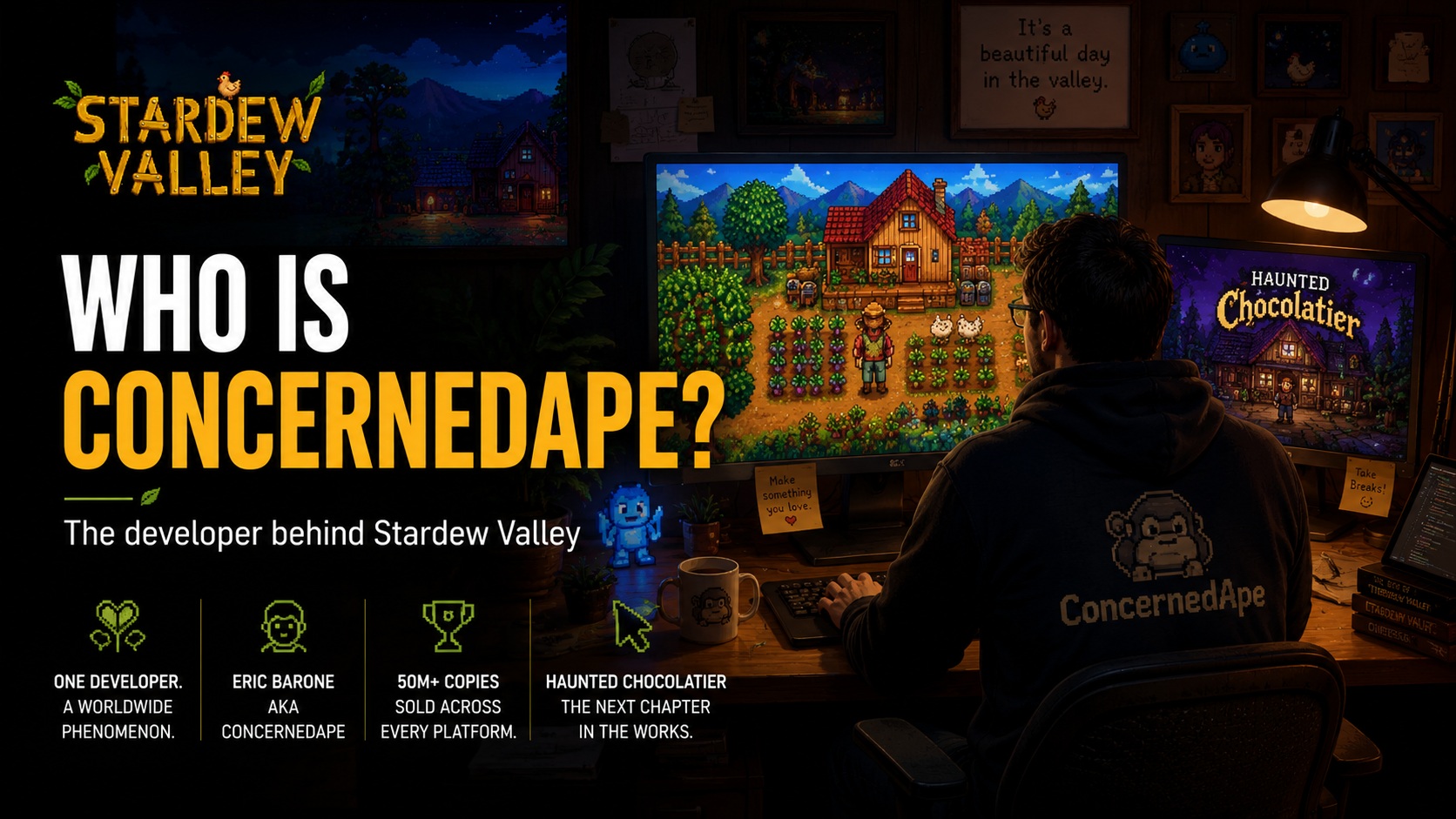
Who is ConcernedApe? The developer behind Stardew Valley
ConcernedApe is the name most players associate with Stardew Valley, but behind it is developer Eric Barone, one of the most unusual success stories in modern indie gaming.
Barone spent around four and a half years developing the original version of Stardew Valley almost entirely by himself. He wrote the code, created the artwork, composed the music and designed the game before releasing it in February 2016.
Ten years later, Stardew Valley has become one of the defining indie games of its generation.
Yet Barone has never turned ConcernedApe into the type of large development studio its commercial success might have supported.
Instead, he continues operating on a remarkably small scale.
A tiny team now helps with Stardew Valley updates, but Barone remains closely involved in every piece of new content. Meanwhile, his next game, Haunted Chocolatier, is still being developed by Barone alone.
That makes ConcernedApe particularly interesting in 2026.
This is not simply the story of someone who made a successful indie game.
It is the story of a developer who became enormously successful and then deliberately resisted becoming a conventional large studio.
ConcernedApe is Eric Barone
ConcernedApe is the development name used by Eric Barone.
The official Stardew Valley FAQ identifies Barone directly as the creator of the game and confirms that Stardew Valley 1.0 was developed completely solo over roughly four and a half years.
That solo-development story has become central to Stardew Valley’s reputation.
Barone did not begin with a large team.
He did not have an established publisher financing a large production.
He taught himself many of the skills required to make the game while development continued.
Programming.
Pixel art.
Music.
Game design.
Writing.
System design.
The result eventually became Stardew Valley.
Stardew Valley began as a solo project
Stardew Valley launched on PC on 26 February 2016.
Within two months, it had already sold more than one million copies.
That alone would have been remarkable for a solo-developed game.
The more unusual part is what happened afterwards.
Stardew Valley kept expanding.
It reached Mac and Linux.
Console versions followed.
Nintendo Switch arrived later.
Mobile versions eventually brought the game to iOS and Android.
The game also received major updates that introduced substantial new systems and content.
However, ConcernedApe did not immediately transform into a huge development company.
That choice shaped everything that followed.
Barone made almost everything himself
The original Stardew Valley was not simply programmed by one developer.
Barone created almost the entire experience.
The art came from him.
The music came from him.
The game design came from him.
The code came from him.
The dialogue came from him.
That matters because Stardew Valley has an unusually consistent identity.
Its music fits the visual style.
The dialogue fits the pacing.
The interface matches the game’s simplicity.
The progression systems feel connected.
When one person creates so many parts of a project, there is less separation between departments.
That can create weaknesses.
It can also create coherence.
Stardew Valley benefited enormously from that coherence.
Stardew Valley was inspired by farming RPGs but became its own thing
The basic idea behind Stardew Valley is familiar.
The player inherits a neglected farm.
Crops need planting.
Animals can be raised.
Villagers have routines and relationships.
Seasons change.
Festivals happen.
The concept clearly belongs to a long tradition of farming and life-simulation games.
However, Barone gradually expanded the formula.
Mining became important.
Combat appeared.
Fishing became its own progression path.
Relationship systems grew.
The Community Center added long-term goals.
Crafting and processing created economic depth.
Eventually, multiplayer changed the game again.
The result was not simply a farming simulator.
It became a collection of interconnected systems that allowed players to decide how they wanted to spend their time.
ConcernedApe kept adding to Stardew Valley
The original release was only the beginning.
Update 1.1 was also developed solo by Barone.
Starting with later updates, additional developers began helping.
The official Stardew Valley FAQ confirms that others started contributing from version 1.3 onwards.
One particularly significant addition was multiplayer.
Retroactively adding multiplayer to an existing single-player game is difficult, and the feature required additional networking work.
Barone later clarified that a Chucklefish employee created the multiplayer netcode, but that Chucklefish otherwise did not participate in the original game’s development.
That distinction is important.
Stardew Valley may have had publishing assistance, but it was not developed by Chucklefish.
The game was Barone’s project.
Chucklefish published Stardew Valley but did not create it
There has been recurring confusion around the relationship between Stardew Valley and Chucklefish.
Barone addressed this directly in 2019.
He stated that throughout the original four-and-a-half-year development period, he was the only person working on Stardew Valley.
Chucklefish’s role was publishing.
That meant helping with areas such as business, marketing, localisation and arranging some platform ports.
It did not mean Chucklefish created the game.
By that stage, Barone had already begun moving Stardew Valley towards self-publishing.
Today, the official FAQ states that Stardew Valley is self-published by ConcernedApe on all platforms.
That gives Barone a level of control many developers never have.
ConcernedApe became the publisher as well
Self-publishing changes the developer’s role considerably.
ConcernedApe is not only responsible for creative decisions.
Barone also controls the product more directly.
There is no external publisher deciding whether Stardew Valley needs another update.
There is no parent company demanding a sequel by a specific financial quarter.
There is no separate franchise owner directing the long-term strategy.
That does not mean Barone works alone on every business function.
Ports, localisation and other specialist work can involve outside contributors.
However, the creative ownership remains unusually concentrated.
That helps explain why Stardew Valley has developed at its own pace.
Stardew Valley did not become a traditional DLC business
The game’s post-launch model is another expression of that independence.
Stardew Valley has repeatedly received substantial free updates.
Multiplayer arrived.
New farms appeared.
New locations were added.
Late-game content expanded.
Characters received additional dialogue.
Version 1.6 added another large collection of content years after launch.
Barone could easily have packaged many of these additions as paid expansions.
He did not.
That does not make the business uncommercial.
Stardew Valley has sold extraordinarily well.
Instead, it shows that ConcernedApe does not appear to manage the game according to the same release model used by many larger studios.
The game grows when Barone still sees something worth improving.
Stardew Valley 1.6 showed how far the game had grown
Version 1.6 arrived on PC in March 2024.
The update introduced the Meadowlands Farm, new festivals, mastery progression, dialogue, items and a substantial list of additional features.
It became one of the largest updates in the game’s history.
TechnologyBlog has already examined Stardew Valley’s remarkable longevity in our Stardew Valley in 2026 feature.
INTERNAL LINK: Link Stardew Valley in 2026 above to the published TechnologyBlog article.
That article looks at the game’s tenth anniversary, player activity, sales and why people continue creating new farms.
For this profile, the more important question is why Barone keeps returning to a game that could reasonably have been considered finished years ago.
Stardew Valley turned 10 in 2026
On 26 February 2026, Stardew Valley celebrated its tenth anniversary.
Barone noted that although the game had been publicly available for ten years, he had effectively been working on it for close to 15.
That is an enormous portion of a creative career devoted to one project.
Yet his anniversary message was not presented as a farewell.
He looked back at early builds and development history, but Stardew Valley remained active.
The game still has a growing audience.
New content remains in development.
And Barone is still involved.
ConcernedApe is now taking a different role on Stardew Valley
One important change has happened.
Barone no longer develops every Stardew Valley update entirely by himself.
A very small team now helps with ongoing development.
For version 1.7, Barone has deliberately moved towards more of a creative-director role so he can spend most of his own development time on Haunted Chocolatier.
That does not mean he has detached himself from Stardew Valley.
Quite the opposite.
Barone has said he still wants his hand to touch every piece of new content.
He also insists on personally handling certain aspects, including music.
That balance is revealing.
He is delegating enough to keep the game growing.
But he is not delegating enough to stop being ConcernedApe.
Stardew Valley 1.7 is another major update
Version 1.7 is currently being developed as another major content update.
There is no confirmed release date.
That is intentional.
Barone has repeatedly avoided locking himself into deadlines.
The 1.7 development model allows the small Stardew Valley team to continue working while Barone remains primarily focused on Haunted Chocolatier.
That means the two projects can progress simultaneously.
Previously, Stardew Valley updates could pull Barone almost completely away from Haunted Chocolatier.
The newer structure is designed to reduce that problem.
It is a small organisational change with significant implications.
ConcernedApe is gradually becoming something slightly more like a studio.
But only slightly.
The Stardew Valley team remains deliberately small
Barone has described the current Stardew Valley development group as very small.
He also said he likes it that way.
That detail matters.
Many developers would respond to 50 million game sales by aggressively hiring.
More programmers.
More artists.
More designers.
More producers.
Potentially several projects at once.
ConcernedApe has taken a different route.
The team helping with Stardew Valley remains compact.
Haunted Chocolatier remains solo.
Growth is happening, but it is carefully controlled.
Haunted Chocolatier is the real test of ConcernedApe’s future
Barone announced ConcernedApe’s Haunted Chocolatier in 2021.
The game is an RPG and simulation project built around a chocolatier living in a haunted castle.
Players will gather ingredients, create chocolates and sell them through a chocolate shop.
Beyond that, Barone has deliberately avoided explaining too much about the systems.
That secrecy is intentional.
He does not want to reveal systems too early when they may still change.
More importantly, Haunted Chocolatier is not simply Stardew Valley 2.
Barone has repeatedly stressed that they are separate games.
Haunted Chocolatier is being developed solo
This may be the most surprising part of ConcernedApe’s current structure.
Despite Stardew Valley’s enormous commercial success, Haunted Chocolatier is still being developed by Eric Barone alone.
The official FAQ confirms that he has been working solo and currently has no plans to bring additional developers directly into the project.
That remains true in 2026.
Barone reiterated that Stardew Valley has a small supporting team while Haunted Chocolatier remains completely solo.
That means the successor to one of the most successful indie games ever made is still effectively a one-person development project.
Haunted Chocolatier is written from scratch
Another important technical detail is that Haunted Chocolatier is not simply Stardew Valley with different artwork.
Barone stated in January 2026 that the new game has been written from scratch.
It does not use the same engine as Stardew Valley.
This matters because some fans had speculated that ideas or systems from Haunted Chocolatier might eventually be folded into Stardew Valley.
Barone rejected that idea.
The games are technically separate.
They are creatively separate.
And he does not use Stardew Valley as a testing ground for Haunted Chocolatier systems.
That makes Haunted Chocolatier a far more significant creative challenge than simply extending something he already built.
ConcernedApe refuses to give Haunted Chocolatier a release date
There is currently no release date for Haunted Chocolatier.
Barone has been explicit about this.
The game will launch when it is ready.
The official FAQ says he does not want the pressure created by even an estimated release date.
In January 2026, he also directly rejected claims that he had said the game would launch in 2030.
He had said only that he hoped it would be completed within a certain period.
That was not a release-date announcement.
TechnologyBlog therefore will not speculate about a launch year.
There is no confirmed one.
Haunted Chocolatier is still making progress in 2026
What we can confirm is that development remains active.
Barone posted another update on 30 August 2026, only days before this article was written.
He said he was still making progress and had recently been highly productive on the project.
He also reiterated his refusal to rush.
The goal is to make something he is personally proud of rather than release according to external pressure.
That philosophy sounds simple.
It becomes much more unusual when attached to a game with enormous expectations behind it.
Stardew Valley created a difficult second-game problem
Haunted Chocolatier faces a challenge that Stardew Valley never had.
Expectation.
Almost nobody expected Stardew Valley to become a 50-million-copy phenomenon when Barone was building it.
Haunted Chocolatier arrives with millions of potential players already watching.
Every screenshot creates analysis.
Every development update creates expectations.
Every similarity to Stardew Valley gets examined.
That puts Barone in an uncomfortable position.
He wants to make another personal project.
The audience sees the follow-up to Stardew Valley.
Those are not necessarily the same thing.
Barone has acknowledged announcing Haunted Chocolatier early
In January 2026, Barone openly acknowledged that he announced Haunted Chocolatier early.
However, he did not respond by creating a rushed deadline.
Instead, he continues developing at his own pace.
That may frustrate players waiting for the game.
But it also reflects one of the biggest differences between ConcernedApe and larger commercial studios.
There are fewer external forces capable of forcing the project onto shelves.
There is no publicly announced financial-quarter target.
There is no publisher campaign requiring a specific launch window.
Barone controls the schedule.
The downside is that development can take a very long time.
The upside is that the release date does not have to dictate when the game is finished.
ConcernedApe’s perfectionism is part of the delay
Barone has been unusually transparent about why Haunted Chocolatier takes time.
In June 2026, he discussed repeatedly revisiting parts of the game’s interface and systems until they felt right.
He described frequently iterating on details because players will interact with them constantly.
That includes seemingly ordinary features such as the recipe interface.
This approach obviously slows development.
However, it helps explain why Stardew Valley feels as coherent as it does.
Small interactions matter when players repeat them hundreds of times.
Planting.
Buying.
Crafting.
Navigating menus.
Talking to characters.
None of those systems can afford to feel irritating if the entire game is built around repetition.
Stardew Valley proved that small details matter
One of Stardew Valley’s greatest achievements is not any individual system.
It is how comfortable those systems become together.
The soundtrack changes with seasons.
The art communicates information immediately.
Characters follow understandable routines.
The interface remains relatively simple.
Activities create short feedback loops.
Those details make the world pleasant to inhabit.
That kind of polish rarely appears through one dramatic feature.
It comes from repeated small decisions.
Barone’s current Haunted Chocolatier development comments suggest he is applying the same obsessive attention to his next game.
ConcernedApe has an unusual relationship with success
Many developers dream of having one breakout hit.
Stardew Valley became vastly larger than that.
It created merchandise.
Cookbooks followed.
Concert tours performed its music.
The game appeared across multiple platforms.
A large international community formed around it.
Yet Barone still talks about development in deeply personal terms.
He wants to enjoy what he creates.
He wants to be proud of it.
He wants direct involvement.
That is difficult to maintain when a project becomes a franchise.
ConcernedApe seems determined to try.
Stardew Valley expanded beyond the game
The wider Stardew Valley brand has gradually grown.
An official cookbook has been released.
Concert tours have performed music from the game.
Books and merchandise continue appearing.
In July 2026, ConcernedApe announced an official Stardew Valley crochet book.
Those products demonstrate how far the property has expanded beyond its original PC release.
However, the game itself remains the centre.
Barone has not transformed Stardew Valley into a constantly monetised content platform.
The brand expands around the game rather than replacing it.
Music remains particularly personal to Barone
Barone’s music deserves special attention because it demonstrates how involved he remains.
Stardew Valley’s soundtrack is part of its identity.
Different seasons have distinct moods.
Locations have their own themes.
Festivals change the atmosphere.
Many players recognise tracks immediately.
With version 1.7, Barone has specifically said music remains an area he insists on creating personally.
That may appear like a small detail.
It says a great deal about how he sees authorship.
Some parts of Stardew Valley can be delegated.
Others remain inseparable from ConcernedApe.
Stardew Valley is no longer technically a one-person project
It is important not to repeat the simplistic claim that Stardew Valley is still developed entirely by one person.
That is no longer accurate.
The original game was.
Update 1.1 was.
Later updates have involved additional contributors.
Today, Barone works with a small development group on Stardew Valley.
He describes his current 1.7 role as closer to creative director, although he remains directly involved in content.
That distinction should be preserved.
The solo-development history is extraordinary enough without exaggerating it.
ConcernedApe still avoids becoming a conventional studio
This is what makes his current structure so unusual.
ConcernedApe has enough success to build a much larger organisation.
Instead, Stardew Valley uses a compact team.
Haunted Chocolatier remains solo.
Barone still writes music.
He still participates directly in content.
He still posts development updates himself.
In many respects, ConcernedApe remains much closer to an individual creator than a conventional game company.
That model provides enormous creative control.
It also creates a bottleneck.
One person can only do so much
The drawback of Barone’s approach is obvious.
Time.
If one person wants direct involvement in almost everything, development moves at that person’s pace.
Haunted Chocolatier demonstrates this clearly.
Barone has Stardew Valley responsibilities.
He has business responsibilities.
He has events and other franchise commitments.
Then he has a large new game to build.
There are only so many hours available.
A larger studio could divide those responsibilities across departments.
ConcernedApe deliberately does not operate that way.
The cost is slower production.
The benefit is creative continuity.
Stardew Valley 1.7 tests the new model
Version 1.7 may therefore be more important organisationally than it appears.
For the first time, Barone is trying to let a small Stardew Valley team make meaningful progress while he focuses mainly on another game.
He still directs.
He still contributes.
He still needs to approve and touch the content.
But he is not personally building everything.
If that model works, ConcernedApe can maintain Stardew Valley without repeatedly stopping Haunted Chocolatier development.
That would be a significant evolution.
It preserves the small-team philosophy without requiring Barone to do every task himself.
Haunted Chocolatier needs to prove ConcernedApe is more than Stardew Valley
There is another challenge.
Stardew Valley became so successful that ConcernedApe and the game are almost inseparable.
Haunted Chocolatier gives Barone the opportunity to demonstrate that his development philosophy works beyond Pelican Town.
It is still recognisably his work.
The pixel-art approach feels familiar.
The simulation and RPG elements create obvious connections.
However, Barone has repeatedly stressed that it is a separate game.
That matters.
If Haunted Chocolatier succeeds creatively, ConcernedApe stops being simply “the Stardew Valley developer.”
He becomes a developer with multiple distinct worlds.
Why ConcernedApe matters
Eric Barone’s development story can easily become romanticised.
One person makes a game.
The game becomes enormously successful.
Everything works out.
The reality is more interesting.
He spent years building Stardew Valley.
He taught himself multiple disciplines.
He maintained direct control over the project.
Then success created an entirely new set of problems.
How do you maintain a game millions of people love?
How do you build something new without abandoning the old one?
How much work can you delegate before the game stops feeling like yours?
How do you follow one of the most successful indie games ever made?
ConcernedApe is still answering those questions.
Stardew Valley now has a small team.
Barone is moving towards a creative-director role for Update 1.7.
Yet he still wants direct contact with every new piece of content.
At the same time, he is developing Haunted Chocolatier alone.
No release date.
No rush.
No large production team.
No attempt to convert the project into something it was never meant to be.
That approach is inefficient by conventional AAA standards.
It is also probably part of why ConcernedApe’s work feels so personal.
Ten years after Stardew Valley launched, Eric Barone could have become the head of a large development company.
Instead, he is still making games.
That may ultimately be the most important thing about ConcernedApe.