Marvel Rivals is nearly two years old – so why is NetEase’s hero shooter still pulling huge numbers?
Marvel Rivals arrived at exactly the point when many players had become wary of new live-service games.
That should have made its job difficult.
Instead, NetEase Games launched a free-to-play third-person hero shooter filled with Marvel characters, destructible environments and team-based abilities, then watched it become one of Steam’s biggest multiplayer launches.
Marvel Rivals released on 5 December 2024 according to the Steam store’s regional listing, with SteamDB recording the global Steam release at midnight UTC on 6 December. It later reached an all-time Steam peak of 644,269 concurrent players on 11 January 2025.
Almost two years later, that launch excitement has inevitably declined.
The important part is what remains.
When TechnologyBlog checked on 1 September 2026, SteamDB showed a 24-hour peak of 90,746 concurrent players and more than 37,000 online at that particular moment. SteamDB also ranked Marvel Rivals 11th in daily active users on Steam. Those figures only represent Steam, not PlayStation, Xbox or other PC versions.
That is not a dead live-service game hanging on to a shrinking community.
Marvel Rivals has become an established competitive shooter.
Marvel Rivals understood that Marvel characters needed to feel powerful
There was an obvious challenge from the beginning.
How do you place Spider-Man, Hulk, Magneto, Rocket Raccoon, Doctor Strange and dozens of other superheroes into the same competitive game without making them feel like ordinary soldiers wearing Marvel costumes?
NetEase’s answer was not to flatten everybody into the same basic shooter template.
Characters move differently.
They attack differently.
Some fly.
Some swing.
Some teleport.
Some shield their team.
Others dive directly into the enemy formation.
That diversity is one of Marvel Rivals’ biggest strengths.
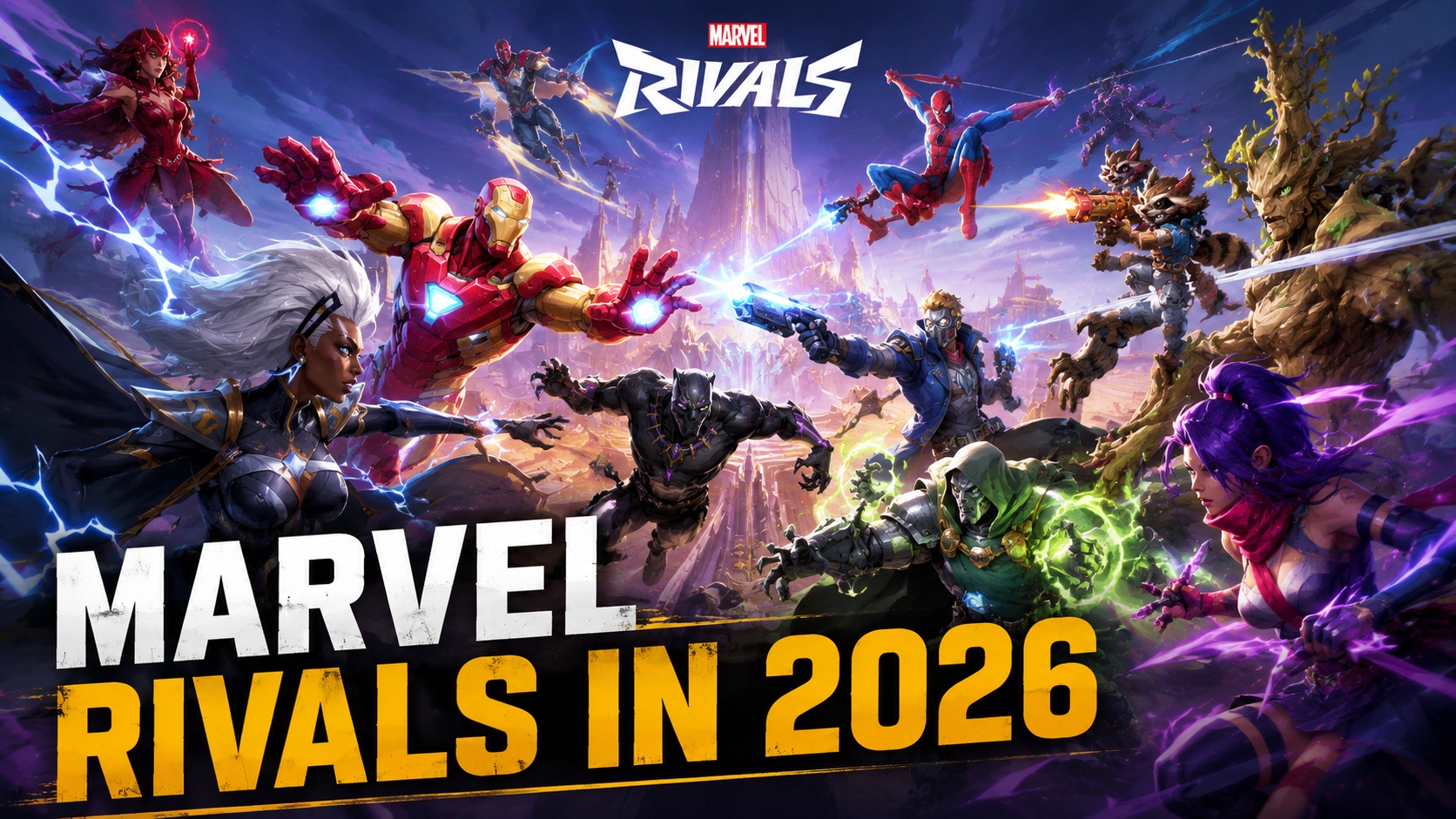
The game’s roster draws from the Avengers, X-Men, Guardians of the Galaxy and many other corners of Marvel. NetEase then groups those characters into three broad combat roles: Vanguard, Duelist and Strategist.
The structure is familiar to anyone who has played a modern hero shooter.
The execution depends on the characters themselves.
Spider-Man should not feel like Punisher.
Hulk should not feel like Rocket Raccoon.
Doctor Strange should not move like Black Panther.
For the most part, they do not.
Team-Up abilities give Marvel Rivals its own identity
The Team-Up system helps separate Marvel Rivals from simply being another game with tanks, damage characters and support heroes.
Specific heroes can combine abilities when they appear together.
Hulk can enhance Iron Man with Gamma energy.
Rocket Raccoon can ride on Groot.
Other combinations provide additional attacks, passive bonuses or entirely new tactical options.
It creates another layer when building a team.
The question is not simply which character a player prefers.
The composition of the entire squad matters.
NetEase has continued modifying this system rather than leaving the original combinations untouched. Season 9 introduced what the developer described as a ground-up revamp of Team-Up abilities, adding new combinations and changing the tactical relationships between heroes.
That matters because hero shooters live or die through their metagame.
If the same combinations remain dominant for years, matches eventually become predictable.
Marvel Rivals keeps interfering with that balance.
Destructible environments add something most hero shooters avoid
The maps themselves also play a more active role than in many competitive shooters.
Marvel Rivals allows parts of environments to be destroyed and reshaped during matches.
Walls disappear.
Cover can be removed.
Routes can change.
Players can occasionally create attacking opportunities simply by destroying something the defending team expected to remain there.
It is not complete environmental destruction.
Maps still need enough structure for competitive play to remain understandable.
But the destruction creates moments where the battlefield changes around the characters rather than functioning only as a fixed arena.
That feels appropriate for Marvel.
A fight involving Hulk, Magneto and other superpowered characters should probably leave some damage behind.
The roster keeps growing instead of relying on the launch heroes
Another reason Marvel Rivals remains visible is the speed at which NetEase adds characters.
Season 9 began on 10 July 2026 and introduced Jubilee. It also reworked Black Widow and substantially changed the Team-Up system.
Then Season 9.5 arrived on 7 August 2026 with another new hero.
The Hood, Parker Robbins, joined the roster as a Vanguard.
Rather than functioning as a conventional defensive tank, The Hood combines firearms with dark magic and can transform into a demonic state.
That pace matters.
Marvel has an enormous library of heroes and villains.
NetEase therefore has something most original hero shooters do not: decades of characters already carrying established identities and fan bases.
A new hero announcement can interest people who may have stopped playing simply because that character means something to them.
Marvel Rivals has become comfortable using lesser-known characters too
The obvious temptation would be to rely entirely on Marvel’s largest names.
Iron Man.
Spider-Man.
Captain America.
Thor.
Wolverine.
Instead, the roster increasingly reaches deeper into Marvel history.
Characters such as Luna Snow, Jeff the Land Shark and The Hood sit alongside globally recognised superheroes.
That is important for the game’s future.
There are only so many headline Marvel characters NetEase can add before it needs to explore the wider comic universe.
Marvel Rivals has shown that it is willing to do so.
That gives the roster room to expand for years without every season depending on another Avengers-level celebrity.
Season 9 shows how aggressively NetEase is still changing the game
Season 9, The Mystery of Thebes, was more than a hero release.
Jubilee joined the roster.
The Team-Up system received a major redesign.
Black Widow was reworked.
Competitive rewards changed.
Events and seasonal stories continued.
NetEase also kept releasing smaller patches between the major seasonal updates.
Season 9.5 followed less than a month later.
The Hood arrived.
Additional story content appeared.
The store introduced a configurable bundle system.
NetEase also changed the game’s storage footprint, reporting that improved texture compression should reduce the PC installation size by around 30% after the update.
Then weekly patches continued through August.
That cadence is one of Marvel Rivals’ biggest advantages.
Players rarely need to wait months before something changes.
Marvel Rivals was still being patched days before September
The latest official patch when TechnologyBlog checked was released on 27 August 2026.
It added new cosmetic bundles, an Infinity Saga store event tied to Avengers: Endgame Encore, and another series of hero and visual fixes.
The patch required no server downtime.
Previous updates arrived on 20 August and 13 August.
This matters less for the individual cosmetics than for what the schedule shows.
NetEase is operating Marvel Rivals as an actively maintained live service rather than relying only on large seasonal drops.
Problems can be addressed between seasons.
Cosmetics rotate.
Balance changes arrive.
Events appear.
Then the next major update changes the meta again.
That constant activity gives players reasons to keep checking what has changed.
The Marvel Rivals player count has dropped – but that is not the same as failure
This is where live-service discussions often become misleading.
Marvel Rivals peaked at 644,269 concurrent Steam players on 11 January 2025.
It does not maintain anything close to that level every day in 2026.
That is normal.
Launch peaks measure excitement concentrated into a very short period.
Long-term health depends more on how many people remain after that excitement settles.
SteamDB showed a 24-hour peak of 90,746 players when TechnologyBlog checked on 1 September 2026.
That is roughly one-seventh of its record.
It is also still an enormous active audience.
For comparison, being outside your launch peak does not automatically make a multiplayer game unsuccessful.
The more useful question is whether enough players remain to support matchmaking, content development and a competitive community.
On Steam alone, Marvel Rivals clearly still has substantial scale.
Seasonal launches can still pull players back
The monthly data makes the pattern even more interesting.
SteamCharts recorded an average of roughly 84,000 concurrent players during July 2026, up more than 20% from June, while the monthly peak approached 197,000.
That coincided with Season 9.
This is exactly what NetEase wants from a seasonal model.
Players do not all need to remain online continuously.
Some leave.
A new hero arrives.
A major balance update launches.
Players return.
Then activity settles again.
The challenge is keeping that cycle healthy enough that each new season still matters.
So far, Marvel Rivals continues to demonstrate that ability.
Steam reviews show that not everything is working perfectly
The player count tells only part of the story.
Player sentiment is more complicated.
Steam currently lists Marvel Rivals as Mostly Positive, with 76% of almost 299,000 English-language reviews positive.
However, recent reviews were Mixed when TechnologyBlog checked, with around 66% of nearly 9,000 reviews over the previous 30 days positive.
That gap is worth paying attention to.
A large active audience does not mean players are satisfied with every change.
Live-service games continuously create friction.
Balance changes upset people who mastered particular heroes.
Monetisation decisions attract criticism.
Performance problems matter.
Matchmaking becomes contentious.
Competitive communities will argue over virtually every adjustment.
NetEase therefore has two separate jobs.
Keep players coming back.
Then keep enough of them happy once they arrive.
Marvel Rivals avoids one major free-to-play problem: heroes are not sold
One of the smartest decisions NetEase made was keeping heroes available without selling access to the playable roster.
The official Marvel Rivals guide continues to describe the game as free-to-play with its heroes unlocked for players.
That matters enormously in a competitive game.
A newly released hero can change the meta.
If only paying players could access that character immediately, competitive balance would become entangled with purchasing decisions.
Instead, monetisation largely revolves around cosmetics and related store content.
Players may still disagree about cosmetic pricing.
But buying a costume does not determine whether you can play the latest hero.
That keeps the competitive foundation cleaner.
Cross-platform multiplayer makes the community much larger than Steam suggests
Steam statistics are useful because they are publicly visible.
They are not the whole Marvel Rivals population.
The game supports cross-platform multiplayer, and NetEase says players across its supported platforms access the same overall server environment.
That includes PC and consoles.
Therefore, when SteamDB shows 90,000 people at a daily peak, that should not be treated as the total number of Marvel Rivals players online.
It is one measurable section of the audience.
This is particularly important when judging the long-term health of modern multiplatform games.
Steam provides excellent public data.
PlayStation and Xbox generally do not provide equivalent live concurrent-player figures.
Marvel Rivals is also becoming a serious esports game
NetEase has continued building a competitive ecosystem around Marvel Rivals.
The Marvel Rivals Championship has run alongside seasonal updates, while the wider Ignite esports structure has divided competition across several international regions.
The 2025 Ignite structure included Americas, Europe/Middle East/Africa, Asia, Oceania and China.
Season 9 also continued the Marvel Rivals Championship with open qualifiers and competitive rewards.
Esports alone cannot keep a multiplayer game alive.
But organised competition creates another layer of engagement.
High-level players develop strategies.
Those strategies influence ranked play.
Balance problems become more visible.
Heroes rise and fall in the meta.
That gives competitive communities something to analyse beyond simply unlocking cosmetics.
South African Marvel Rivals players need to pay attention to server location
This is where the South African context becomes important.
NetEase currently lists server nodes in:
North America: Oregon, Dallas and Northern Virginia
Europe: Frankfurt and Warsaw
Middle East: Dammam
South America: São Paulo
Asia-Pacific: Tokyo, Singapore and Sydney.
There is no South African server node listed on the current official server-selection page.
That does not mean South Africans cannot play Marvel Rivals.
It does mean latency needs consideration.
NetEase itself specifically warns that ping can affect whether movement abilities, dashes, swings and other combat actions connect as intended. Players can select one or several available server nodes based on latency and matchmaking.
For South African players, checking the in-game ping to the available regions is therefore more useful than assuming one location will always perform best.
The quality of individual fibre routes and international connectivity can affect results.
TechnologyBlog has not conducted controlled latency testing across South African ISPs, so we are not assigning a specific expected ping figure.
South Africa is not currently listed in the 2026 Ignite eligibility table
There is another distinction worth making.
Marvel Rivals uses the term EMEA for parts of its esports structure, but that does not automatically mean every African country appears in each tournament’s eligibility list.
The published rules for Marvel Rivals Ignite 2026 list a number of European, Middle Eastern and African countries under EMEA, including Egypt, Algeria, Morocco and Tunisia, but South Africa does not appear in that published country list.
That is an esports eligibility issue, not a statement about whether South Africans can play the normal game.
The two should not be confused.
Marvel Rivals PC requirements remain relatively approachable
Marvel Rivals does require a reasonably modern PC, but its minimum specifications are not extreme by 2026 standards.
NetEase lists a minimum Intel Core i5-6600K or AMD Ryzen 5 1600X, 16GB of memory and a GTX 1060, RX 580 or Intel Arc A380.
The recommended configuration increases that to an Intel Core i5-10400 or Ryzen 5 5600X alongside an RTX 2060 Super, RX 5700 XT or Intel Arc A750.
Marvel Rivals PC requirements
| Specification | Minimum | Recommended |
|---|---|---|
| OS | Windows 10 64-bit, version 1909+ | Windows 10 64-bit, version 1909+ |
| CPU | Core i5-6600K / Ryzen 5 1600X | Core i5-10400 / Ryzen 5 5600X |
| RAM | 16GB | 16GB |
| GPU | GTX 1060 / RX 580 / Arc A380 | RTX 2060 Super / RX 5700 XT / Arc A750 |
| DirectX | 12 | 12 |
| Storage | 70GB | 70GB |
| Network | Broadband | Broadband |
NetEase recommends installing the game on an SSD.
TechnologyBlog has not independently benchmarked Marvel Rivals on these configurations, so these are the developer’s published requirements rather than our own performance results.
The visual identity helped Marvel Rivals avoid looking like an MCU tie-in
One of Marvel Rivals’ quieter successes is its art direction.
The game does not simply copy the Marvel Cinematic Universe.
Characters are recognisable, but many designs lean heavily into stylised comic-book interpretation.
That was important.
A game built entirely around movie likenesses could have felt like a promotional extension of whatever film Marvel happened to be releasing at the time.
Marvel Rivals instead created its own visual identity.
That gives NetEase more freedom.
It can revisit costumes from films.
It can use comic designs.
It can create original interpretations.
It can then sell those cosmetic variations without every character needing to resemble one actor.
For a game funded heavily through cosmetic content, that flexibility matters.
Marvel has an almost unfair advantage when it comes to future characters
Most hero shooters eventually face the same question.
Who do you add next?
Marvel Rivals has the opposite problem.
The Marvel catalogue is enormous.
There are major X-Men still available.
Avengers.
Street-level heroes.
Cosmic characters.
Mystical characters.
Villains.
Alternate-universe versions.
Characters most mainstream audiences have never encountered.
That creates a content pipeline NetEase could theoretically use for years.
The harder task is deciding which characters work mechanically.
A recognisable name is not enough.
Each hero needs abilities that create a reason to select them instead of somebody already on the roster.
The Hood is a useful example.
He is not simply another gun character.
NetEase combined his firearms with magical powers and a demonic transformation, giving him a specific tactical identity.
The biggest threat to Marvel Rivals may be its own content pace
Rapid updates are a strength.
They can also become a weakness.
Every new hero creates another balance problem.
Every Team-Up adds another interaction developers need to test.
Every rework risks upsetting people who preferred the previous version.
As the roster grows, balancing the game becomes exponentially more complicated.
NetEase already uses emergency balance changes between major updates.
That is likely to continue.
The challenge will be keeping Marvel Rivals understandable without removing the chaos that makes it entertaining.
Too little change and players become bored.
Too much change and players feel as though they need to relearn the game constantly.
The studio needs to live somewhere between those extremes.
Marvel Rivals has survived the part where most live-service games become vulnerable
Launching successfully is one problem.
Remaining relevant after the novelty disappears is another.
Marvel Rivals has already passed through its initial explosion of interest.
It has lost a large percentage of its record Steam concurrency.
That was inevitable.
What matters is that underneath that decline remains a very large active game.
A 24-hour Steam peak around 90,000 players nearly two years after launch is substantial.
Seasonal updates can still push activity higher.
New heroes still create attention.
NetEase is still restructuring major systems rather than merely rotating cosmetics.
The competitive scene continues.
That puts Marvel Rivals in a very different position from live-service games that enter a downward spiral within months.
Marvel Rivals does not need to return to 644,000 players to succeed
This may be the most important point when looking at Marvel Rivals in 2026.
Its 644,269-player Steam record is spectacular.
It is also the wrong benchmark for judging every month that followed.
Live-service games do not need to continuously reproduce their largest-ever launch or season peak.
They need enough people to sustain the ecosystem.
Marvel Rivals currently has that.
The game remains among Steam’s stronger daily performers.
It has a much larger multiplatform audience beyond Steam.
NetEase continues releasing heroes and major updates.
Marvel provides a character library large enough to support years of expansion.
And the basic combat remains immediately understandable:
Pick a superhero.
Find five teammates.
Fight another team of superheroes.
Then watch everything become considerably more complicated once dozens of abilities begin interacting at the same time.
That foundation worked in December 2024.
Almost two years later, it is still working.
Marvel Rivals no longer needs to prove that it can launch successfully.
The question now is whether NetEase can turn that success into the kind of longevity enjoyed by the multiplayer games that remain relevant for five, ten or even fifteen years.
The numbers in 2026 suggest it has made a credible start.