5. Article
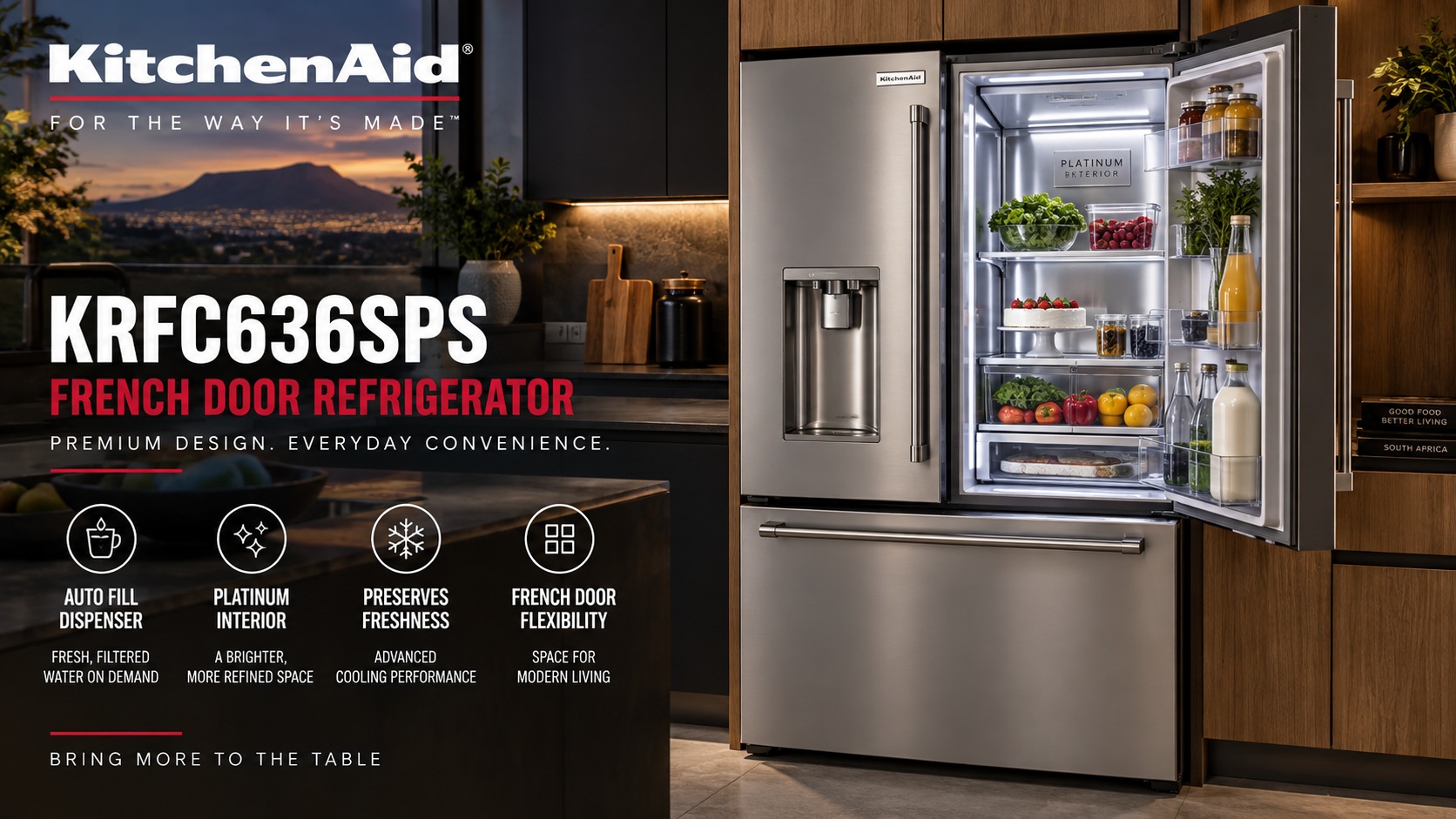
KitchenAid KRFC636SPS uses AI to automatically fill your glass
Artificial intelligence in a refrigerator can easily sound like technology looking for a problem.
The KitchenAid KRFC636SPS offers a more practical example.
Its Intelligent Auto Fill dispenser uses sensors to recognise a container and automatically dispense water. It can account for an off-centre glass and detect when somebody removes the container, allowing users to put down a cup and let the refrigerator handle the filling process.
However, that is only one part of this premium French-door refrigerator.
KitchenAid combines the dispenser with dual ice production, adaptable refrigerated storage, humidity-controlled crisper bins, a temperature-controlled pantry drawer and Wi-Fi features.
There is also an important warning for South African readers. The KRFC636SPS covered here is a US-market appliance. Therefore, anyone considering an import needs to investigate electrical compatibility before looking at its more interesting features.
KitchenAid KRFC636SPS makes Auto Fill genuinely hands-free
The KitchenAid KRFC636SPS uses what the company calls Intelligent Auto Fill.
Instead of holding a glass against a dispenser lever, users can place a container underneath the water outlet.
Sensors then determine its position and manage the filling process.
KitchenAid says the system can recognise when a cup sits off-centre. In addition, it can detect when somebody pulls the container away.
That turns Auto Fill into more than a preset quantity of water.
The system reacts to what happens around the dispenser rather than simply releasing a predetermined volume.
For someone preparing food while moving between several kitchen tasks, that could prove surprisingly convenient.
Preserva monitors refrigerator and freezer temperatures
KitchenAid’s Preserva Food Care System manages temperature inside the refrigerator.
The system uses sensors to monitor both the refrigerator and freezer compartments. It then adjusts cold-air distribution to help maintain the required temperatures.
Importantly, KitchenAid describes this as a single-evaporator system.
Therefore, readers should not interpret Preserva as meaning the refrigerator has completely independent refrigeration systems for its fresh-food and freezer sections.
Instead, sensors help the single system respond to conditions across the appliance.
FreshChill gives different foods different temperature presets
The full-width FreshChill pantry drawer adds another level of control.
Users can select temperature presets designed for wine, deli products, drinks and meat.
That is useful because not everything benefits from exactly the same storage temperature.
A bottle of wine and fresh meat may share refrigerator space, but their ideal storage requirements differ.
Consequently, the drawer provides a more specialised area without requiring an entirely separate appliance.
FreshSeal crisper bins manage humidity
Fresh produce introduces another storage challenge: humidity.
KitchenAid equips the KRFC636SPS with FreshSeal humidity-controlled crisper bins.
The bins use extending gaskets intended to retain humidity around stored produce.
This is different from simply making the entire refrigerator colder.
Vegetables, fruit, meat and drinks all respond differently to temperature and moisture. Therefore, modern refrigeration increasingly relies on specialised zones rather than treating the entire fresh-food compartment as one identical environment.
Dual Ice separates everyday dispensing from larger demand
The KitchenAid KRFC636SPS contains two ice makers.
One sits in the refrigerator door and supplies the external dispenser.
A second ice maker operates in the freezer.
That arrangement gives users quick access to ice from the door while maintaining additional production for larger requirements.
KitchenAid says its In-Door-Ice system can produce up to 3.5lb of ice per day.
The door-mounted design also moves the ice bin away from the main refrigerator shelves, preserving more usable storage space inside.
For households that regularly entertain, the second freezer ice maker may prove more valuable than another smart feature.
Counter depth gives the refrigerator a more integrated appearance
Large French-door refrigerators can protrude noticeably beyond kitchen cabinetry.
KitchenAid uses what it calls True Counter Depth to reduce that effect.
The refrigerator cabinet is designed around a standard 25.5-inch cabinet and countertop installation, excluding the doors.
KitchenAid also uses True Clearance hinges, which allow the refrigerator doors to open as far as 135 degrees while maintaining the counter-depth design.
This matters for more than appearance.
A refrigerator needs enough door clearance to remove shelves and load larger items comfortably.
Consequently, buyers should measure the full installation area rather than considering refrigerator width alone.
The KitchenAid KRFC636SPS is a substantial appliance
Despite its counter-depth design, this remains a large refrigerator.
KitchenAid lists the KRFC636SPS at approximately:
69.875 inches high
35.625 inches wide
32.625 inches deep
That translates to roughly 177.5cm high, 90.5cm wide and 82.9cm deep.
The dimensions alone demonstrate why installation planning matters.
South African kitchens designed around narrower conventional fridge-freezers may not have a 90cm-wide refrigerator opening.
Furthermore, doors, handles and surrounding cabinetry affect the space required in actual use.
Always measure the installation area before considering an appliance in this size class.
Around 23 cubic feet provides substantial storage
KitchenAid markets the refrigerator as a 23-cu.-ft. model.
Detailed listings put total capacity at approximately 23.1 cubic feet, split between roughly 16.09 cubic feet of fresh-food storage and 6.57 cubic feet of freezer capacity.
In metric terms, the total nominal volume is around 650 litres.
However, cubic-foot-to-litre conversion should not be confused with a locally certified net usable capacity figure. Regional appliance standards can measure capacity differently.
For that reason, South African buyers should use the metric conversion as an indication of scale rather than treating it as an official local capacity rating.
The interior is unusually distinctive
KitchenAid has also paid considerable attention to what the refrigerator looks like when the doors open.
The Signature Platinum Interior combines a silver-coloured lining with wood-look trim, metallic details and smoked crisper bins.
Ultra-bright LED lighting illuminates the compartment.
That design separates the KRFC636SPS from refrigerators that reserve almost all of their visual styling for the exterior.
Whether the premium interior justifies part of the refrigerator’s positioning will depend on the buyer.
Nevertheless, it gives KitchenAid a clear design identity.
Storage can adapt to different groceries
Inside the refrigerator, adjustable glass shelving helps accommodate containers of different sizes.
KitchenAid also includes a removable wine rack capable of holding up to three bottles.
Meanwhile, a wood-look sliding storage tray provides another location for ingredients and serving platters.
The freezer uses a two-tier drawer arrangement.
An adjustable divider, pizza pocket and flat-item shelf help separate smaller frozen items instead of allowing everything to disappear beneath large bags and containers.
Together, these features address a mundane but important refrigeration problem: usable organisation matters as much as headline capacity.
An Extra Cold Zone targets drinks
KitchenAid also provides an Extra Cold Zone.
According to the manufacturer, this area can keep beverages up to 5°F colder than the main refrigerator compartment without freezing them.
That makes it useful for bottled water, juices and similar drinks that benefit from colder serving temperatures.
Again, this is an example of zoned refrigeration rather than simply lowering the temperature of the entire compartment.
Max Cool helps after a large grocery shop
Opening a refrigerator repeatedly and loading it with room-temperature groceries raises its internal temperature.
KitchenAid’s Max Cool function responds by temporarily setting the refrigerator compartment to its coldest level.
The mode can remain active for up to 24 hours.
That gives the refrigeration system an opportunity to pull newly loaded groceries down towards storage temperature more quickly.
Afterward, normal temperature management resumes.
Max Freeze does the same for frozen food
A similar Max Freeze function handles the freezer.
KitchenAid says the feature drops the freezer setting to its coldest level, specified as -8°F, before automatically restoring the previous setting after 48 hours.
This can help when adding a substantial quantity of unfrozen or partially warmed food.
However, manufacturer temperature settings should not be confused with guaranteed temperatures throughout every item in the freezer.
Food temperature depends on several factors, including loading, placement and how often users open the drawer.
The KitchenAid app adds remote control
The KRFC636SPS is also a smart refrigerator.
Through the KitchenAid app, users can adjust refrigerator temperature remotely and receive selected notifications.
For example, the system can warn users if they leave a door open.
It can also notify them when the water filter needs replacement.
These functions require Wi-Fi and the appliance’s remote-enable setting.
Unlike some questionable smart-appliance features, an open-door warning has a clear practical purpose.
A phone notification could prevent a refrigerator full of food from warming because someone failed to close a door properly.
The water filter targets more than taste
KitchenAid uses an everydrop water filter in the refrigerator.
The manufacturer says the filter carries certification under NSF/ANSI Standards 42, 53, 372 and 401 for reducing specified contaminants.
KitchenAid says this includes substances such as lead and microplastics among a broader group of contaminants covered by the filter’s certifications.
That wording matters.
A refrigerator water filter should not be described as removing every contaminant from all water.
Its performance applies to the substances and conditions covered by its certification.
PrintShield targets fingerprints
Stainless-steel appliances look attractive when clean.
Fingerprints are the problem.
KitchenAid applies its PrintShield finish to the stainless-steel KRFC636SPS to resist fingerprints and smudges.
The company says users can clean the coated surface with water and a soft cloth.
That may sound minor compared with refrigeration technology, but refrigerator doors are touched repeatedly throughout the day.
Consequently, surface maintenance can have a noticeable impact on how a premium stainless-steel appliance looks after installation.
Buyers can personalise the hardware
KitchenAid also treats the refrigerator more like part of the kitchen’s design scheme.
The range offers several exterior finishes, while optional handle kits allow buyers to introduce different metal accents.
KitchenAid currently highlights finishes such as Stainless Steel, Juniper and Black Ore across this refrigerator family, with hardware options including Brass, Bronze, Black Ore and Stainless Steel.
The exact KRFC636SPS supplied here uses the PrintShield stainless-steel finish.
This customisation is primarily aesthetic, but it reflects KitchenAid’s premium positioning.
There is a serious South African compatibility problem
For TechnologyBlog’s South African audience, this section matters more than the smart dispenser.
The KRFC636SPS page supplied for this article is KitchenAid’s United States product page.
KitchenAid explicitly states on the site that it ships only to the United States.
More importantly, available electrical specifications identify the KRFC636SPS as a roughly 110V/60Hz appliance.
South African household electricity is based around approximately 230V/50Hz.
Therefore, this exact US refrigerator should not simply be imported and connected to a South African wall socket.
A physical plug adapter does not convert voltage or frequency.
A transformer does not automatically solve everything
It may be tempting to assume that a large step-down transformer solves the voltage difference.
That is not something TechnologyBlog recommends without written confirmation from the manufacturer or an appropriately qualified electrical professional.
Refrigerators contain compressors, control electronics, fans, ice makers and other components.
Furthermore, the difference is not only voltage. The US model operates on a 60Hz supply, while South Africa uses 50Hz.
A transformer can change voltage but does not inherently change mains frequency.
Consequently, importing a large US refrigerator creates more complexity than importing a simple low-power universal-voltage electronic device.
South Africans should look for a regional version
The KRFC636SPS remains worth covering because it demonstrates KitchenAid’s current refrigeration technology.
However, South African buyers should treat it primarily as an international product unless KitchenAid confirms a locally compatible equivalent.
The sensible approach is to find a refrigerator specifically rated for 220–240V/50Hz operation and supported in the intended market.
That protects more than the appliance.
Regional support affects warranty service, replacement water filters, ice-maker components, app functionality and access to authorised repairs.
A premium refrigerator becomes far less attractive if every future part has to travel across continents.
KitchenAid’s Intelligent Auto Fill is still the standout feature
Regional compatibility aside, the KRFC636SPS contains several interesting ideas.
The most convincing remains Intelligent Auto Fill.
Using sensors and automated dispensing to fill a glass solves a small but genuine everyday inconvenience.
More importantly, KitchenAid has not made AI the centre of the entire refrigerator.
Temperature sensors handle food preservation.
Specialised drawers manage different storage requirements.
Dual ice makers address entertaining.
Wi-Fi provides remote alerts.
AI appears where it can perform a specific task rather than becoming a vague label attached to every feature.
That makes the technology easier to justify.
It also shows where premium refrigerators are heading
The KitchenAid KRFC636SPS illustrates how premium refrigeration is moving beyond the basic question of whether food stays cold.
Modern high-end refrigerators increasingly focus on specialised storage zones, humidity management, filtered water, ice capacity, remote monitoring and integration into kitchen design.
That does not make every feature essential.
However, it changes what manufacturers compete on once reliable refrigeration becomes expected.
KitchenAid’s approach combines those functional improvements with a more decorative interior and customisable exterior hardware.
Who is the KitchenAid KRFC636SPS for?
In its intended market, the KitchenAid KRFC636SPS suits buyers who want a premium counter-depth French-door refrigerator and value food organisation, water dispensing and ice production as much as raw capacity.
Intelligent Auto Fill will appeal to households that regularly use filtered water from the refrigerator.
Dual ice makers make more sense for people who entertain frequently.
Meanwhile, FreshChill and FreshSeal provide more control over how different ingredients are stored.
Its counter-depth format and customisable design also target kitchens where appliance appearance matters.
For South Africans, however, the answer is different.
This exact US-market KRFC636SPS should not go onto a shopping shortlist until electrical compatibility, regional support and warranty implications have been properly resolved.
Is the KitchenAid KRFC636SPS worth watching?
The KitchenAid KRFC636SPS is interesting because its technology mostly addresses practical kitchen problems.
Intelligent Auto Fill makes the water dispenser hands-free.
Dual ice makers increase ice availability.
Temperature and humidity-controlled storage zones give different ingredients more appropriate environments.
Meanwhile, app notifications can warn users about something as simple but potentially costly as an open refrigerator door.
The premium interior and customisable hardware then address design rather than refrigeration.
For US buyers, those features combine into a sophisticated counter-depth French-door refrigerator.
For South Africans, the story comes with a significant qualification.
The exact KRFC636SPS linked here is a US-market electrical appliance. Until KitchenAid offers or confirms a suitable 220–240V/50Hz regional equivalent, it is better viewed as an example of KitchenAid’s latest refrigerator technology than as a product South Africans should import themselves.
Sometimes the most important specification on a technology product is not the one printed largest on the box. It is whether the product was designed to work safely where you live.
KitchenAid KRFC636SPS key specifications
| Specification | KitchenAid KRFC636SPS |
|---|---|
| Type | French-door bottom-freezer refrigerator |
| Nominal capacity | 23 cu. ft. class |
| Detailed listed capacity | Approx. 23.1 cu. ft. |
| Fresh-food capacity | Approx. 16.09 cu. ft. |
| Freezer capacity | Approx. 6.57 cu. ft. |
| Width | 35.625 in / approx. 90.5cm |
| Height | 69.875 in / approx. 177.5cm |
| Depth | 32.625 in / approx. 82.9cm |
| Configuration | Counter-depth French door |
| Water dispenser | Intelligent Auto Fill |
| Ice | Dual ice makers |
| Door ice production | Up to 3.5lb/day manufacturer figure |
| Food-care system | Preserva |
| Pantry drawer | FreshChill temperature controlled |
| Crispers | FreshSeal humidity controlled |
| Extra Cold Zone | Yes |
| Wine rack | Removable, up to 3 bottles |
| Freezer | Two-tier drawer |
| Lighting | Ultra-bright LED |
| Connectivity | Wi-Fi / KitchenAid app |
| Remote temperature control | Yes |
| Door-open notifications | Yes |
| Water-filter notification | Yes |
| Exterior | PrintShield stainless steel |
| Exact supplied model market | United States |
| Electrical specification | Approx. 110V/60Hz |
| Direct SA mains compatibility | No — not designed for 230V/50Hz direct connection |


