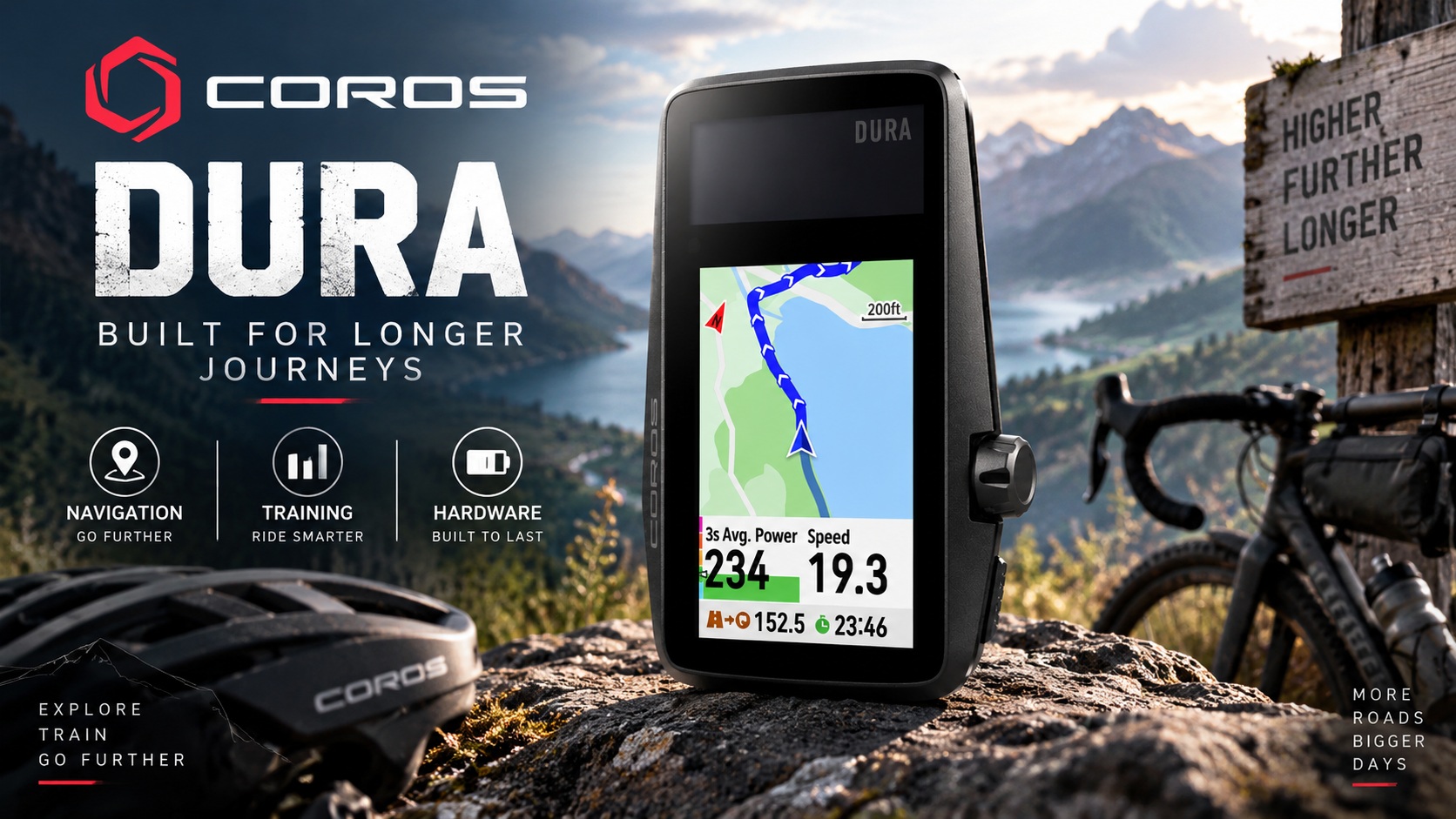
COROS DURA combines 120-hour GPS battery life with solar charging
Cycling computers normally create another battery that riders need to remember to charge.
The COROS DURA takes almost the opposite approach.
COROS rates its first dedicated GPS bike computer for up to 120 hours of riding in its standard all-systems GPS mode, while an integrated solar panel can extend that endurance further when riding in strong sunlight.
Battery life is only part of the story.
DURA combines dual-frequency satellite tracking, global offline maps, turn-by-turn navigation, Google Maps-powered rerouting, structured workouts and support for power meters, heart-rate monitors, cadence sensors, smart trainers and cycling radar.
It also continues to evolve through software.
COROS added Live Tracking during August 2026 and followed that with torque and Total Work measurements in its 31 August firmware release.
That makes DURA particularly interesting in 2026 because the hardware launched in 2024, but the cycling platform surrounding it has continued developing.
COROS DURA lasts up to 120 hours with GPS
The headline COROS DURA specification is its battery life.
COROS currently estimates up to 120 hours in All Systems GPS mode during a standard daytime ride without solar assistance.
That is five continuous days of GPS recording.
The figure changes once navigation, accessories and screen settings become more demanding.
COROS’ updated August 2026 battery documentation estimates approximately 67 hours for a daytime ride using navigation with three connected accessories.
A similar configuration at night with a high screen brightness drops the estimate to 55 hours.
That distinction matters.
The 120-hour figure is genuine manufacturer guidance, but it should not be interpreted as the runtime every cyclist will see regardless of how the device is configured.
IMAGE 1 — place here
Alt text: COROS DURA solar GPS bike computer
Dual-frequency GPS still delivers up to 70 hours
DURA can also use dual-frequency satellite positioning.
This allows it to communicate over two satellite frequencies and is intended to improve positioning in difficult environments such as dense urban areas, mountainous terrain or areas with obstructed sky views.
Dual-frequency mode consumes more energy.
COROS rates a standard daytime ride at up to 70 hours in this mode without solar assistance.
Using navigation and three accessories reduces that estimate to around 49 hours during the day or 42 hours at night with higher backlight use.
Those figures are still substantial for a cycling computer.
More importantly, riders can choose between endurance and higher-positioning precision according to the ride.
Solar charging extends COROS DURA battery life
The black panel above DURA’s display is not decorative.
It contains the solar-charging system.
COROS says that under strong sunlight of at least 75,000 lux, one hour of solar exposure can generate enough energy for up to two additional hours of riding.
That does not mean an hour outside always adds two hours.
Cloud cover, riding direction, tree cover, time of day and the angle of the device relative to the sun all affect solar input.
Nevertheless, the potential is significant for long-distance riders.
A cyclist completing multi-day gravel routes or bikepacking events may be able to reduce how often the computer needs access to a charger.
For ordinary two-hour weekend rides, the benefit is different.
Solar charging could simply make plugging the computer in an infrequent job.
South African sunlight makes the idea particularly interesting
Solar charging is especially relevant in South Africa because outdoor cyclists often train in strong sunshine.
That does not guarantee COROS’ maximum charging rate, because its two-hours-per-hour claim requires sufficiently strong direct light.
However, the basic idea makes sense locally.
A device mounted horizontally and exposed throughout a road, gravel or mountain-bike ride has a better opportunity to collect solar energy than a wearable sitting partly underneath a sleeve.
This is one of the rare consumer products where solar charging is not merely a small emergency feature.
It directly supports the device’s primary activity.
COROS DURA uses a 2.7-inch MIP display
DURA uses a 2.7-inch colour Memory-in-Pixel touchscreen.
MIP technology behaves differently from the bright AMOLED screens increasingly used on sports watches.
Rather than trying to overpower sunlight, a transflective MIP display becomes particularly readable in bright outdoor conditions.
COROS specifically notes that DURA’s screen visibility improves under stronger sunlight.
That makes it well suited to cycling, where the display spends much of its life outdoors.
An adaptive backlight takes over when conditions become darker.
The touchscreen is not the only control
Touchscreens can be useful on a map but less convenient with gloves, rain or rough terrain.
COROS therefore gives DURA a digital dial and separate back button in addition to touch control.
The dial lets riders scroll through screens and menu options using a physical control.
Users can also limit touch operation to maps or keep it active throughout the interface.
That combination makes more sense on a bicycle than relying entirely on touch input.
A road cyclist may happily use the touchscreen during a stop, while a mountain biker wearing gloves can rely on physical controls.
COROS DURA weighs 102g
Despite its large battery claims and solar panel, DURA weighs approximately 102g without the mount.
Its current dimensions are roughly 99.5 × 60.8 × 15.7mm.
The supplied out-front mount adds around 53g and extends approximately 70mm from the centre of the handlebar.
COROS supports 25.4mm and 31.8mm handlebar diameters with the included mounting hardware.
The computer itself carries an IP67 water- and dust-resistance rating.
That is important on a cycling device that may encounter rain, dust, mud and sweat.
IP67 does not make it indestructible, but it provides meaningful environmental protection for normal riding conditions.
Global offline maps are built in
Navigation is another major part of DURA.
COROS provides global landscape and topographic maps that can be downloaded to the device through the COROS app.
Once stored locally, those maps remain available without a mobile-data connection.
That becomes particularly useful during gravel riding, mountain biking or long-distance events where cellular coverage may disappear.
There is a limitation worth understanding.
Street names are not permanently labelled across the map itself.
COROS says street names appear with turn indicators while following navigation.
Therefore, DURA’s mapping is primarily designed around route following rather than functioning like a miniature Google Maps screen showing every street label around the rider.
IMAGE 2 — place here
Alt text: COROS DURA offline cycling navigation map
Turn-by-turn guidance handles planned routes
Routes can be created inside the COROS app.
Cyclists can also bring routes across from services including Strava, Komoot and Ride with GPS.
DURA then provides turn-by-turn directions while following the route.
This makes the device useful for more than training loops.
A rider planning a long gravel route, unfamiliar road ride or bikepacking trip can prepare the route beforehand and keep the phone safely stored.
Offline maps provide the underlying geographic information.
The navigation system then adds route-specific guidance.
Google Maps powers smart rerouting
Going off course does not necessarily mean stopping to rebuild the route manually.
COROS uses Google Maps information for smart rerouting.
When the cyclist deviates from a route, DURA can calculate a route back while taking information such as road conditions, construction and seasonal closures into account.
This requires the connected ecosystem rather than meaning Google Maps itself is stored completely offline inside DURA.
It is therefore useful to distinguish between offline map display and route following, which can work from downloaded data, and features that benefit from connectivity to a smartphone.
Instant navigation can change the destination mid-ride
Cycling plans change.
Weather arrives, a café closes, someone develops a mechanical problem or the rider simply decides to take another route.
COROS allows users to select a destination on the connected phone and quickly send the revised route to DURA.
That is useful because route planning is often easier on a larger smartphone screen, while actual navigation is safer and more convenient on the handlebar-mounted computer.
The two devices therefore perform different parts of the job.
DURA supports road, gravel and mountain biking
COROS has not designed DURA exclusively for road cycling.
Its activity profiles include Road, Gravel and Mountain Bike, along with E-Bike, E-MTB and indoor trainer use.
That broader support matters because navigation needs change significantly between disciplines.
Road riders may spend more time following structured routes and monitoring power.
Gravel riders often combine training data with remote navigation.
Mountain bikers may place greater value on maps and accurate satellite positioning beneath trees or in complex trail systems.
A single computer capable of moving between those bicycles makes more sense than separate devices.
Cycling sensors connect over ANT+ or Bluetooth
The COROS DURA supports both ANT+ and Bluetooth accessories.
Compatible device categories include:
heart-rate monitors, power meters, speed sensors, cadence sensors, indoor trainers, cycling radar, e-bike data and electronic drivetrains.
COROS specifically supports Garmin Varia vehicle radar as well as radar lights from other manufacturers using ANT+.
Electronic drivetrain integration covers Shimano and SRAM systems.
That interoperability is important.
A rider should not have to replace existing sensors simply because the head unit comes from another manufacturer.
Up to 12 Bluetooth devices can connect
COROS lists support for as many as 12 simultaneous Bluetooth accessory connections.
In practice, most riders will use far fewer.
A serious road-training setup might combine heart rate, power, radar and electronic shifting.
An indoor setup could connect DURA directly to a smart trainer.
The important point is that DURA is designed as the central display and recording device for a broader cycling sensor ecosystem.
It is not restricted to measurements generated by the computer itself.
Power meters unlock more serious training data
Pairing a power meter significantly expands DURA’s usefulness for structured cycling training.
Power measures the work the rider produces rather than relying only on speed or heart rate.
DURA can display power data and use it within structured workouts.
COROS also supports an FTP test when DURA is paired with a suitable indoor trainer.
FTP, or Functional Threshold Power, is commonly used to establish cycling training zones.
Rather than riders manually interpreting every number, COROS can then use those zones to structure training intensity.
COROS added torque and Total Work in August 2026
DURA is also a useful example of hardware changing substantially through software.
Firmware V3.1908.0, released on 31 August 2026, added torque and Total Work in kilojoules to cycling activities.
Earlier 2026 updates added media controls and improvements to map road-surface information.
Another August update introduced Live Tracking.
Those additions are important when assessing DURA in 2026.
A review written around the 2024 launch feature set no longer describes everything the computer can do today.
IMAGE 3 — place here
Alt text: COROS DURA cycling training data display
Live Tracking arrived in August 2026
Live Tracking allows riders to share their position and activity statistics with friends or family while riding.
COROS added the feature on 14 August 2026.
That can be particularly useful for solo cyclists.
Someone at home can follow the rider’s progress without repeatedly requesting location updates.
Live Tracking naturally relies on connectivity through the paired smartphone.
Therefore, it should not be confused with standalone satellite communication.
DURA itself is not an emergency satellite messenger.
Crash detection also needs the phone
DURA supports crash-detection safety alerts.
If a crash is detected, the system can notify an emergency contact.
However, COROS explicitly states that the feature requires the cyclist’s phone to remain connected, with the COROS app running in the background.
This is an important practical limitation.
The bike computer can detect the event, but it does not contain its own cellular or satellite communication service for independently sending the alert.
Anyone riding beyond mobile coverage should not treat DURA as a substitute for a dedicated satellite communicator.
Group Tracking helps cyclists stay together
Group Tracking provides another connected safety and convenience feature.
It allows riders using the COROS ecosystem to keep track of one another during a ride.
This is useful for cycling clubs or groups where differences in pace can spread riders across several kilometres.
Rather than repeatedly stopping to phone someone, position information can help show where the rest of the group has gone.
Again, connected features depend on the appropriate phone and network environment.
A bike alarm protects against opportunistic movement
DURA also contains a Bike Alarm.
Once enabled, movement can trigger an audible alarm and generate an alert on the connected smartphone.
The cyclist creates a numerical passcode when activating the feature.
Bringing the connected phone back within range with the COROS app open can also unlock it.
This is useful when stopping briefly at a café or during an event.
However, an electronic alarm is not a substitute for a proper bicycle lock.
It can draw attention to movement but cannot physically prevent someone from taking the bicycle.
Structured workouts run directly on DURA
DURA is also part of COROS’ wider training platform.
Cyclists can build workouts in the COROS app or Training Hub and synchronise them to the bike computer.
During the ride, DURA displays the planned intervals and targets.
This makes the device relevant to cyclists training toward specific performance goals rather than simply recording distance afterwards.
Training plans can also be transferred to the computer.
For coached athletes, COROS Training Hub provides another route for workout planning and feedback.
Training Load adds context to individual sessions
With heart-rate and power information available, DURA can calculate Training Load.
A hard ride and an easy recovery spin should not contribute equally to an athlete’s training picture.
Training Load provides a way to quantify how demanding a session was.
The value increases further for someone already using a COROS sports watch because cycling sessions can sit alongside running, recovery, sleep, stress and other fitness information inside the same ecosystem.
The bike computer therefore becomes part of a larger training history rather than an isolated activity recorder.
There is no mandatory subscription
COROS says its core fitness and training insights do not require a monthly subscription.
That distinction becomes relevant as more fitness platforms place advanced analysis behind recurring memberships.
DURA still relies heavily on the COROS app and cloud ecosystem, but the company does not currently require owners to maintain a paid monthly plan to access the primary training platform.
Long-term buyers should always recognise that software policies can change.
However, as of September 2026, subscription-free access remains part of COROS’ positioning.
DURA integrates with major training platforms
Cyclists are not locked entirely into COROS software.
Supported third-party platforms include Strava, Komoot, TrainingPeaks, Ride with GPS, Final Surge and Relive, with integration varying according to the type of data being transferred.
That matters because endurance athletes often already have years of training history elsewhere.
A cyclist using TrainingPeaks with a coach may want structured workouts.
Another may mainly care about uploading rides to Strava.
A bike computer becomes considerably less useful if it creates a separate ecosystem that refuses to communicate with those services.
Wi-Fi speeds up synchronisation
DURA can connect to Wi-Fi for data synchronisation and firmware updates.
It also synchronises through the COROS smartphone app.
COROS makes particularly strong claims around post-ride upload speed, saying DURA can transfer activity data in seconds regardless of activity duration.
TechnologyBlog has not independently tested that claim.
Nevertheless, Wi-Fi connectivity makes sense for a device capable of recording exceptionally long activities.
A 100-hour bikepacking record is a very different dataset from a 45-minute morning ride.
Internal storage reaches 32GB
Current specifications list 32GB of internal storage.
That space accommodates offline mapping and activity data.
Third-party specification listings based on COROS documentation estimate activity storage at around 1,200 hours of outdoor activities.
Storage is therefore unlikely to be a meaningful limitation for ordinary riders.
Map management matters more because cyclists travelling between distant regions may need to download appropriate offline-map areas through the app.
Charging uses USB-C
Eventually, even a 120-hour solar-assisted bike computer needs external power.
DURA charges through USB-C.
COROS supplies a USB-C charging cable in the box.
The company specifies charging time at roughly 2.5 hours under normal supported temperatures, although colder conditions can extend this.
Using a standard connector is particularly useful for bikepacking.
A rider carrying a phone, power bank or other modern equipment may already have compatible USB-C charging equipment rather than needing a proprietary cable purely for the cycling computer.
The supplied mount includes an anti-theft screw
COROS supplies an out-front handlebar mount with DURA.
The package includes mounting screws, rubber pads and installation tools, including a smaller tool used for the anti-theft screw.
The mount supports conventional 25.4mm and 31.8mm handlebars.
COROS uses a quarter-turn mounting approach, which provides compatibility options beyond the standard supplied mount.
That becomes relevant on aerodynamic integrated cockpits where a conventional round-handlebar clamp cannot be used.
COROS DURA makes most sense for endurance riders
The COROS DURA has obvious appeal for long-distance cycling.
A 120-hour maximum GPS estimate dramatically reduces battery anxiety during bikepacking, ultra-endurance events and multi-day tours.
Solar charging strengthens that advantage.
Gravel riders also gain offline mapping and dual-frequency GNSS for routes that move beyond reliable mobile coverage.
Road cyclists can connect power meters, radar, electronic shifting and structured training.
Mountain bikers get trail navigation and a device designed to withstand dust and rain.
That makes DURA unusually broad despite being COROS’ first dedicated bike computer.
Casual riders may not need everything it offers
The opposite is also true.
Someone who rides an hour around the neighbourhood twice a week may have little need for 120-hour GPS endurance, global maps, FTP testing or power-meter integration.
A smartphone or simpler cycling computer may already provide enough information.
DURA becomes more compelling as riding becomes longer, more structured or more adventurous.
That distinction is useful because exceptional battery life is impressive without automatically making it necessary.
COROS DURA complements sports watches rather than replacing them
TechnologyBlog recently covered the Suunto Race 2, another endurance-focused device with offline mapping, dual-band satellite positioning and support for cycling activities.
The difference in format matters.
A sports watch remains on the wrist and tracks activity, recovery and everyday metrics.
DURA sits directly in the cyclist’s field of view and can dedicate its entire interface to navigation and ride data.
Readers interested in broader endurance technology can read our Suunto coverage for context.
TechnologyBlog has also covered the Fitbit Charge 6, which approaches fitness from a much more compact everyday-tracker perspective.
These products are not direct alternatives. They show how specialised fitness technology has become for different types of users.
South African availability needs confirmation
COROS maintains regional stores for several international markets, but TechnologyBlog could not confirm an official dedicated South African COROS storefront or local DURA product page at the time of publication.
Third-party import listings exist in South Africa.
However, the presence of an importer does not automatically establish official COROS distribution, local warranty processing or authorised support.
South African buyers should therefore confirm the seller, warranty route and after-sales arrangements before ordering.
South African pricing is deliberately not included in this article.
Is the COROS DURA worth considering in 2026?
The COROS DURA stands out because its biggest advantage is easy to understand.
Battery life can reach 120 hours before solar charging is considered.
That changes how often a cyclist has to think about power.
However, DURA would be far less interesting if endurance were its only strength.
It also offers a sunlight-friendly touchscreen, physical controls, offline maps, turn-by-turn navigation, smart rerouting, dual-frequency satellite positioning, ANT+ and Bluetooth connectivity and a substantial structured-training platform.
More importantly, COROS has continued improving it.
Live Tracking, road-surface improvements, media controls and the latest torque and Total Work metrics show that DURA in September 2026 is more capable than the product COROS launched in June 2024.
Its main South African weakness is not technical.
It is the uncertainty around official local distribution and support.
For riders comfortable resolving that before buying, DURA offers one of the more unusual propositions in cycling technology: a GPS computer whose battery may last considerably longer than the rider does.
COROS DURA specifications
| Specification | COROS DURA |
|---|---|
| Product type | Solar GPS bike computer |
| Display | 2.7-inch colour MIP touchscreen |
| Resolution | 400 × 240 |
| Controls | Touchscreen, digital dial, back button |
| Weight | Approx. 102g |
| Dimensions | Approx. 99.5 × 60.8 × 15.7mm |
| Water/dust resistance | IP67 |
| GPS | All-systems GNSS |
| Dual-frequency GNSS | Yes, L1 + L5 |
| Standard GPS battery | Up to 120 hours |
| Dual-frequency battery | Up to 70 hours |
| Navigation + accessories | Approx. 67 hours daytime in All Systems mode |
| Solar charging | Up to 2 hours additional ride time per hour in sufficiently strong sunlight |
| Offline maps | Global landscape and topographic maps |
| Turn-by-turn navigation | Yes |
| Smart rerouting | Yes, Google Maps-powered |
| Bluetooth | Yes |
| ANT+ | Yes |
| Wi-Fi | Yes |
| External sensor support | Yes |
| Power meters | Yes |
| Heart-rate monitors | Yes |
| Speed/cadence sensors | Yes |
| Smart trainers | Yes |
| Cycling radar | Yes |
| Shimano/SRAM electronic shifting | Yes |
| E-bike data | Yes |
| Safety alerts/crash detection | Yes, connected phone required |
| Live Tracking | Yes |
| Group Tracking | Yes |
| Bike Alarm | Yes |
| Structured workouts | Yes |
| FTP testing | Yes, compatible trainer required |
| Internal storage | 32GB |
| Charging | USB-C |
| Included mount | Out-front mount |
| Supported handlebar sizes | 25.4mm / 31.8mm |
| Current firmware activity | Updated August 2026 |
| Confirmed official SA storefront | Not found at publication |