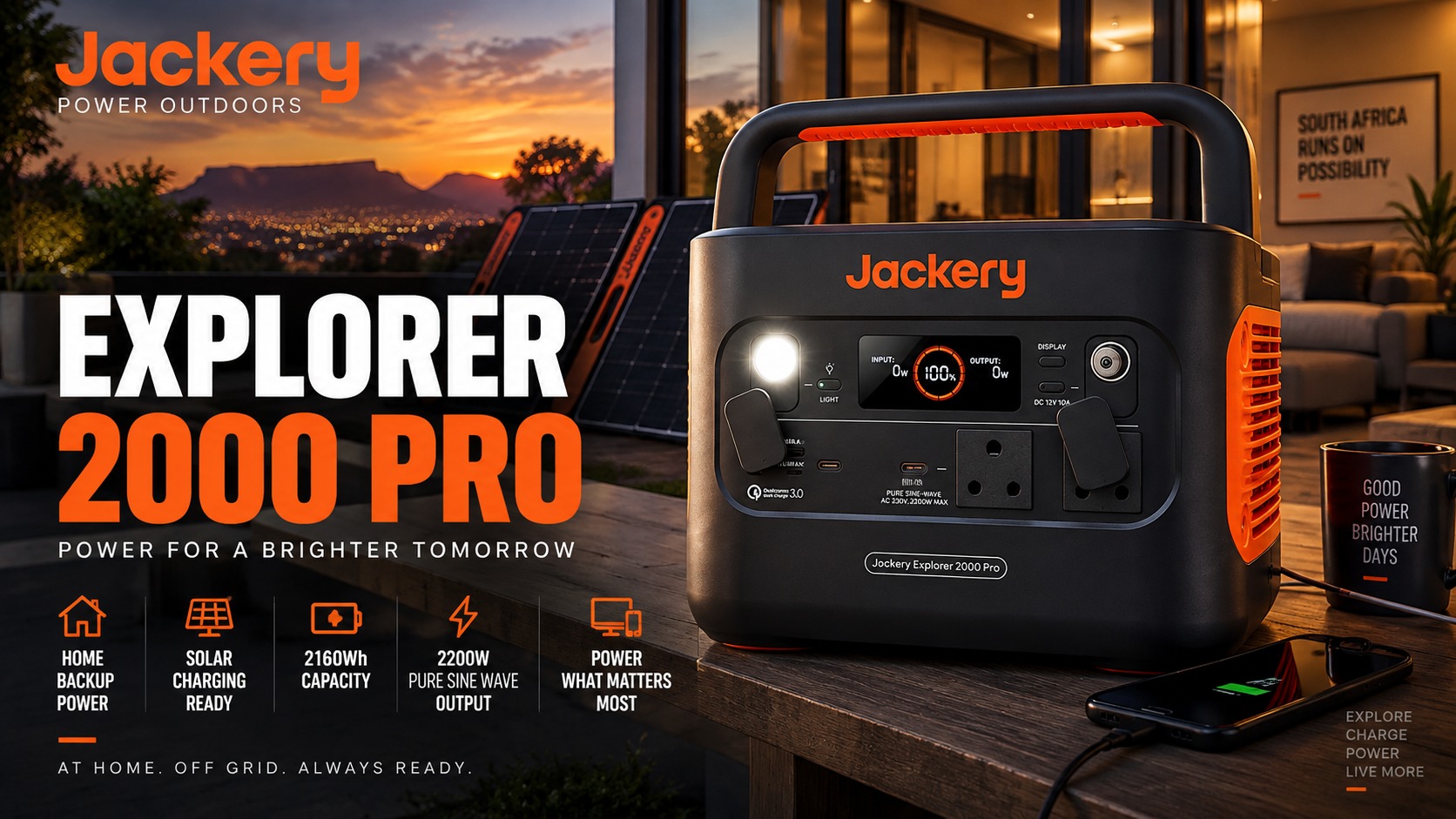
Jackery Explorer 2000 Pro brings 2.16kWh backup power to South African homes
Portable power stations start becoming considerably more interesting when they can move beyond charging laptops, routers and phones.
The Jackery Explorer 2000 Pro makes that jump.
It combines a 2,160Wh lithium-ion battery with a 2,200W pure sine-wave inverter and 4,400W surge capability. Jackery also gives it fast AC charging, substantial solar input and a South African 230V configuration.
At 19.5kg, this is still a portable power station rather than a permanently installed home battery. However, its capacity and output put refrigerators, televisions, computers and selected kitchen appliances within reach during an outage.
That makes the Explorer 2000 Pro interesting for two very different uses: home backup and portable off-grid power.
Jackery Explorer 2000 Pro stores 2,160Wh
The starting point is its 2,160Wh battery capacity.
Battery capacity and inverter output describe two different things.
The 2,160Wh figure tells us how much energy the battery stores, while the 2,200W inverter rating tells us how much AC power the system can deliver continuously.
That distinction matters when estimating what the Explorer can actually do.
A relatively low-powered appliance may run for many hours. A high-powered appliance can consume the same stored energy much faster.
Jackery provides a rough runtime formula based on approximately 85% usable conversion efficiency:
Runtime ≈ 2,160Wh × 0.85 ÷ appliance power
Using that formula, a constant 100W load would theoretically run for roughly 18 hours.
Real-world results can vary because appliances do not always consume a constant amount of electricity and conversion losses change with operating conditions.
The 2,200W inverter opens the door to larger appliances
The 2,200W continuous pure sine-wave inverter is arguably as important as the battery capacity.
Jackery rates the South African Explorer 2000 Pro for 4,400W surge output.
That gives the system enough inverter capacity for considerably more than electronics.
Jackery lists refrigerators, microwaves, kettles, toasters, hairdryers, coffee machines, televisions, blenders and electric grills among the types of equipment that can potentially operate from the unit.
There is an important qualification.
The total continuous load still needs to remain within 2,200W.
A 2,000W kettle may work by itself, for example, but adding several other substantial loads at the same time could push the system beyond its rated output.
Jackery says the AC output shuts down if connected equipment exceeds the 2,200W limit.
Pure sine-wave output matters for electronics
Jackery uses a pure sine-wave inverter for the AC outputs.
That makes the Explorer suitable for a much broader selection of modern electronics than the rough output produced by some inexpensive inverter systems.
Computers, televisions, chargers and other electronically controlled devices can all form part of a backup setup, provided their total demand remains within the power station’s limits.
TechnologyBlog has not independently analysed the Explorer 2000 Pro’s AC waveform or voltage regulation under load, so we would not make laboratory-style power-quality claims.
The important confirmed specification is that Jackery identifies the inverter as pure sine wave.
The South African model outputs 230V at 50Hz
Regional electrical specifications matter enormously with portable power equipment.
The South African Explorer 2000 Pro operates at 230V AC and 50Hz and provides two AC outputs. Its local product page specifically identifies the unit as using a South African three-prong plug configuration.
That makes this very different from importing a 110V US-market power station because the product is configured for the local electrical environment.
Jackery South Africa also lists NRCS and SANS IEC 60950 certification information for the product.
Fast charging is one of the Explorer 2000 Pro’s strongest features
A large battery is less useful when it takes most of a day to recharge.
Jackery specifies approximately 1.8 hours for a full recharge from an AC wall outlet.
That becomes particularly useful when grid availability is unpredictable.
If electricity returns for a relatively short period, fast charging gives the Explorer an opportunity to replenish a substantial amount of energy before the next interruption.
It also changes how practical the unit becomes for travel.
An overnight stop is not necessarily required simply to recharge the battery from mains power.
Solar input reaches up to 1,400W
The Explorer 2000 Pro also contains two MPPT solar charge controllers and supports up to 1,400W of solar input.
That is substantial for a portable system.
Jackery says six compatible 200W panels can recharge the battery in around 2.5 hours under suitable solar conditions.
Using two 200W panels increases the manufacturer’s quoted charging time to approximately 7.5 hours.
Those times should be treated as idealised manufacturer figures.
Actual solar production depends on panel orientation, temperature, cloud cover, shading and the amount of usable sunlight available during the day.
A solar panel carrying a 200W rating does not continuously produce 200W from sunrise to sunset.
Solar turns it into more than an emergency battery
The ability to add substantial solar generation changes the Explorer’s role.
Without panels, it is essentially a large rechargeable battery that eventually needs mains or vehicle power.
Add enough solar capacity and the system can replenish itself away from the grid.
That is useful for camping and overlanding, but it also has a South African backup-power application.
During an extended outage, solar can put energy back into the battery during the day instead of forcing the household to wait for mains electricity to return.
The result is not equivalent to a permanently installed solar system with large rooftop arrays and fixed battery storage.
It is a portable alternative that can be deployed where needed.
UPS functionality adds another home-backup option
Jackery South Africa specifically advertises UPS functionality on the Explorer 2000 Pro.
Compatible devices can remain connected to the power station while the Jackery itself receives mains electricity.
Under normal conditions, the unit bypasses its battery and allows mains electricity to power the connected equipment.
If grid electricity disappears, the Explorer switches to battery power. When mains supply returns, it moves back to bypass operation.
That can make the system more convenient for equipment that users do not want to reconnect manually every time an outage starts.
It is worth stressing that this feature applies specifically to the Explorer 2000 Pro covered here.
Some older Jackery South Africa Explorer product pages explicitly warn against using those models as a UPS, so the capability should not automatically be assumed across the entire Explorer family.
Fibre, computers and entertainment are relatively easy loads
A 2,200W inverter gives the Explorer plenty of headroom for lower-powered electronics.
A fibre ONT, Wi-Fi router, laptop, monitor and television collectively consume far less power than a kettle or heater in most circumstances.
That makes home-office equipment one of the more sensible applications for a power station of this capacity.
Instead of spending most of the stored energy producing heat, the battery can support relatively efficient electronic equipment for much longer.
The exact runtime will depend on the combined measured load.
Heating appliances can drain the battery quickly
The ability to run an appliance does not mean running it for long periods makes sense.
This is especially important with resistive heating.
Kettles, heaters, hairdryers and similar appliances can consume well over 1,000W.
The Explorer’s inverter may be capable of supplying them, but the 2,160Wh battery still represents a finite energy reserve.
A high-power appliance used briefly may be perfectly reasonable.
A high-power heater running continuously can consume the available battery much more quickly.
For backup-power planning, capacity management is just as important as maximum inverter output.
Two 100W USB-C ports can power laptops directly
Not every device needs to use an AC outlet.
The Explorer 2000 Pro includes two USB-C ports rated at up to 100W each.
That makes direct USB-C charging practical for compatible laptops, tablets, phones and other USB Power Delivery devices.
Direct DC charging can also avoid the unnecessary step of converting battery power into AC only for a laptop charger to convert it back into DC.
Alongside the USB-C ports are two USB-A Quick Charge 3.0 outputs rated at up to 18W.
There is also a 12V car output
Jackery includes a 12V, 10A DC car-style output.
That broadens the Explorer’s usefulness for camping and overlanding equipment designed around automotive 12V power.
Portable fridges are an obvious example.
Again, users need to check the actual requirements of the connected equipment rather than relying solely on the type of connector.
The presence of a compatible plug does not override the electrical limits of the output.
The LCD shows what the system is doing
A large battery becomes much easier to manage when users can see energy moving in and out of it.
Jackery’s LCD displays battery status alongside charging and discharge information.
That allows users to see how much power connected equipment is drawing and monitor remaining battery capacity.
This becomes particularly useful when experimenting with household loads.
Instead of guessing how much electricity a combination of devices consumes, the user can observe the Explorer’s output while those devices operate.
The battery uses lithium-ion cells
The Explorer 2000 Pro uses lithium-ion battery chemistry rather than the newer lithium iron phosphate chemistry increasingly found in current-generation portable power stations.
Jackery rates the battery for at least 1,000 full cycles before reaching approximately 80% of its original capacity.
That does not mean the battery suddenly stops working after its thousandth cycle.
Battery-cycle ratings describe gradual degradation.
Reaching 80% means the battery retains roughly four-fifths of its original storage capacity under the manufacturer’s test criteria.
For occasional backup and outdoor use, 1,000 cycles can represent a substantial service period.
However, users expecting very frequent daily cycling should consider cycle life alongside capacity and inverter output when evaluating any portable power station.
The battery management system adds protection
Jackery equips the Explorer 2000 Pro with a battery management system, or BMS.
The South African product documentation lists protection against conditions including overvoltage, short circuits, high and low temperatures, overcharging and excessive discharge.
These systems monitor the battery and can intervene when operating conditions move outside acceptable limits.
They are an important part of modern lithium battery design.
They do not remove the need to follow charging, storage and operating instructions.
At 19.5kg, portable does not mean lightweight
Jackery places considerable emphasis on portability.
The Explorer 2000 Pro weighs 19.5kg and measures approximately 38 × 27 × 31cm according to the South African listing.
That is compact for more than 2kWh of portable storage, but 19.5kg remains substantial.
The integrated carrying handle makes it possible to move between a house, vehicle and campsite.
It is less suited to being casually carried over long distances.
The distinction is important: this is transportable backup power rather than a battery pack intended for a backpack.
Jackery has designed it for outdoor use as well
The Explorer range has strong roots in camping and outdoor power.
Jackery says the 2000 Pro can continue operating after being dropped from one metre up to three times under its stated shock-resistance testing.
That is a manufacturer durability claim rather than something TechnologyBlog has independently tested.
Nevertheless, the combination of an integrated handle, 19.5kg weight, solar charging and 12V output makes the outdoor positioning understandable.
It can move from household backup duty to a vehicle-based camping setup without requiring a separate power system for each role.
Battery power avoids generator exhaust
A portable battery station also differs fundamentally from a petrol generator.
There is no combustion engine while the Explorer supplies electricity.
That means no petrol needs to be burned at the point of use and no carbon-monoxide exhaust is produced by the power station itself.
This allows the battery unit to operate indoors in situations where a combustion generator cannot safely do so.
Cooling fans may still operate under appropriate conditions, but Jackery describes the unit as designed for quiet operation.
TechnologyBlog has not independently measured its noise level, so we would avoid attaching an unsupported decibel figure.
The Explorer 2000 Pro and a generator solve different problems
This becomes particularly interesting after our recent look at the EcoFlow Smart Generator.
A generator creates electricity as long as it has fuel.
The Jackery stores electricity generated elsewhere.
That means each technology has different strengths.
A battery provides quiet indoor backup with no local exhaust. A generator can keep producing electricity during a prolonged outage as long as fuel remains available.
Solar gives a portable battery another source of energy without requiring petrol.
For many households, the more useful question is therefore not whether batteries or generators are universally better.
It is which combination of energy sources best fits the duration and type of outages they need to handle.
The South African version matters
Jackery says its portable power stations have been available in South Africa since 2020 through its local operation and retail partners.
The company lists local support in Cape Town and Johannesburg.
That is relevant because high-capacity portable power stations are not products where regional specifications should be ignored.
The local Explorer 2000 Pro uses 230V output and South African connections, and Jackery South Africa lists a two-year warranty for the unit.
Local support can also matter if a battery system develops a fault several years into ownership.
Current availability needs checking
There is one caveat for buyers considering this exact model.
At the time of publication, Jackery South Africa’s individual Explorer 2000 Pro page listed the product as out of stock.
The model remains present in Jackery South Africa’s portable-power catalogue and shop listings, so this appears to be a stock-status issue rather than evidence that the product has disappeared from the local range.
Availability can change quickly, so buyers should check current stock directly rather than relying on an article’s publication-day status.
Who is the Jackery Explorer 2000 Pro for?
The Jackery Explorer 2000 Pro makes the strongest case for households and outdoor users who need substantially more power than a small portable battery can provide but still want something transportable.
Its 2,160Wh battery provides meaningful energy storage.
The 2,200W inverter allows it to operate a broad selection of appliances.
Fast AC charging makes it easier to recover between outages, while up to 1,400W of solar input gives users another way to replenish the battery when grid electricity is unavailable.
For home use, the UPS functionality adds another layer of convenience.
For camping and overlanding, the same battery can support refrigeration, electronics and other equipment without requiring a running combustion engine.
Is the Jackery Explorer 2000 Pro worth considering?
The Jackery Explorer 2000 Pro sits at the point where a portable power station starts behaving like a serious backup-energy system.
Its 2,160Wh capacity is large enough to support more than basic electronics, while the 2,200W pure sine-wave inverter means users are not restricted to tiny loads.
The ability to recharge from an AC outlet in approximately 1.8 hours is particularly valuable when grid availability is limited.
Solar support up to 1,400W adds genuine off-grid potential, while the South African model’s UPS functionality makes the unit easier to integrate into a home-office or entertainment setup.
There are trade-offs.
At 19.5kg, portable does not mean light. Its lithium-ion battery is rated for 1,000 cycles to 80% capacity rather than the substantially higher cycle figures now associated with some newer LiFePO4 systems.
And, at the time of writing, the exact model is out of stock on Jackery South Africa’s individual product page.
Even so, the Explorer 2000 Pro demonstrates how far portable power stations have moved beyond oversized power banks.
For a South African household that wants backup power without installing a permanent battery system — or an outdoor user who wants more than a small camping battery can provide — 2.16kWh of storage and a 2.2kW inverter create a genuinely useful amount of portable electricity.
Jackery Explorer 2000 Pro specifications
| Specification | Jackery Explorer 2000 Pro |
|---|---|
| Model | JE-2000A |
| Battery capacity | 2,160Wh |
| Battery chemistry | Lithium-ion |
| Battery configuration | 50Ah / 43.2V |
| Battery cycle rating | 1,000 cycles to 80%+ capacity |
| AC output | 2 × 230V |
| Continuous AC output | 2,200W |
| Surge output | 4,400W |
| Inverter | Pure sine wave |
| USB-A | 2 × Quick Charge 3.0, 18W max |
| USB-C | 2 × 100W max |
| 12V output | 12V / 10A |
| AC recharge time | Approx. 1.8 hours |
| Maximum solar input | 1,400W |
| Solar controllers | Dual MPPT |
| 6 × 200W solar recharge | Approx. 2.5 hours under suitable conditions |
| 2 × 200W solar recharge | Approx. 7.5 hours under suitable conditions |
| Car charging | Approx. 12–24 hours |
| UPS functionality | Yes, according to Jackery SA |
| Display | LCD |
| Weight | 19.5kg |
| Dimensions | Approx. 38 × 27 × 31cm |
| Discharge temperature | -10°C to 40°C |
| Charging temperature | 0°C to 40°C |
| Warranty | 2 years |
| SA configuration | 230V / 50Hz, South African plug configuration |