APC History: The 1984 UPS Pivot That Defined Its Power-Protection Business
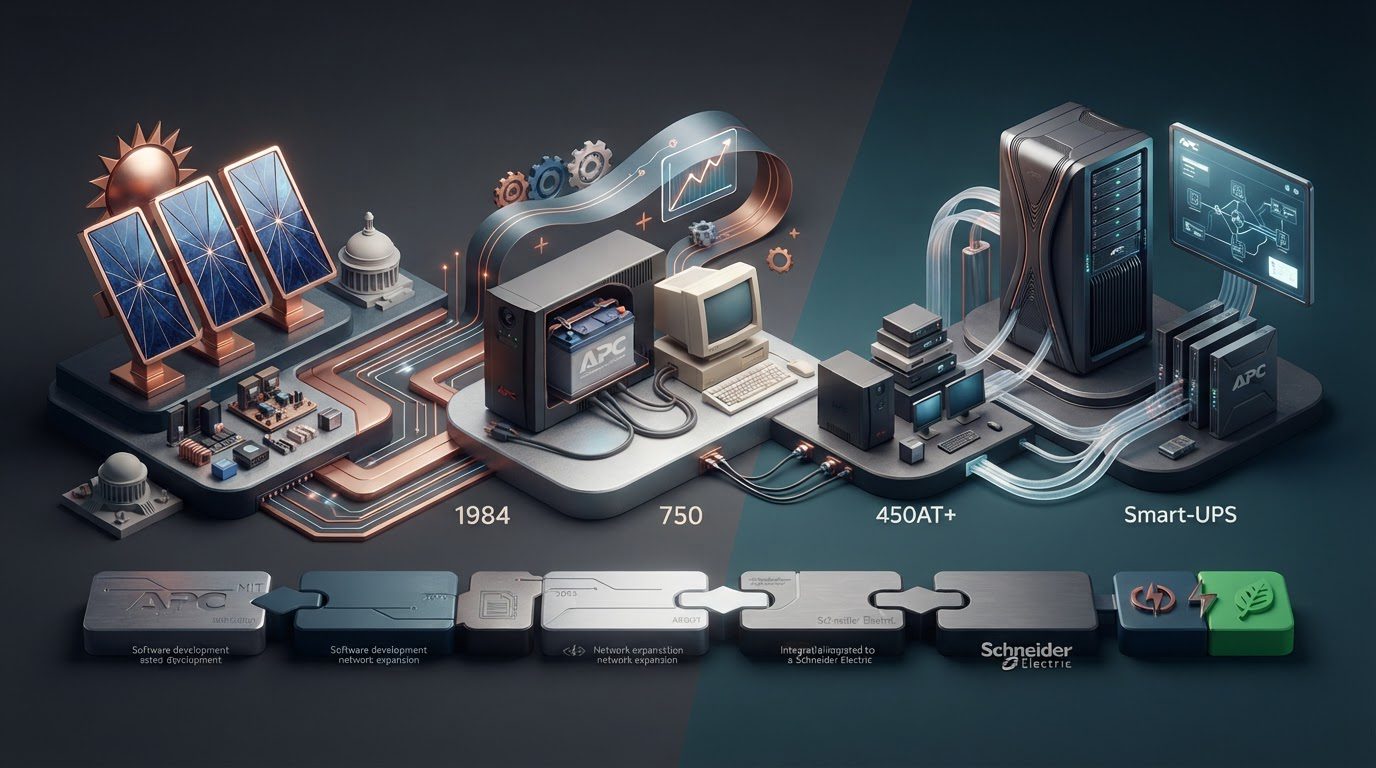
American Power Conversion was founded in 1981 by three MIT engineers, but the company did not begin with the UPS products that later defined the APC name. Schneider Electric’s history says the founders initially focused on solar energy. The decisive change came in 1984, when APC pivoted toward power protection for personal computers and introduced its first uninterruptible power supply.
That original UPS, the APC 750, used a lead-acid battery to protect PCs, local-area networks and workstations from power interruptions and surges. Schneider Electric notes that the product was expensive to develop and did not sell as well as hoped. The response was more important than the disappointment: APC quickly developed a smaller and cheaper 450AT+ design, showing that the company’s early success depended on making backup power practical for the rapidly expanding PC market.
The 1984 UPS Pivot That Defined Its Power-Protection Business
Software became part of the value proposition in 1989 with PowerChute, while the Smart-UPS line followed in 1990. Those products helped move UPS equipment from being a simple battery box toward managed infrastructure that could communicate power conditions and shut systems down safely. As networks and servers became business-critical, the cost of an outage made that management layer increasingly valuable.
APC later expanded into racks, cooling, monitoring and data-centre infrastructure. The company acquired NetBotz in 2005, and Schneider Electric acquired APC in 2007, combining it with MGE’s three-phase UPS business. The acquisition changed ownership but did not erase the APC brand, which remains a major part of Schneider Electric’s secure-power portfolio.
APC today
APC remains a Schneider Electric secure-power brand. Its range spans battery backup, Smart-UPS systems, racks, monitoring and infrastructure used to keep IT equipment operating through power disturbances.
The central thread in APC’s history is the shift from protecting one computer to protecting digital infrastructure. The 1984 UPS addressed a PC-era problem; Smart-UPS, PowerChute and later data-centre systems extended the same requirement across networks and server rooms. That makes APC’s first unsuccessful UPS especially revealing: it established the problem the company would spend decades solving, even though the first implementation needed to be reworked before the market responded.