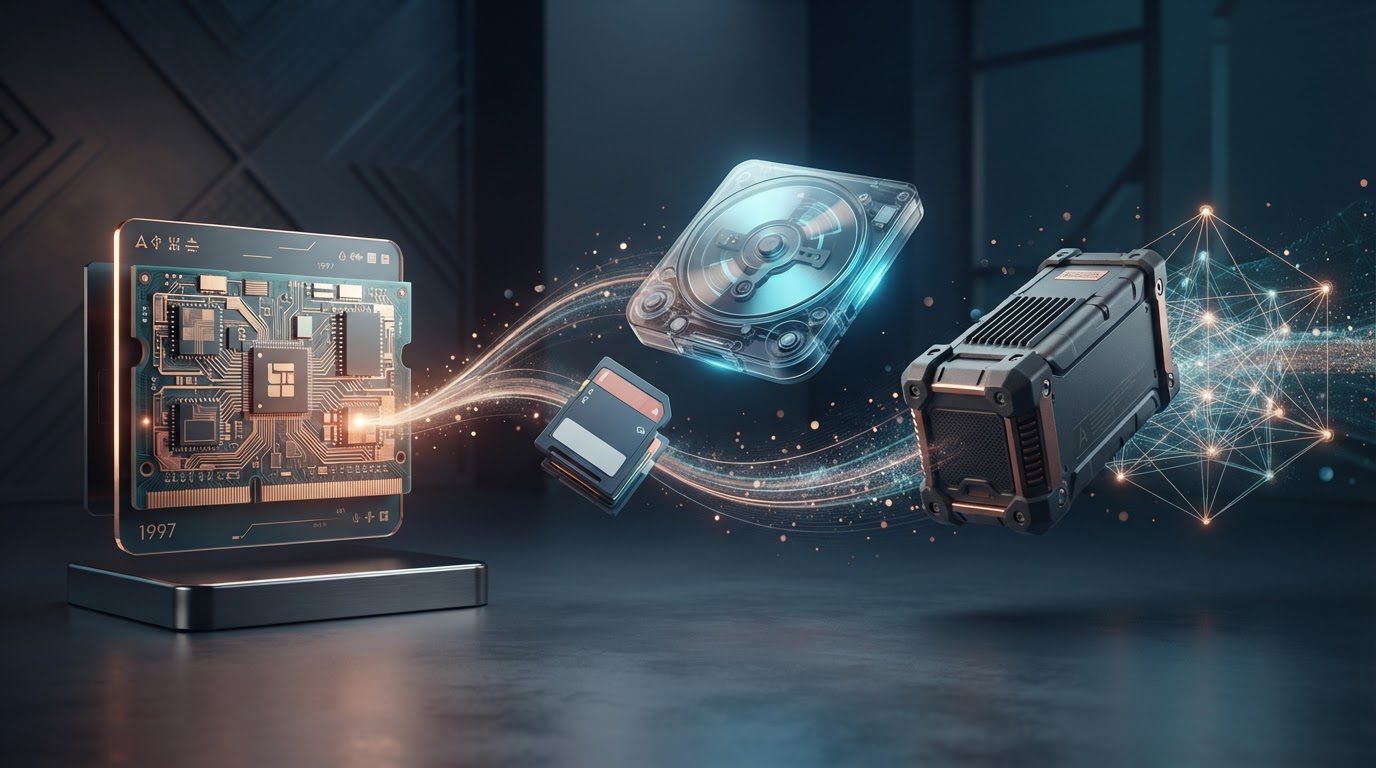
Apacer History: From a 1997 Memory-Module Maker to Industrial and Flash Storage
Apacer’s corporate records give its history an unusually specific starting point. The company was founded on 16 April 1997 in Taipei as BizAnchor Service Network Inc., with investment connected to the Acer Group, and initially operated as a professional manufacturer of memory modules. It adopted the Apacer Technology name a few months later. That sequence distinguishes the legal company origin from the consumer brand name that followed.
Memory modules were the initial business, and Apacer moved quickly to build international operations. A US subsidiary was established in 1997 and a European operation followed in 1998. The company’s milestone record also shows early work on Intel PC100-compliant DRAM and RIMM products, indicating how closely its first years were tied to PC memory standards rather than to the broad storage catalogue it carries today.
From a 1997 Memory-Module Maker to Industrial and Flash Storage
Flash memory widened the business at the end of the 1990s. Apacer introduced a flash-memory product line in 1999 and formed partnerships as it moved into newer storage formats. In 2000 it worked with IBM on DDR memory-module enablement, while industrial-grade memory arrived in the following years. These changes gave Apacer access to markets where long-term availability and validation could matter more than retail branding.
A more visible consumer-storage milestone came in 2003, when Apacer introduced the Disc Steno CP100 portable CD recorder, which the company described as a world-first product. That wording comes from Apacer rather than an independent industry record, while the same period clearly marked expansion into flash-based multimedia products.
Apacer today
Apacer remains a Taiwan-listed memory and storage company, combining consumer products with industrial and embedded memory for long-lifecycle commercial systems.
Apacer today spans consumer storage, industrial memory and embedded applications, but its evolution remains close to the semiconductor-memory expertise of 1997. The important change was not a leap from one unrelated category to another; it was the widening of memory from PC modules into flash, industrial storage and specialised data products. The legal-name change, early international expansion and movement into flash are therefore more informative milestones than a generic claim that the company simply “grew its portfolio”.