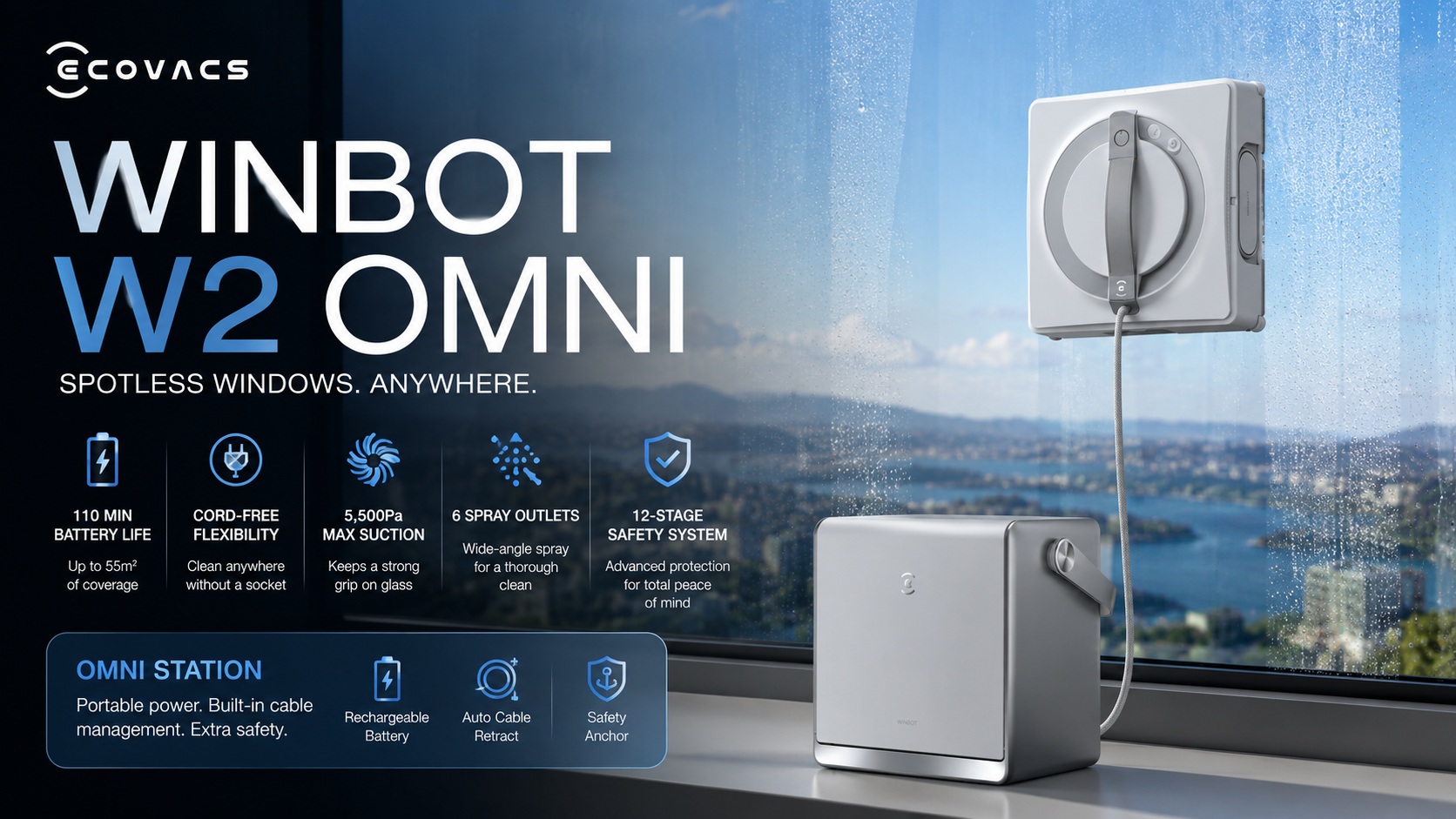
ECOVACS WINBOT W2 OMNI automates difficult window cleaning
The ECOVACS WINBOT W2 OMNI is a robotic window cleaner designed to clean large, high and difficult-to-reach glass surfaces. It combines 5,500Pa maximum suction, WIN-SLAM 4.0 navigation, automated water spraying and a portable battery-powered OMNI Station that allows the robot to operate without a nearby wall socket.
Cleaning floors with a robot is now fairly common. However, cleaning the outside of a large window several metres above the ground presents a very different problem.
ECOVACS approaches that job by attaching the WINBOT directly to flat glass. The robot sprays cleaning solution, moves across the surface and uses electronically planned routes to cover the available area.
Its most important feature, though, may be the portable OMNI Station.
The station combines a rechargeable battery, controls, cable management and additional fall protection. As a result, the system can clean windows where running an extension cable to a nearby socket would be inconvenient.
ECOVACS WINBOT W2 OMNI can work away from a wall socket
Many robotic window cleaners depend on continuous mains electricity.
The ECOVACS WINBOT W2 OMNI takes a different approach because its station includes a rechargeable lithium battery. ECOVACS states that a full charge provides approximately 110 minutes of operation and can cover around 55m² of glass under its test conditions.
That flexibility could prove useful for large sliding doors, floor-to-ceiling windows and exterior glass where an electrical socket is not conveniently positioned.
It does not make the system completely cordless, though.
A combined power and safety cable still connects the robot to the OMNI Station. Instead, the advantage is that the station itself does not need permanent mains power during every cleaning session.
Readers can find the complete technical information on the official ECOVACS South Africa WINBOT W2 OMNI product page.
The OMNI Station handles power, controls and safety
ECOVACS designed the station to perform several tasks rather than simply charging the robot.
It combines battery power, physical controls, automatic cable management, safety anchoring and storage in one portable unit.
The control panel provides access to functions such as power, start and pause, cleaning-mode selection, return-to-start and suction-cup release.
Therefore, owners do not need to reach for the ECOVACS HOME app whenever they want to perform a basic task.
Automatic cable retraction also keeps the compound power and safety cable organised after cleaning.
WIN-SLAM 4.0 plans the cleaning route
The ECOVACS WINBOT W2 OMNI uses WIN-SLAM 4.0 to plan how it moves across a window.
ECOVACS says the system improves route planning, turning and edge detection. In addition, the company claims that its newer brushless motor and WIN-SLAM 4.0 increase cleaning efficiency by 30% compared with its previous approach.
That figure comes from ECOVACS testing rather than an independent TechnologyBlog test.
Instead of wandering randomly across the glass, the robot identifies the available cleaning area and follows a planned route.
After finishing its work, the WINBOT can also return to its original starting position.
Five cleaning modes target different jobs
The W2 OMNI supports five cleaning modes:
- Fast Cleaning
- Deep Cleaning
- Thorough Cleaning
- Edge Cleaning
- Spot Cleaning
Each mode targets a different situation.
For example, Fast Cleaning makes sense for routine maintenance. Meanwhile, Spot Cleaning concentrates on a smaller area where more attention is required.
Edge Cleaning specifically targets the perimeter of the glass.
That matters because window edges can be difficult for an automated cleaner to cover effectively.
Users can select the modes through either the ECOVACS HOME app or the OMNI Station controls.
Six spray outlets apply the cleaning solution
The ECOVACS WINBOT W2 OMNI uses a wide-angle spray system to wet the glass ahead of its cleaning pad.
ECOVACS describes the hardware as three spray nozzles on each side of the robot, resulting in six spray outlets overall.
The integrated tank holds approximately 60ml of cleaning liquid.
In addition, the robot can adjust the spray and warn the owner when the tank becomes empty.
ECOVACS states that a full tank can provide approximately 30m² of accumulated spray coverage when using Fast Mode.
A washable microfibre pad then wipes the dampened surface.
Maximum suction reaches 5,500Pa
Cleaning vertically creates an obvious challenge: the robot needs to remain attached to the window.
ECOVACS specifies approximately 2,800Pa of suction while the robot is moving and up to 5,500Pa maximum suction.
That suction serves two purposes.
First, it keeps the WINBOT attached to the glass. Secondly, it creates pressure between the cleaning pad and the surface.
However, suction is not the only safety measure.
ECOVACS also uses sensors, physical tethering and the OMNI Station to provide additional protection if something goes wrong.
ECOVACS WINBOT W2 OMNI uses several fall-protection systems
Safety matters considerably more for a window robot than it does for a conventional robot vacuum.
A vacuum reaching the edge of a lounge floor normally has nowhere dangerous to fall. A window cleaner operating several metres above the ground presents a much more serious risk.
Consequently, ECOVACS uses several layers of protection.
The company’s broader W2 OMNI documentation describes a 12-stage protection system comprising eight hardware protections, three intelligent protections and an additional accidental-protection layer where applicable.
The South African product page contains inconsistent wording in this area, referring to different protection counts in different sections. However, ECOVACS’ wider documentation consistently supports the 12-stage description.
Among those measures are pressure monitoring, edge detection, suction monitoring and physical tethering.
Sensors detect the edge of the glass
The WINBOT uses a gravity-acceleration sensor to monitor its position and optocoupler sensors to detect window edges.
ECOVACS claims an edge-detection response of approximately 0.2 seconds.
That becomes particularly important when cleaning frameless windows.
Without a physical frame to stop it, the robot needs to recognise the edge and change direction before moving beyond the glass.
According to ECOVACS, the W2 OMNI can therefore operate on both framed and frameless flat windows.
The OMNI Station provides a physical safety anchor
The portable station also forms part of the safety system.
Depending on the regional specification, ECOVACS lists the OMNI Station at roughly 5.2kg to 5.5kg.
Its base uses suction to help anchor the station, while a separate safety rope provides another physical connection.
Furthermore, the compound cable combines power delivery and safety tethering.
Should the robot lose its grip, these additional measures are intended to prevent it from simply falling away from the building.
Owners still need to install and secure the system correctly.
Even a sophisticated safety system cannot compensate for ignoring the manufacturer’s operating instructions.
It can remain attached during a power interruption
ECOVACS also includes power-loss protection.
The company states that the WINBOT can remain attached to the glass for more than 30 minutes after power becomes critically low or is interrupted.
That does not mean users should leave the robot unattended during a power problem.
Instead, the system provides additional time to retrieve it safely rather than immediately losing suction.
For South African homes, the OMNI Station’s battery also reduces dependence on uninterrupted mains electricity during a cleaning session.
TechnologyBlog has previously looked at how electricity requirements can affect other connected household products, including LG’s large-capacity ThinQ washing machine.
The power adapter supports South African electricity
The ECOVACS South Africa specification lists an adapter input range of 90–264V AC at 47–63Hz.
That includes South Africa’s nominal 230V/50Hz electricity supply.
Consequently, the underlying electrical specification does not create the voltage problem often associated with importing appliances designed exclusively for 110V markets.
Because ECOVACS officially distributes products in South Africa, owners should still use the supplied local adapter and power cable rather than substitute an unrelated charger.
The ECOVACS HOME app adds another control option
The ECOVACS WINBOT W2 OMNI also works with the ECOVACS HOME app.
Users can select cleaning modes, trigger manual spraying and control the robot’s movement across the glass.
ECOVACS describes the manual movement control as omnidirectional rather than restricting users to four basic directions.
In addition, the W2 OMNI supports over-the-air software updates.
That allows ECOVACS to deliver compatible firmware changes after purchase.
It works on several types of flat glass
ECOVACS markets the W2 OMNI for several window configurations, including:
- Floor-to-ceiling windows
- Smaller windows
- Framed windows
- Frameless windows
- Tilted windows
The important limitation is that ECOVACS specifies flat glass.
Therefore, prospective owners should not assume that the WINBOT can negotiate curved glazing, heavily textured surfaces or every unusual architectural window design.
Official technical specifications list the minimum supported window size at approximately 30 × 40cm.
Sensors help detect frames and obstacles
ECOVACS lists a minimum detectable window-frame height of approximately 4mm.
Meanwhile, its technical specifications give a minimum detectable obstacle height of approximately 2mm.
These sensors help the robot recognise smaller features rather than simply continuing forward until something physically blocks it.
However, owners with unusual window designs should still check ECOVACS’ operating instructions before use.
Do not use the WINBOT in the rain
The W2 OMNI can clean exterior glass, but that does not mean it should operate in every weather condition.
ECOVACS advises against using robotic window cleaners in the rain.
Excess water can affect suction and sensor performance while also making streaking more likely.
Therefore, exterior window cleaning should take place during suitable dry conditions.
That advice becomes even more important when using the machine on upper-storey windows.
Automation can reduce the amount of manual work required, but it does not remove the need for sensible operating conditions.
Operating noise varies by mode and test conditions
ECOVACS’ South African marketing material says operating noise can fall to approximately 63dB.
However, another official ECOVACS specification lists noise at 72 ±2dB.
Those figures may come from different operating modes or measurement conditions. Unfortunately, the available documentation does not provide enough information to make a direct comparison.
TechnologyBlog would therefore avoid describing the W2 OMNI simply as a 63dB device.
An independent test would provide more useful information about how noticeable the robot sounds when operating inside a home.
ECOVACS publishes conflicting runtime figures
Runtime presents a similar problem.
Most ECOVACS product material states approximately 110 minutes of operation from a fully charged station. The company also associates that runtime with cleaning approximately 55m².
However, a detailed specification section on the South African product page lists 130 minutes ±10%.
Elsewhere on the same page, ECOVACS returns to the 110-minute figure.
Because the company’s broader documentation repeatedly supports 110 minutes, TechnologyBlog considers approximately 110 minutes the safer specification to publish.
Real-world runtime would still need to be established through testing.
ECOVACS WINBOT W2 OMNI specifications
| Specification | ECOVACS WINBOT W2 OMNI |
|---|---|
| Product type | Robotic window cleaner |
| Navigation | WIN-SLAM 4.0 |
| Maximum suction | 5,500Pa |
| Moving suction | 2,800Pa |
| Cleaning modes | 5 |
| Spray outlets | 6 |
| Automatic spraying | Yes |
| Manual app spraying | Yes |
| Water tank | Approx. 60ml |
| Fast-mode cleaning time | Approx. 2 minutes per 1m² |
| Claimed runtime | Approx. 110 minutes |
| Claimed coverage | Up to 55m² |
| Station battery | Lithium |
| Power-loss attachment | More than 30 minutes |
| Minimum window size | Approx. 30 × 40cm |
| Framed glass | Yes |
| Frameless glass | Yes |
| Edge cleaning | Yes |
| ECOVACS HOME app | Yes |
| Manual app control | Yes |
| OTA updates | Yes |
| Robot rated power | 96W |
| Robot voltage | 24V |
| Adapter input | 90–264V AC, 47–63Hz |
| Adapter output | 24V / 2.75A |
| Robot weight | Approx. 1.6kg |
| Station weight | Approx. 5.2–5.5kg |
| Warranty | One-year limited warranty in South Africa |
The WINBOT W2 OMNI is officially listed in South Africa
Unlike some international smart-home products, the ECOVACS WINBOT W2 OMNI has an official South African product listing.
ECOVACS South Africa also provides local warranty information and maintains a list of physical retail locations.
However, there is an important distinction between local support and current stock.
At the time of publication, ECOVACS South Africa’s W2 OMNI page marks the model as unavailable.
The company’s current local catalogue also includes the newer WINBOT W2S OMNI.
Therefore, South African buyers may encounter newer WINBOT models when checking current stock.
TechnologyBlog would describe the W2 OMNI as officially introduced and supported in South Africa, but we would not claim that it is currently available for immediate purchase.
Who actually needs a robotic window cleaner?
For a single-storey home with only a few easily accessible windows, a robot may be more technology than the job requires.
The argument becomes stronger when windows are large, high or difficult to reach.
Floor-to-ceiling glass, tall sliding doors and upper-storey windows can turn routine cleaning into an awkward task.
In those situations, the W2 OMNI allows the user to remain on the safer side of the glass while the robot performs much of the repetitive movement.
It does not eliminate human involvement, though.
Someone still needs to prepare the cleaning pad, fill the solution tank, position the station, secure the safety system, attach the robot and retrieve it afterwards.
Therefore, automated window cleaning describes the experience more accurately than completely autonomous cleaning.
Other connected household appliances follow a similar approach by automating specific repetitive tasks rather than removing the owner from the process completely. TechnologyBlog’s coverage of LG’s 21kg AI-powered washing machine provides another example of how automation and app connectivity are moving into everyday household equipment.
Is the ECOVACS WINBOT W2 OMNI worth considering?
The ECOVACS WINBOT W2 OMNI tackles a cleaning job where automation can provide a practical benefit beyond simple convenience.
Its portable OMNI Station stands out because it allows the robot to work where a convenient wall socket is unavailable. Meanwhile, automatic cable management and integrated safety hardware make the complete system easier to organise.
WIN-SLAM 4.0 handles route planning, while five cleaning modes provide options for different levels of dirt. In addition, the six spray outlets automate application of the cleaning solution.
More importantly, ECOVACS has designed several safeguards around a robot that operates vertically.
Strong suction, edge sensors, pressure monitoring, the compound safety cable and the anchored station provide multiple layers of protection rather than relying on a single mechanism.
There are still limitations.
Weather conditions matter, preparing the robot takes time, and exterior operation requires careful safety setup. ECOVACS should also correct the inconsistent runtime and safety-stage figures on its South African product page.
For homes with large or awkward glazing, however, the concept makes considerably more sense than it may initially appear.
The W2 OMNI’s biggest achievement is not eliminating window cleaning completely. Instead, it shifts much of the repetitive movement from the person to a machine designed specifically to remain attached to the glass.