SteelSeries History: From the Icemat to a Full Esports Peripherals Business
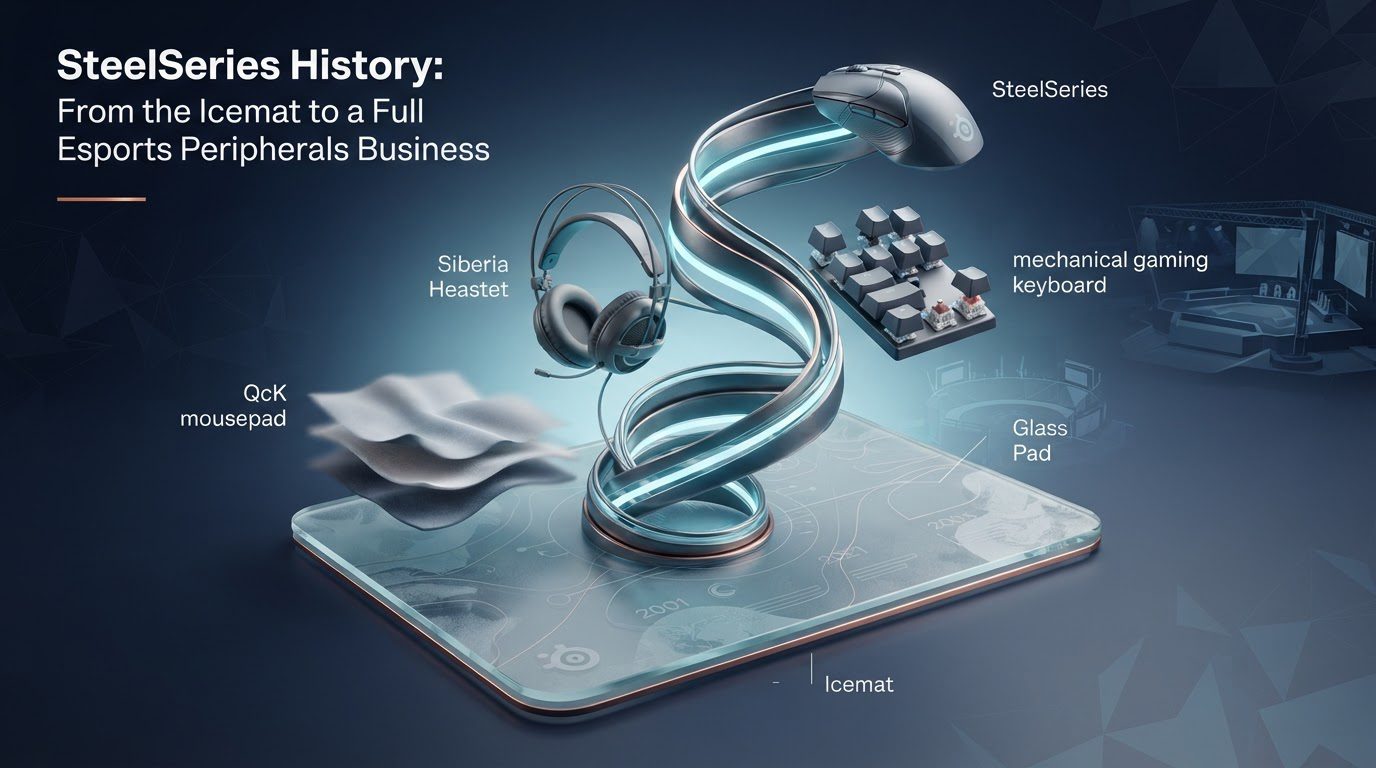
SteelSeries began in Denmark in 2001 with a product that was far narrower than the keyboards, mice and headsets now associated with the name: the Icemat, a glass mousepad designed specifically for competitive gaming. That origin is useful because it explains the company’s early route into the market. SteelSeries was not initially trying to build an all-purpose electronics catalogue; it was selling specialist equipment into a small but increasingly organised esports scene.
The Icemat gained visibility through tournament and professional-player use, while later mousepads such as the QcK helped turn a seemingly simple surface into a repeat-purchase gaming product. SteelSeries’ own innovation timeline dates the Icemat to 2001 and describes the QcK as one of the products that became closely associated with competitive play. The company then moved outward from surfaces into the devices players touched and heard: the Siberia headset appeared in 2004, the 5H headset in 2005 and the 6G mechanical gaming keyboard in 2006.
From the Icemat to a Full Esports Peripherals Business
Those expansions mattered because they changed SteelSeries from a niche accessory supplier into a company that could equip most of a competitive gaming setup. The brand continued to use esports as a development and marketing channel, where latency, fit, durability and repeatable control could be demonstrated in a more demanding environment than ordinary desktop use. Its relationships with teams and tournament players therefore served a different purpose from conventional celebrity sponsorship: they reinforced the idea that the products were built around competitive use.
The product history also shows how SteelSeries increasingly relied on engineering features rather than styling alone. The company lists products such as the Sensei with onboard processing, the Rival 310 with 1-to-1 tracking and the Apex Pro with adjustable actuation among its claimed firsts. Those are company-positioning claims rather than independently established industry firsts, but they reflect the broader move from gaming surfaces into sensors, switches, wireless audio and software-controlled input devices.
SteelSeries today
SteelSeries is now part of GN Store Nord. GN completed its acquisition of the company in January 2022 and continued to list SteelSeries among its operating brands in 2026, while SteelSeries retains its own gaming identity across mice, keyboards, headsets and related software.
SteelSeries today competes across headsets, keyboards, mice, controllers and accessories, but the Icemat remains the clearest explanation of its identity. The company entered gaming by focusing on a small physical detail that competitive players cared about and then kept moving closer to the player’s inputs and feedback. That is a more precise history than describing it as a generic gaming brand: its growth came from turning esports-specific requirements into product categories that eventually became mainstream PC-gaming equipment.