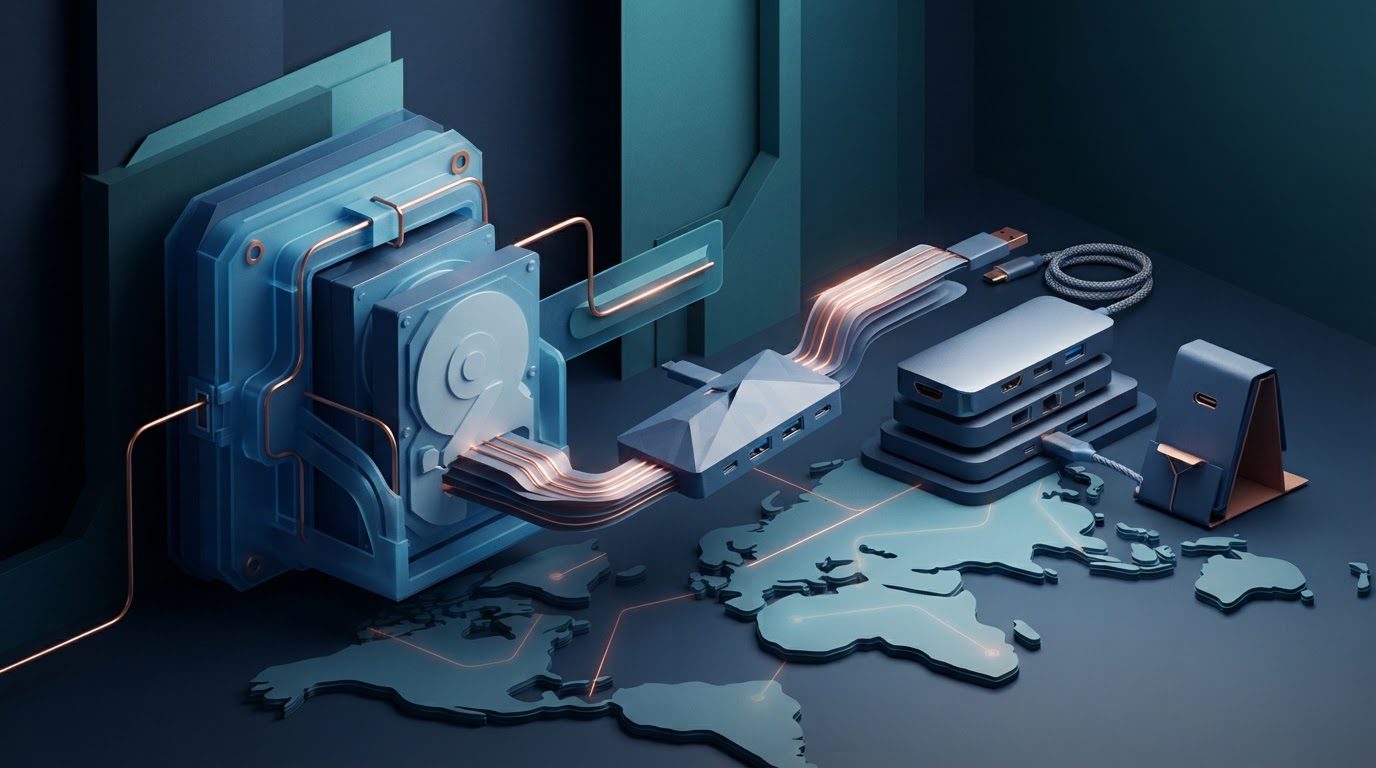
ORICO History: From a Tool-Free Drive Enclosure to USB-C Accessories
ORICO's own corporate history gives both a founding year and an early product: the company was founded in 2009 and says it first released a 'Tool Free' hard-drive enclosure that year. That is a much better starting point than describing ORICO as a generic power brand, because its initial problem was storage access—making it easier to install and use bare drives.
A tool-free drive enclosure started ORICO’s story
The tool-free enclosure removed screws and other installation friction from a product category used by PC builders, technicians and people repurposing internal drives. ORICO then entered major Chinese and international e-commerce channels in 2010 and expanded offline distribution in several countries in 2011. Channel growth was therefore part of the early story alongside product design.
The company widened from enclosures into docks, hubs, storage adapters, NAS products, cables and charging devices. Its own timeline also records work on USB and Type-C data and power transmission and later partnerships around storage. Those moves are technically related: ORICO operates where drives, ports, power and external peripherals meet the computer.
USB-C expanded the same connectivity problem
That makes data movement a more accurate organising idea than 'energy resilience'. A USB-C dock and a hard-drive enclosure may look different, but both manage interfaces between a host computer and external hardware. Charging products add power delivery to the same connection problem rather than representing a complete departure into utility-scale energy.
ORICO's first tool-free drive enclosure is a revealing product because it placed the company between storage components and end users. Hard drives and SSDs may hold the data, but enclosures, docks and adapters determine how those devices connect, are reused and migrate between computers. As USB and later USB-C became more important, ORICO could expand naturally from enclosures into hubs, docks, card readers and charging accessories. That progression is a connectivity and storage-access story, not a backup-power story. The brand's value has consistently come from packaging interfaces and removable storage into practical desktop and mobile accessories.
ORICO's 2009 tool-free enclosure still explains the brand well. The company made a fiddly connection task simpler, then repeated that strategy across more types of ports and storage. Its history is less about one dramatic breakthrough than about reducing friction around the physical interfaces people use to move data and power between devices.