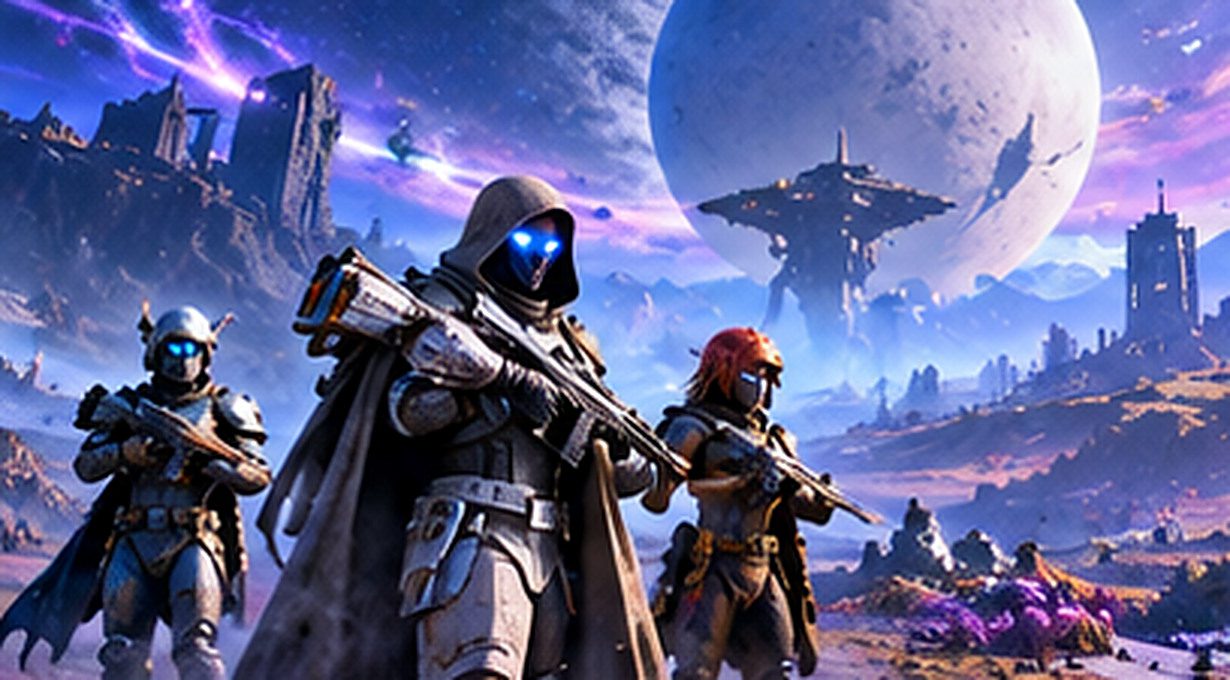
Destiny 2: Guardians, gear and choosing where to begin
Destiny 2 combines first-person shooting with the continuing development of a Guardian. The weapons a player collects and the abilities they choose affect how they approach the next encounter, while different activities provide reasons to change a build.
The original launch and the Steam release
Bungie’s getting-started guide dates the original launch to 6 September 2017. The Steam listing records 1 October 2019 for that storefront.
Bungie is the developer and the current Steam publisher. The later storefront date should not be used to make the original game appear to have launched in 2019.
A Guardian begins with a class
The three classes are Hunter, Warlock and Titan. Bungie’s guide describes broad identities around mobility, abilities and defensive or close-combat strengths, while also explaining that equipment can create different roles within a class.
That flexibility matters. Choosing a class does not mean that every character of that class must fulfil one fixed team role. Weapons, armour and abilities contribute to how a Guardian is built.
Equipment connects encounters
The official description presents collecting and combining gear as part of the progression. A weapon is therefore both a tool used in the current fight and a possible component of a longer-term build.
This gives repeated activities a purpose beyond completing the same objective again. Players can pursue equipment combinations while becoming more familiar with the encounter itself.
Cooperative and competitive play
Steam describes missions, quests, patrols, strikes and raids alongside competitive modes. These activities ask different things of a player and their group.
A cooperative encounter is organised around completing a shared task against the game. Competitive play adds opponents who are making their own decisions. The presence of shooting in both does not make their pacing or preparation identical.
The official Destiny site links player guides and team-finding resources, offering a starting point for understanding activities beyond the initial introduction.
Free access and paid content are separate
The base game is listed as free to play, with expansions and other content sold separately. Downloading Destiny 2 does not establish ownership of every campaign, dungeon or commercial bundle.
For someone joining friends, the useful check is the exact activity they intend to play and the access it requires. A general statement that the game is free is insufficient for that decision.
Check current installation space
Steam lists a Windows minimum of 6 GB RAM and processors including the Core i3-3250, Pentium G4560 or FX-4350, with GTX 660, GTX 1050 or Radeon HD 7850 graphics options. Its recommended table raises RAM to 8 GB and specifies stronger processors and graphics cards.
The storefront’s 105 GB storage entry is lower than Bungie’s current storage guidance. At verification, Bungie lists a Steam installation of up to 180.90 GB and up to 353 GB for the stated pre-load process.
Bungie describes these as estimates that vary with languages, platform and updates. Installation size and temporary space needed during an update are different figures.
Choose the activity before the purchase
Bungie lists PC, PlayStation and Xbox routes. The practical starting point is a supported device, sufficient installation space and the content needed for the intended activity.
That gives a new player a clearer entry point than buying a collection solely because the franchise contains many releases. The class, group and activity are the decisions that make the wider catalogue relevant.