Garmin Edge 850 puts smarter navigation and training on your handlebars
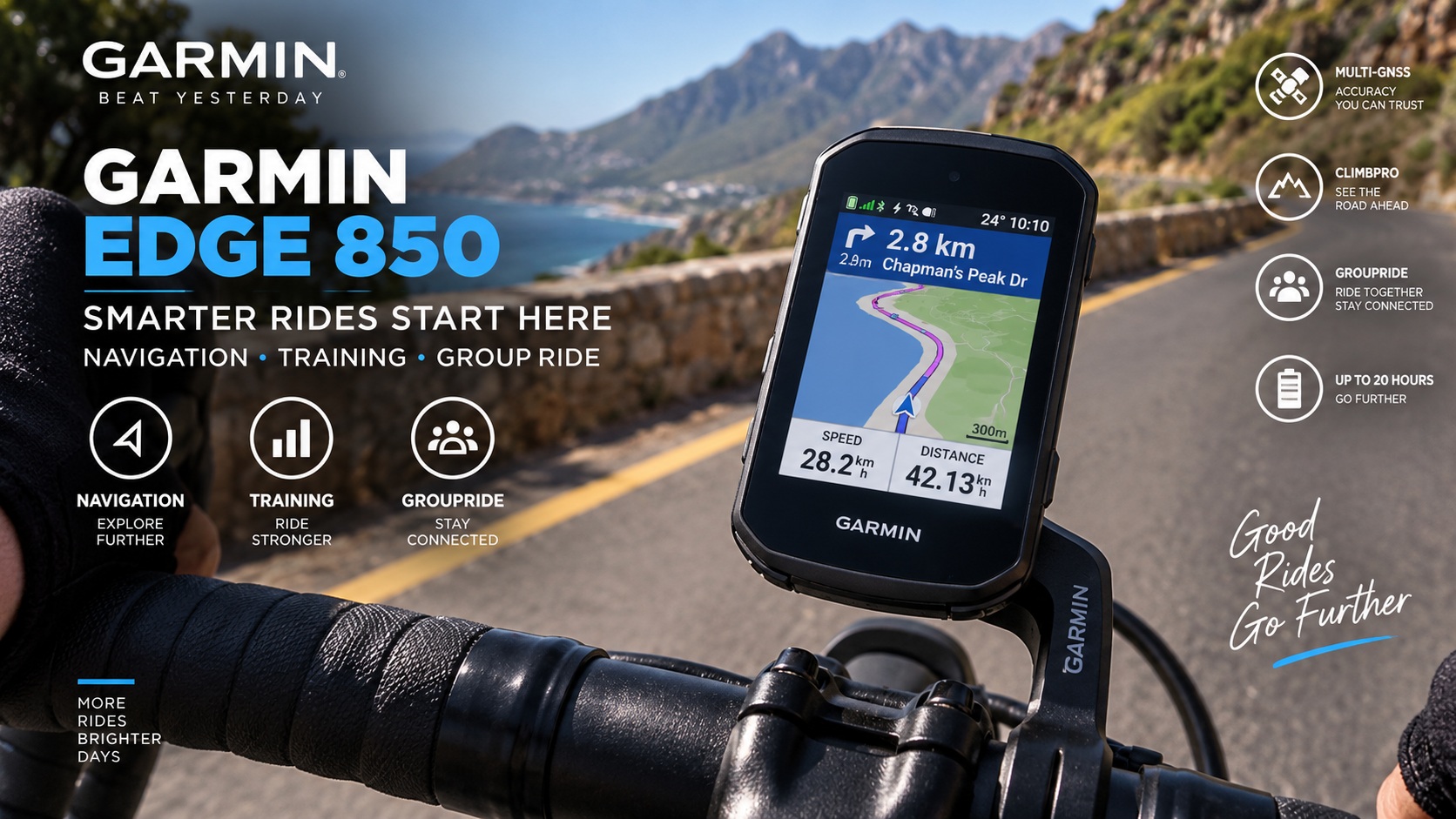
The Garmin Edge 850 is a compact GPS cycling computer designed to put considerably more than speed and distance information on a bicycle’s handlebars.
Its 2.7-inch colour touchscreen displays maps, navigation and performance data. However, Garmin has retained physical buttons as another way to control the device while riding.
Inside, multi-band GNSS handles positioning, while a barometric altimeter, gyroscope, accelerometer, magnetometer and ambient light sensor provide additional data.
The Edge 850 also introduces some interesting everyday features.
A built-in speaker can function as an electronic bicycle bell. Garmin Pay provides contactless payments, while smart fuelling alerts can help riders plan carbohydrate and hydration intake.
GroupRide, road-hazard reporting, incident detection and LiveTrack add another layer focused on connected riding.
For South African cyclists, that combination makes the Edge 850 particularly interesting. It is not simply recording the ride after it happens. Garmin increasingly wants the cycling computer to help manage what happens during the ride itself.
Garmin Edge 850 combines touchscreen and button control
The Garmin Edge 850 uses a 2.7-inch colour liquid-crystal display with a resolution of 420 × 600 pixels.
It is a touchscreen.
However, Garmin has not abandoned physical buttons.
That combination makes practical sense on a bicycle.
Touch controls can make maps and menus easier to navigate. Meanwhile, buttons remain useful when conditions make touchscreen interaction less convenient.
Gloves, rain and rough terrain can all change how easily a rider interacts with a screen.
Giving riders both options avoids forcing every interaction through one control method.
The display concentrates on maps and riding data
A 2.7-inch display sounds small beside a modern smartphone.
On bicycle handlebars, the requirements are different.
The screen needs to remain compact enough not to dominate the cockpit while still displaying navigation, training information and ride statistics clearly.
Garmin uses the 420 × 600 resolution to present colour maps and data.
The device can also display real-time weather information when connected to Garmin Connect.
That allows the Edge to remain focused on information relevant to the ride rather than attempting to become a miniature smartphone.
Multi-band GNSS handles positioning
Accurate positioning is fundamental to a cycling computer.
The Garmin Edge 850 supports GPS, GLONASS and Galileo alongside multi-band GNSS.
Garmin also lists 5Hz GPS support.
Satellite positioning feeds several functions.
It records the route, supports navigation and contributes to speed and distance information.
More accurate positioning becomes particularly useful in environments where satellite reception can become difficult.
Trees, buildings and terrain can all complicate location tracking.
Multi-band technology gives the Edge 850 another tool for maintaining useful positional data in challenging environments.
Garmin includes 64GB of internal storage
The Edge 850 provides 64GB of internal storage.
That capacity supports maps, courses and recorded activity history.
Garmin lists support for up to 100 courses, 200 saved locations or favourites and around 200 hours of activity history.
Integrated Trailforks trail data also extends the device beyond road cycling.
That is useful for riders who move between road, gravel and mountain-bike routes.
Maps can also be managed over Wi-Fi.
Therefore, the Edge 850 can function as a standalone navigation device rather than relying on a phone screen throughout the ride.
Courses can be created directly on the Edge
Garmin also supports on-device course creation.
That removes another reason to reach for a smartphone or computer.
A rider can create a route directly from the cycling computer rather than always preparing it beforehand.
This becomes particularly useful when plans change during a ride.
Perhaps a road is closed, the weather changes or the group decides to take a different route.
Being able to alter navigation from the handlebars makes the Edge more useful as an active riding tool rather than merely a device following instructions prepared earlier.
Road-hazard alerts use information from other cyclists
The Garmin Edge 850 can receive road-hazard alerts reported by other cyclists.
This introduces a community element into navigation.
A route may look perfectly usable on a static map while conditions on the road have changed.
Other cyclists can report hazards, allowing compatible Garmin users to receive information while approaching the affected area.
The usefulness naturally depends on available reports.
It should also never replace watching the road.
Nevertheless, community-generated hazard information can add another layer of awareness to conventional navigation.
GroupRide keeps cyclists connected
Garmin’s GroupRide feature is designed for cyclists riding together.
Compatible devices can share courses, locations and ride information.
Riders can also exchange messages.
That addresses a common group-riding problem.
Even an organised group can become separated after climbs, intersections, mechanical problems or stops.
Seeing the position of other riders can make regrouping considerably easier.
The feature requires compatible equipment and connected services, but it turns the Edge into a group coordination device rather than simply an individual cycling computer.
GroupRide adds friendly competition
GroupRide is not limited to location sharing.
Garmin also supports competitions, rankings and awards within group sessions.
That adds a social layer to riding.
A relaxed weekend ride can therefore include optional competitive elements without becoming a formally organised race.
Garmin’s approach reflects how cycling computers have evolved.
Recording a GPX route and basic speed information is no longer enough at the premium end of the market.
Modern devices increasingly combine navigation, training, safety and social features in one interface.
Incident detection extends to group rides
The Garmin Edge 850 includes incident detection.
Garmin lists support for both normal and off-road cycling.
GroupRide also has its own incident-detection functionality.
When compatible connected features are configured, the system can help notify others when an incident is detected.
However, riders should not treat electronic detection as a substitute for safe riding or emergency planning.
No automated system can guarantee that every accident will be detected correctly.
Its value lies in providing another safety layer when something goes wrong.
LiveTrack lets others follow the ride
Garmin also includes LiveTrack.
This allows approved contacts to follow a rider’s location while an activity is underway.
For long-distance cyclists, that can provide useful reassurance to family or friends.
It can also help when meeting someone at the end of a ride.
Instead of repeatedly sending location updates, the rider can share tracking through Garmin’s connected ecosystem.
Again, the feature depends on connectivity and correct setup.
Riders heading into remote areas should not assume conventional connected tracking replaces dedicated satellite communication where cellular coverage is unavailable.
A built-in speaker becomes an electronic bicycle bell
One of the Edge 850’s most unusual additions is its built-in speaker.
Garmin uses it for more than interface sounds.
The device can function as an electronic bicycle bell.
That means riders can alert pedestrians and other cyclists directly from the cycling computer.
The speaker can also provide audible navigation and workout information.
This is a good example of a relatively simple hardware addition serving several purposes.
Rather than fitting a speaker merely for notifications, Garmin integrates it into functions that make sense while actually riding.
Smart fuelling alerts look beyond navigation
The Garmin Edge 850 also tackles something cycling computers historically left largely to the rider: eating and drinking.
Garmin’s smart fuelling alerts can estimate nutrition and hydration requirements based on factors including fitness, route demands and environmental conditions.
The system can then remind the rider to consume carbohydrates and fluids during the ride.
This becomes increasingly relevant as distance and intensity increase.
For a short casual ride, nutrition planning may barely matter.
During a long endurance ride, inadequate fuelling can have a substantial effect on performance.
Some advanced features require compatible sensors.
Advanced training needs additional sensors for full functionality
The Edge 850 supports extensive training and performance analysis.
However, buyers should understand that the cycling computer cannot generate every advanced metric by itself.
Some features require a compatible heart-rate monitor, power meter or both.
With the appropriate sensors connected, Garmin can provide information including power guidance, real-time stamina and cycling ability.
This modular approach allows riders to build a more sophisticated training setup over time.
Someone can begin with the Edge alone and later add heart-rate, power or other compatible sensors as training requirements become more advanced.
Garmin Cycling Coach can adapt training
The Edge 850 supports Garmin Cycling Coach.
Training plans can adapt according to performance and recovery information.
That shifts the cycling computer from recording training to actively helping structure it.
A rider preparing for an event can therefore follow a plan rather than simply accumulating kilometres.
Adaptive coaching also recognises that training does not always proceed exactly as scheduled.
Performance, recovery and life outside cycling can change what makes sense on a particular day.
The usefulness of the recommendations will still depend on the quality of the data available to Garmin.
ClimbPro helps riders understand upcoming climbs
Garmin’s ClimbPro functionality gives riders information about climbs.
Knowing the distance and gradient remaining can help with pacing.
That is useful whether the objective is racing, training or simply reaching the top without exhausting available energy too early.
On unfamiliar routes, climb information also removes some uncertainty.
Instead of wondering whether the current steep section ends around the next corner, riders can see more of the climb’s structure.
For South African cyclists tackling hilly routes, that can become one of the Edge’s more frequently used features.
Real-time weather information adds context
Weather can change a ride very quickly.
The Garmin Edge 850 can display real-time weather information when connected through Garmin Connect.
Garmin includes weather-map functionality capable of displaying information such as radar or wind overlays where supported.
That can help riders make decisions before conditions become problematic.
A strong headwind, approaching storm or significant weather change may justify altering a route.
However, connected weather information still depends on available data and connectivity.
Riders should continue to pay attention to actual conditions around them.
Garmin Pay puts payments on the handlebars
The Edge 850 supports Garmin Pay.
That may initially seem like an unusual feature for a cycling computer.
In practice, it makes sense.
Cyclists frequently stop for coffee, food or additional water.
Contactless payment from the Edge means a compatible bank card does not necessarily need to be retrieved from a jersey pocket or bag.
Availability depends on participating financial institutions and payment networks.
South African riders should therefore check Garmin’s current local Garmin Pay support for their bank and card before relying on the feature.
Connectivity includes Bluetooth, ANT+ and Wi-Fi
Garmin gives the Edge 850 Bluetooth, ANT+ and Wi-Fi connectivity.
Each connection serves different parts of the cycling ecosystem.
Bluetooth helps connect the Edge with smartphones.
ANT+ remains important for cycling sensors and accessories.
Wi-Fi supports functions such as map management and data synchronisation.
The Edge can also work with smart trainers and other compatible equipment.
This broad connectivity is important because a cycling computer often becomes the central display for several separate sensors rather than operating alone.
Varia compatibility can extend rearward awareness
The Edge 850 also works within Garmin’s wider cycling ecosystem.
That includes compatible Varia radar and lighting products.
A rear-facing radar can provide information about approaching vehicles on compatible Garmin devices.
For road cyclists, this can add useful situational information.
However, radar should never replace looking behind before changing position or turning.
Technology should supplement rider awareness rather than encourage dependence on a screen.
The Edge’s value lies in bringing information from compatible accessories into one central display.
The Garmin Edge 850 weighs 113g
Despite its growing list of functions, the Garmin Edge 850 weighs 113g.
Its dimensions are approximately 54.6 × 92.2 × 16.8mm.
That keeps it relatively compact on the handlebars.
Weight matters differently on a cycling computer than on many other electronics.
Performance-focused cyclists can be extremely conscious of unnecessary mass.
At the same time, the device needs a sufficiently large screen and battery to remain useful.
The Edge 850 balances those requirements within a relatively small enclosure.
IPX7 provides water resistance
Garmin rates the Edge 850 at IPX7.
That matters because a cycling computer inevitably faces weather.
A ride that starts in sunshine can end in rain.
Sweat and road spray create additional exposure.
Water resistance therefore needs to be part of the fundamental design rather than an optional extra.
However, an IP rating should still be interpreted according to Garmin’s usage guidance.
It does not mean owners should deliberately expose the device to unnecessary water or ignore proper care.
Battery life reaches 12 hours under demanding use
Garmin quotes up to 12 hours of battery life under demanding use.
Battery-saver mode can extend that figure to up to 36 hours.
The distinction matters.
Thirty-six hours should not be presented as the normal battery figure when every major feature is operating at maximum demand.
For many normal rides, 12 hours already represents substantial time on the bicycle.
Ultra-distance riders can also use compatible Garmin charging accessories to extend operation while riding.
Actual battery life will vary according to settings, sensors, display use and connected features.
Garmin Edge 850 specifications
| Specification | Garmin Edge 850 |
|---|---|
| Product type | GPS cycling computer |
| Dimensions | 54.6 × 92.2 × 16.8mm |
| Weight | 113g |
| Water rating | IPX7 |
| Display | Colour LCD |
| Display size | 2.7 inches |
| Resolution | 420 × 600 |
| Touchscreen | Yes |
| Physical buttons | Yes |
| Built-in speaker | Yes |
| Battery | Rechargeable lithium-ion |
| Demanding-use battery | Up to 12 hours |
| Battery-saver mode | Up to 36 hours |
| Internal storage | 64GB |
| GPS | Yes |
| GLONASS | Yes |
| Galileo | Yes |
| Multi-band GNSS | Yes |
| 5Hz GPS | Yes |
| Barometric altimeter | Yes |
| Gyroscope | Yes |
| Accelerometer | Yes |
| Magnetometer | Yes |
| Ambient light sensor | Yes |
| Bluetooth | Yes |
| ANT+ | Yes |
| Wi-Fi | Yes |
| GroupRide | Yes |
| LiveTrack | Yes |
| Incident detection | Yes |
| Community hazard reporting | Yes |
| Garmin Pay | Yes |
| Smart fuelling alerts | Yes |
| Garmin Cycling Coach | Yes |
| Integrated Trailforks data | Yes |
Why the Garmin Edge 850 matters for South African cyclists
The Garmin Edge 850 has several features with obvious relevance to South African cycling.
Navigation is the first.
A dedicated cycling computer keeps a phone available for communication while putting maps directly on the handlebars.
Battery life also matters during longer rides.
Then there are safety-related features such as LiveTrack, incident detection and compatibility with Garmin’s Varia ecosystem.
GroupRide can help riders remain connected during club and weekend rides.
Meanwhile, smart fuelling and advanced performance information target cyclists who approach riding as structured training.
Garmin South Africa also has an official regional product page for the Edge 850, which removes the availability uncertainty that accompanies some products TechnologyBlog covers from overseas websites.
Garmin Edge 850 is becoming more than a bike computer
The Garmin Edge 850 demonstrates how much the definition of a cycling computer has changed.
Speed, distance and GPS recording remain fundamental.
However, they now form only the foundation.
The Edge 850 can navigate a route, display climbs, communicate with other riders, report road hazards, monitor training, suggest fuelling, display weather information and accept compatible contactless payments.
Its speaker can even replace a conventional bicycle bell for certain situations.
At the same time, Garmin keeps the hardware relatively compact.
The 2.7-inch touchscreen and physical buttons provide two ways to interact with the device, while multi-band GNSS and a broad sensor set handle positioning and movement data.
For cyclists who simply want to know how far they rode, much of this capability will be unnecessary.
For riders who train seriously, explore unfamiliar routes or spend long hours on the bicycle, the Edge 850 is increasingly less about recording the ride and more about helping manage it while it is happening.