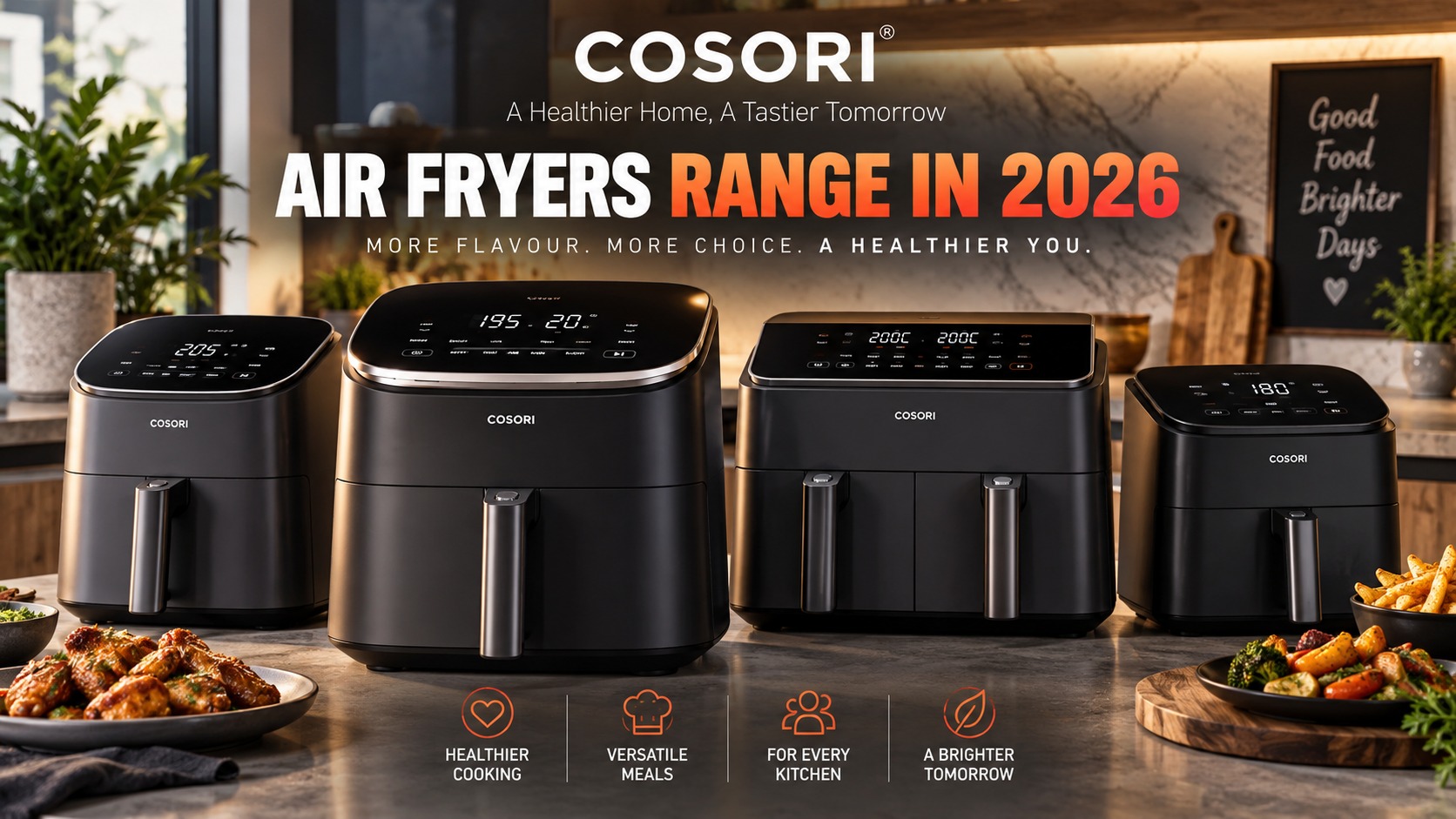
Cosori air fryers in 2026: which models and features stand out?
The Cosori air fryer range has grown well beyond the familiar single basket with a heating element on top.
Cosori now sells compact models for individual portions, conventional single-basket machines, connected air fryers, dual-basket designs and a larger air-fryer oven. Consequently, choosing between them depends as much on cooking style as it does on capacity.
The current range includes models such as the TurboBlaze 6.0-Quart, Pro LE 5.0-Quart, Dual Blaze 6.8-Quart Smart Air Fryer, Iconic 6.5-Quart Smart Air Fryer, TWINFRY 9-Quart Double Air Fryer, 9.0-Quart Dual Basket Air Fryer, Lite 2.1-Quart Mini and a 13-Quart Air Fryer Oven.
Cosori itself now divides its range according to household size and usage, including options for individuals and couples, smaller households, larger households and users interested in connected appliances.
That makes more sense than judging the range only by litre capacity.
Cosori air fryers range from compact to family-size
At the smallest end sits the Lite 2.1-Quart Mini Air Fryer.
Its purpose is straightforward: small portions, reheating and kitchens where counter space matters.
Moving upward, the Pro LE 5.0-Quart and TurboBlaze 6.0-Quart fit more conventional everyday family use.
Cosori then moves into larger machines with the 6.5-quart Iconic, 6.8-quart Dual Blaze and 9-quart dual-basket products.
Finally, the 13-quart Air Fryer Oven shifts from a drawer format towards a small countertop-oven design.
Therefore, there is no single “Cosori air fryer” specification.
Capacity, heating design and functionality vary significantly across the range.
TurboBlaze is the current mainstream model
The TurboBlaze 6.0-Quart Air Fryer holds a prominent position in Cosori’s current collection.
Cosori currently highlights it as part of the latest generation of its air-fryer range.
Its six-quart format places it in the middle of the company’s lineup, making it more suitable for everyday household use than the compact Lite while avoiding the width of a dual-basket machine.
That middle ground is important.
Many buyers do not need two completely separate cooking zones. Instead, they need one basket large enough for normal family portions without sacrificing too much counter space.
For those users, the TurboBlaze represents Cosori’s more conventional approach.
Dual Blaze heats from above and below
The Dual Blaze 6.8-Quart Smart Air Fryer takes a different approach.
Instead of relying only on a heating element above the food, Cosori uses heating elements at both the top and bottom.
The company calls the system 360 ThermoIQ Technology.
Cosori says the dual-heater design can cook both sides of food without requiring the same degree of shaking or flipping associated with conventional basket air fryers.
That is a meaningful technical difference rather than another cooking preset.
Air fryers normally move hot air around food from a top-mounted heating system. Adding lower heat gives Cosori another way to influence how energy reaches the food.
TechnologyBlog has not independently tested the Dual Blaze, so we cannot verify Cosori’s claims about cooking evenness.
Nevertheless, the hardware itself clearly distinguishes this model from a basic single-heater design.
Dual Blaze also adds connected cooking
The Dual Blaze belongs to Cosori’s smart-appliance range.
Through the VeSync app, users can monitor cooking progress and access supported remote controls.
Cosori also lists Amazon Alexa and Google Assistant voice-control support.
The company’s wider air-fryer range includes other connected models as well.
However, smart functionality is not universal.
Someone who has no interest in phone control should therefore look at the individual model rather than assuming that every Cosori air fryer includes Wi-Fi.
The presence of an app also should not become the main reason to buy an air fryer.
Heating performance, useful capacity and ease of cleaning remain more important in everyday use.
Cosori’s 9-quart models solve a different problem
The Cosori 9.0-Quart Dual Basket Air Fryer uses two separate cooking drawers.
That matters when a meal contains foods requiring different temperatures or cooking times.
Chicken can cook in one drawer while vegetables or chips occupy the other.
A single large basket may hold the same overall volume, but it cannot isolate those foods as effectively.
Consequently, dual-basket models make particular sense for households that regularly prepare two components simultaneously.
They also reduce the need to cook one part of dinner and then wait while the second batch finishes.
TWINFRY offers another dual-zone approach
Cosori also lists the TWINFRY 9-Quart Double Air Fryer in its current range.
Like the conventional dual-basket model, TWINFRY targets users who want more flexibility than a single drawer provides.
This category has become important because capacity alone does not tell the whole story.
Nine quarts in one large chamber and nine quarts divided into separate cooking areas can suit very different meals.
Someone regularly cooking a whole chicken may prefer uninterrupted basket space.
Another household preparing protein and sides together may gain more value from independent zones.
Therefore, buyers should ask what they cook rather than simply choosing the largest capacity number.
The Iconic moves Cosori further upmarket
One of Cosori’s newest products is the Iconic Stainless Steel 6.5-Quart Smart Air Fryer.
Cosori currently lists it among its new arrivals and positions it as a more premium model.
Its stainless-steel exterior gives it a noticeably different design direction from the black or grey plastic-bodied air fryers most buyers associate with the category.
Smart functionality also places it within Cosori’s connected ecosystem.
The Iconic demonstrates another shift in the air-fryer market.
These appliances are no longer always something owners expect to hide in a cupboard.
Manufacturers increasingly treat them as permanent countertop appliances and therefore place more emphasis on design and materials.
The 13-quart model moves closer to a countertop oven
Cosori’s 13-Quart Air Fryer Oven occupies the largest end of its current air-fryer collection.
Its format differs from the familiar pull-out basket.
Instead, the larger chamber gives buyers an appliance that begins to overlap with countertop ovens.
That may suit households wanting greater cooking flexibility or more usable internal space.
However, larger is not automatically better.
A 13-quart appliance takes substantially more room on a countertop than a compact basket fryer.
Furthermore, someone using an air fryer mostly for chips, vegetables and reheating may gain little from the extra volume.
Kitchen space should therefore be part of the purchase decision.
Capacity numbers need context
Cosori uses quarts on its US website.
For South African readers, litres are normally more familiar.
One US liquid quart equals roughly 0.946 litres, although marketed air-fryer capacity should not always be treated as an exact usable-volume measurement.
For example, Cosori lists its 9.0-quart Dual Basket model at 8.5 litres.
The Dual Blaze’s 6.8-quart capacity is listed at 6.4 litres.
Those metric figures make the products easier to understand locally.
However, usable cooking area still matters.
A wide shallow basket and a narrow deep basket can carry similar volume ratings yet behave differently when cooking food in a single layer.
Basket shape can matter more than headline capacity
Air fryers work best when hot air can move freely around food.
Therefore, filling a deep basket to its theoretical maximum can reduce the benefit of a large capacity figure.
A wider cooking surface can sometimes prove more useful than extra depth.
This is especially true for chips, chicken pieces and vegetables where spreading food out helps expose more surface area to circulating hot air.
Dual-basket models introduce another consideration because their total advertised capacity is split between separate drawers.
Buyers should therefore examine basket dimensions and cooking layout instead of relying solely on the largest number printed on the specification sheet.
Smart control centres on VeSync
Cosori uses the VeSync app for its connected products.
The ecosystem can provide remote monitoring and control on supported models, while some Cosori air fryers also integrate with Alexa and Google Assistant.
Cosori actively promotes the ability to manage cooking without remaining directly beside the appliance.
However, remote cooking controls require sensible safety expectations.
An air fryer is still a high-power cooking appliance generating substantial heat.
Smartphone control should not encourage users to ignore appropriate supervision, ventilation or manufacturer instructions.
The app is best viewed as a convenience layer rather than a reason to treat cooking as completely unattended.
Scan-to-Cook appears on supported smart models
Cosori also offers Scan-to-Cook through VeSync on products such as the Dual Blaze.
The feature can provide cooking instructions for supported packaged foods after scanning them in the app.
This is another example of software being useful when it removes a repetitive task.
Instead of manually translating conventional oven instructions into an air-fryer time and temperature, the app can supply compatible settings where available.
Its usefulness naturally depends on whether the specific food product exists in the supported database.
Therefore, it should be considered an additional convenience rather than a universal automatic cooking system.
Air frying still relies on convection
Despite brand-specific names such as TurboBlaze and Dual Blaze, the underlying principle remains familiar.
An air fryer uses rapidly circulating hot air to cook and brown food.
That means the appliance is fundamentally a compact high-airflow convection cooker.
The relatively small chamber allows it to heat quickly compared with a large conventional oven in many circumstances.
This explains much of the category’s appeal.
However, an air fryer does not literally fry food in the same way as submerging it in hot oil.
The texture and flavour can differ, particularly with foods where deep-frying oil plays a major role in the final result.
Less oil does not automatically mean healthy food
Cosori promotes air frying as a way to achieve crisp results with little or no added oil.
That can reduce the quantity of cooking oil required for certain dishes.
However, the appliance itself does not determine whether a meal is healthy.
Frozen processed food cooked in an air fryer remains processed food.
Conversely, vegetables, fish or lean meat can make good use of the fast convection system.
Therefore, the meaningful benefit is that air frying gives people another cooking method that may require less added oil than deep frying.
Health claims should go no further than that without nutritional evidence for a particular meal.
Cleaning is still part of ownership
One reason basket air fryers became popular is relatively straightforward cleanup.
Food cooks inside removable baskets or crisper plates rather than across a full conventional oven cavity.
Nevertheless, grease and food residue still build up.
Basket coatings require appropriate utensils and cleaning methods to prevent unnecessary damage.
Meanwhile, the heating area above the basket may also collect grease over time.
Dual-basket appliances increase the number of components requiring cleaning, although they can make meal preparation more flexible.
As a result, potential buyers should consider dishwasher compatibility and removable parts alongside cooking programmes.
South African buyers need to check voltage carefully
This is particularly important with the Cosori link supplied for this article.
The website is Cosori’s US storefront.
For example, the current Dual Blaze 6.8-Quart Smart Air Fryer is specified at AC 120V, 60Hz and 1,750W.
Cosori’s US 9.0-Quart Dual Basket model is also listed at 120V/60Hz and 1,750W.
Those electrical specifications are not designed for direct connection to normal South African 230V/50Hz mains.
A plug adapter does not change voltage.
Therefore, South African consumers should not buy a US Cosori simply because an international seller can ship one.
Cosori does make products for other electrical regions
Cosori maintains European and UK declarations of conformity for several air-fryer models.
That confirms that the company’s range is not exclusively designed around US electricity.
However, model numbers and regional specifications matter.
A European version should not automatically be assumed to have identical specifications, warranty terms or software features to the US product carrying a similar name.
Consequently, buyers need the exact regional model rather than simply the words “Cosori TurboBlaze” or “Dual Blaze”.
South African availability remains the unanswered question
TechnologyBlog could not confirm a dedicated Cosori South Africa storefront or official local air-fryer range from the manufacturer’s current global website.
That means we should not tell South African readers that the current US collection is officially available locally.
Likewise, an imported marketplace listing does not necessarily establish authorised South African distribution.
The distinction matters for electrical compatibility, warranty support and replacement parts.
Therefore, any future Cosori product article should verify the exact regional model before recommending it for local purchase.
Cosori sits in an increasingly crowded air-fryer market
South African consumers already have access to a large selection of air fryers.
TechnologyBlog has previously covered the Hisense 8L air fryer, while other household-appliance manufacturers continue to expand their own ranges.
That gives Cosori a challenge if it expands more formally into South Africa.
Capacity alone will not separate it from established local options.
Features such as Dual Blaze’s top-and-bottom heating, TWINFRY’s flexible cooking arrangement and VeSync integration are therefore more important to the brand’s identity.
Which Cosori air fryer makes the most sense?
The answer depends on the household.
For an individual or couple, the Lite 2.1-Quart Mini keeps size under control.
For ordinary household use, the Pro LE 5.0-Quart or TurboBlaze 6.0-Quart represents a more conventional basket format.
Users interested in connected controls can look towards smart models such as the Dual Blaze or newer Iconic.
Meanwhile, households that regularly cook two different foods at once should investigate the 9-quart dual-basket options.
The 13-Quart Air Fryer Oven makes the most sense where capacity and versatility matter more than keeping the appliance compact.
Which Cosori features actually matter?
Not every feature deserves equal weight.
Capacity and basket layout come first because they determine what fits.
Heating design comes next because products such as Dual Blaze genuinely alter how heat reaches the food.
Temperature range and control affect flexibility.
Easy cleaning matters because the machine will probably be used frequently.
Smart features come after those fundamentals.
VeSync, voice control and Scan-to-Cook can improve convenience, but they cannot compensate for an air fryer that is too small or awkward for the household’s normal meals.
That hierarchy makes it easier to cut through a long specification list.
Are Cosori air fryers worth watching in South Africa?
The current Cosori air fryer range demonstrates how far the category has moved beyond a basic basket and timer.
Cosori now has small machines for one or two people, mainstream six-quart models, dual-heater designs, connected appliances, dual-zone systems and larger countertop-oven formats.
The strongest ideas are the ones that change cooking rather than simply add presets.
Dual heating can alter how food cooks.
Two independent baskets can make an entire meal easier to coordinate.
Smart monitoring can reduce repeated trips to the kitchen.
Different sizes can prevent someone from dedicating half a countertop to an appliance meant for one person.
For South Africans, though, availability and electrical specification come before all of those features.
The Cosori site supplied here primarily represents its US range, and several current models are designed for 120V/60Hz operation.
If Cosori develops stronger official South African distribution, the brand could become an interesting addition to the local air-fryer market.
Until then, buyers should focus on properly rated regional models rather than importing a US version simply because its features look attractive.
Current Cosori air-fryer range at a glance
| Model | Format | Approx. capacity | Key distinction |
|---|---|---|---|
| Lite Mini | Single basket | 2.1 qt | Compact individual/couple option |
| Pro LE | Single basket | 5.0 qt | Conventional mid-size model |
| TurboBlaze | Single basket | 6.0 qt | Current mainstream generation |
| Iconic Smart | Single basket | 6.5 qt | Premium stainless-steel smart model |
| Dual Blaze Smart | Single basket | 6.8 qt / 6.4L | Upper and lower heating elements |
| TWINFRY | Double/dual-zone | 9 qt | Flexible larger cooking arrangement |
| Dual Basket | Two baskets | 9 qt / 8.5L | Independent side-by-side cooking |
| Air Fryer Oven | Oven format | 13 qt | Larger countertop-oven design |
Exact specifications depend on the regional model and hardware version. South African electrical compatibility should therefore be confirmed before purchase.