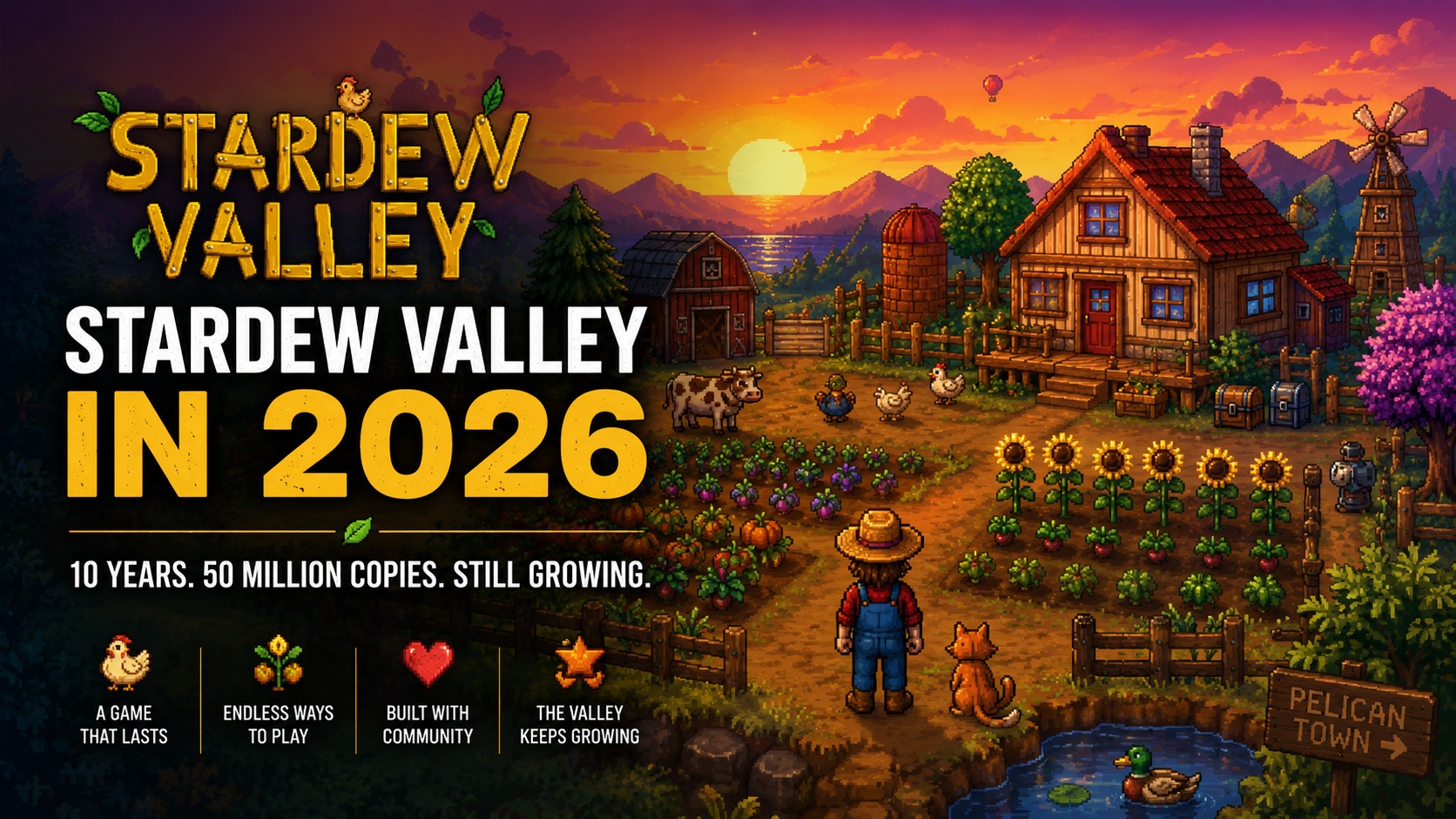
Stardew Valley is 10 years old – so why are tens of thousands still playing it?
Stardew Valley turned 10 years old in February 2026.
For many games, reaching a tenth anniversary means looking backwards. The servers may still be running, nostalgic players return occasionally, and the developer celebrates what the game once achieved.
Stardew Valley is doing something very different.
Creator Eric “ConcernedApe” Barone confirmed during the anniversary that the game has now sold 50 million copies worldwide. More importantly, he said there are still new and returning players arriving every day.
Steam supports that claim.
When TechnologyBlog checked in September 2026, Stardew Valley was attracting tens of thousands of simultaneous Steam players. SteamDB recorded a 24-hour peak above 80,000 players, while its historical record stands at 236,614 concurrent Steam players.
Recent Steam sentiment is equally remarkable.
Around 98% of more than 7,000 recent Steam reviews are positive, while 98% of almost 400,000 English-language reviews are also positive.
And the game still is not finished.
ConcernedApe has another major content update in development.
Ten years after players first inherited their grandfather’s neglected farm, Stardew Valley may be stronger than it has ever been.
Stardew Valley started with a very simple idea
Stardew Valley begins with an escape.
Your character is working an unfulfilling corporate job at Joja Corporation when they remember a letter left by their grandfather.
Inside is the deed to his old farm in Stardew Valley.
So you leave.
What waits is hardly an agricultural empire.
The property is overgrown.
Resources are limited.
Your tools are basic.
From there, the game largely allows you to decide what your new life becomes.
You can grow crops.
Raise animals.
Fish.
Mine.
Craft equipment.
Build relationships.
Explore caves.
Improve the town.
Or spend an unreasonable amount of time designing the perfect farm.
The concept is straightforward.
What makes Stardew Valley unusual is how many systems eventually grow from that simple beginning.
ConcernedApe built Stardew Valley largely by himself
The story behind Stardew Valley is almost as well known as the game itself.
Eric Barone developed the original game under the name ConcernedApe.
During roughly four years of solo development, he taught himself many of the skills needed to create it.
He programmed the game.
He created the artwork.
He designed the characters.
He wrote the dialogue.
He composed the music.
He built the gameplay systems.
The official Stardew Valley history describes Barone teaching himself the necessary skills across music, art, programming and design while developing the project.
The game finally launched for PC on 26 February 2016.
Within two months, it had already passed one million copies sold.
That was only the beginning.
Stardew Valley understands the satisfaction of starting small
The opening farm is deliberately unimpressive.
You do not arrive with automated equipment and enormous fields.
You begin by clearing weeds, chopping wood and breaking rocks.
Early crops require manual watering.
Energy limits how much work you can complete in a day.
Money matters.
Even upgrading a basic tool feels significant.
Gradually, everything changes.
A tiny field becomes several crop areas.
Sprinklers reduce manual watering.
Buildings appear.
Animals arrive.
Processing equipment turns basic produce into more valuable goods.
The farm starts reflecting the player’s decisions.
That progression creates an important psychological loop.
There is almost always another small improvement available.
And small improvements eventually become enormous changes.
Farming is only part of Stardew Valley
Calling Stardew Valley a farming simulator is accurate.
It is also incomplete.
Farming provides the economic foundation, but the game constantly encourages players to leave their property.
Pelican Town contains more than 30 characters with routines, birthdays, relationships and personal stories.
The mines introduce combat and resource gathering.
Fishing becomes almost a separate progression system.
Foraging rewards exploration.
Seasonal festivals change the normal routine.
The Community Center creates longer-term collection goals.
Relationships can eventually lead to marriage and family life.
Players can also choose the Joja route rather than restoring the Community Center.
These systems overlap.
A trip to buy seeds can become a conversation.
That conversation might remind you about a birthday.
The birthday sends you looking for a gift.
Finding that gift takes you somewhere else.
Suddenly, the farming game has consumed another evening.
Pelican Town gives the farm a reason to exist
The characters are crucial to Stardew Valley’s longevity.
Pelican Town is small enough that players begin recognising everyone’s routines.
You learn where people work.
You discover where they spend evenings.
You learn who likes particular gifts.
Then heart events reveal more about them.
Some stories are funny.
Others deal with loneliness, family problems, ambition, alcoholism, insecurity or frustration.
Not every character is immediately likeable.
That helps.
The town feels more believable because its residents are not simply standing around waiting to congratulate the player.
They have their own relationships and problems.
Over time, those characters become part of the routine.
The calendar makes ordinary decisions matter
Time is one of Stardew Valley’s most effective systems.
Each year is divided into seasons.
Different crops grow during different periods.
Fish appear at particular times and under certain weather conditions.
Festivals occur on specific dates.
Characters have birthdays.
The clock continues moving throughout the day.
Consequently, players are constantly making small decisions.
Do I water everything before going into town?
Do I spend today mining?
Should I fish because it is raining?
Can I reach the shop before it closes?
Have I forgotten someone’s birthday again?
None of those decisions sounds dramatic.
Together, they create the rhythm that keeps Stardew Valley moving.
There is no single correct farm
Another reason Stardew Valley lasts is that optimisation is optional.
Players who enjoy efficiency can calculate crop profits, automate production and organise enormous processing operations.
Other players can ignore almost all of that.
You can create an animal-focused farm.
You can concentrate on fishing.
You can decorate.
You can chase achievements.
You can build relationships.
You can attempt perfection.
Or you can simply play another day.
That flexibility makes Stardew Valley unusually accommodating.
The game contains systems for players who enjoy optimisation without demanding that everyone becomes an accountant.
The Community Center gives the early game structure
The Community Center is one of Stardew Valley’s most effective pieces of progression design.
At first, the abandoned building appears to be another sign of Pelican Town’s decline.
Then players begin completing bundles.
Those bundles encourage engagement with different systems.
Grow specific crops.
Catch particular fish.
Collect resources.
Produce animal goods.
Explore different seasons.
Instead of giving players a conventional checklist labelled “learn every mechanic”, the Community Center gradually encourages them to experience more of the game.
Completing bundles also restores parts of the valley.
Progress therefore becomes visible beyond the farm itself.
Joja provides an alternative
Players do not have to restore the Community Center.
They can side with Joja instead.
That choice is interesting because the game begins with the protagonist escaping corporate life.
Then it gives players an opportunity to embrace the corporation that is changing Pelican Town.
Mechanically, the Joja route offers another path towards unlocking improvements.
Narratively, it changes what the player’s farm represents.
Stardew Valley rarely turns this into an elaborate political argument.
Instead, it allows the player’s actions to define the direction.
The mines change the pace completely
Eventually, peaceful farming gives way to swords and monsters.
The mines introduce combat alongside resource gathering.
Players descend through increasingly dangerous floors while collecting ore, gems and other materials.
Those resources feed directly back into farm progression.
Copper becomes tool upgrades.
Iron unlocks better equipment.
Rare materials become increasingly important.
Later, the Skull Cavern raises the difficulty considerably.
Suddenly, the relaxing farming game can become frantic.
That contrast helps prevent the routine from becoming monotonous.
One day can involve planting blueberries.
The next can involve desperately trying not to die underground.
Fishing became its own obsession
Fishing has probably produced as much frustration as any system in Stardew Valley.
It starts awkwardly.
Early attempts can feel difficult because the player’s fishing bar is small.
Then the skill improves.
Better rods become available.
Bait and tackle expand the system.
Different seasons, weather conditions, locations and times affect which fish appear.
Eventually, players begin planning entire days around catching one missing species.
It is another example of Stardew Valley’s design philosophy.
A simple activity contains enough progression and variation to remain interesting long after players understand the basics.
Relationships give repeated playthroughs another dimension
Stardew Valley includes 12 original marriage candidates, alongside friendships with the wider community.
Relationships develop through conversations, gifts and heart events.
Choosing a different partner can therefore change parts of another playthrough.
More importantly, relationships provide emotional progression alongside economic progression.
The farm becomes more efficient.
Your house grows.
Your skills improve.
At the same time, your character becomes more integrated into the community.
That combination gives progression a different feeling from simply watching numbers increase.
Multiplayer changed Stardew Valley significantly
Stardew Valley originally launched as a single-player game.
Multiplayer arrived later.
Today, the Steam version supports online co-op, LAN co-op and shared or split-screen play.
Steam currently describes support for farms with up to eight players, allowing the group to share resources and develop the same property.
That changes the experience substantially.
One player can manage crops.
Someone else can fish.
Another can disappear into the mines.
Or everyone can ignore efficiency and cause complete chaos.
Multiplayer also gives longtime players another reason to restart.
A farm built with friends develops differently from one managed alone.
Stardew Valley 1.6 was much larger than a normal update
One of the most important reasons Stardew Valley remains relevant is ConcernedApe’s approach to updates.
Version 1.6 arrived on PC in March 2024 before expanding to other platforms.
Calling it a patch undersells it.
The update introduced the Meadowlands Farm, which begins with a coop and two chickens.
It added the three-day Desert Festival.
Two fishing events arrived: Trout Derby and SquidFest.
There was also a new mastery system, additional NPC dialogue and numerous other additions.
For a game already eight years old at the time, it was an extraordinary amount of new content.
And ConcernedApe did not charge players for it.
Free updates have become part of Stardew Valley’s identity
Stardew Valley’s post-launch history is unusual.
The game did not rely on a stream of paid expansion packs.
Instead, major updates repeatedly expanded the base game.
Multiplayer arrived.
New locations appeared.
New mechanics were added.
Dialogue expanded.
Farms changed.
Late-game progression grew.
Version 1.6 continued that approach.
This creates considerable goodwill.
Someone who purchased Stardew Valley years ago has received a substantially larger game without needing to buy a catalogue of gameplay DLC.
The Steam page currently lists only the soundtrack as additional content rather than a collection of paid gameplay expansions.
Stardew Valley has now sold 50 million copies
The scale of the game’s success is remarkable.
ConcernedApe confirmed during Stardew Valley’s tenth anniversary that the game has sold 50 million copies.
For perspective, the official site previously reported 41 million copies sold by December 2024.
That means millions of additional copies were sold after a game already approaching its tenth birthday had become one of the best-known indie releases ever made.
Stardew Valley is not surviving primarily through nostalgia.
New players are still arriving.
ConcernedApe explicitly described the game in February 2026 as having “many new and returning players every single day”.
Steam activity supports that assessment.
Tens of thousands still play Stardew Valley on Steam
SteamDB’s September 2026 data shows how unusual Stardew Valley’s longevity has become.
Depending on the time of day, tens of thousands of people continue playing simultaneously.
A recent 24-hour peak reached approximately 84,000 Steam players.
Its all-time record stands at 236,614 simultaneous Steam players, reached on 24 March 2024 around the arrival of Update 1.6.
That record itself is fascinating.
Stardew Valley did not reach its Steam concurrency peak during launch week in 2016.
It reached it eight years later.
Few games demonstrate long-term growth that clearly.
These figures apply only to Steam. They should not be extrapolated into a total active audience across consoles and mobile.
Stardew Valley remains one of Steam’s most highly rated games
Player sentiment is equally impressive.
The Stardew Valley Steam page currently lists both recent and overall English-language reviews as Overwhelmingly Positive.
Approximately 98% of recent reviews are positive.
Around 98% of almost 400,000 English-language reviews are also positive.
SteamDB’s broader review tracking exceeds one million reviews and gives the game a rating above 97%.
Maintaining sentiment at that level after a decade is difficult.
It suggests that Stardew Valley is not simply being kept alive by a small group of nostalgic players.
New players are still discovering something they like.
Stardew Valley is still receiving another major update
Perhaps the biggest surprise came during the tenth-anniversary celebration.
ConcernedApe confirmed that another major content update is in development.
The next version is Stardew Valley 1.7.
His stated objective is not simply to pile more systems onto an already enormous game.
Instead, the intention is to add greater depth to areas that currently feel less developed without unnecessarily bloating the experience.
That is an important distinction.
After ten years of updates, endlessly adding new mechanics could eventually make Stardew Valley worse.
Deepening existing areas may be a better direction.
Update 1.7 gives returning players another reason to watch 2026
ConcernedApe has already begun revealing parts of the update.
However, there is currently no reason to invent a release date.
The important fact is that development continues.
That is remarkable because Barone is simultaneously developing his next game, Haunted Chocolatier.
Stardew Valley could reasonably have been considered complete years ago.
Instead, its creator keeps returning.
During the anniversary message, Barone said he prefers concentrating on the present and future of Stardew Valley rather than spending too much time looking backwards.
For a ten-year-old game, that says a great deal.
Stardew Valley does not need realistic graphics
Its visual design also contributes to its longevity.
Pixel art ages differently from games chasing photorealism.
Stardew Valley did not look technically realistic in 2016.
It does not need to look realistic in 2026.
The visual language is clear.
Characters are recognisable.
Seasons dramatically alter the farm.
Buildings have personality.
Weather changes the atmosphere.
The soundtrack reinforces those seasonal changes.
Because the game’s identity depends on style rather than technical spectacle, ageing hardware does not make it feel obsolete in the same way.
It will run on extremely modest PC hardware
That visual approach also makes Stardew Valley highly accessible.
The Steam minimum requirements ask for a 2GHz processor, 2GB of RAM, 256MB of video memory and only 500MB of available storage.
Those requirements are tiny by modern gaming standards.
That matters in South Africa.
A player does not need an expensive current-generation gaming PC to experience Stardew Valley.
It also makes the game practical on laptops and older systems that would struggle with modern AAA releases.
Accessibility has almost certainly contributed to the game’s enormous reach.
South African players do not need local servers to enjoy it
Stardew Valley works particularly well for South African players because the core experience remains completely playable alone.
There is no competitive matchmaking requirement.
There is no battle pass.
There is no need to connect to an international server every time you want to tend your crops.
Multiplayer obviously depends on the players’ connections.
However, the core farming, exploration and relationship systems do not rely on a persistent online service.
That makes Stardew Valley unusually resistant to one of the problems South African gamers sometimes face with online-focused games.
You can simply play.
Stardew Valley respects the player’s time differently
This sounds strange because Stardew Valley can consume hundreds of hours.
Yet the game rarely demands those hours.
There is no daily login reward.
No season expires if you stop playing.
No battle pass punishes you for taking a month away.
Your farm waits.
That changes the relationship between player and game.
You can disappear for six months.
Then you can return, load the farm and continue.
Nothing was lost because you were not there.
In an industry increasingly designed around keeping players constantly engaged, Stardew Valley’s lack of urgency can feel refreshing.
It is relaxing without being empty
Stardew Valley is frequently described as a cosy game.
That description is accurate, but incomplete.
The game can be relaxing.
It can also become surprisingly demanding.
There are deadlines.
Energy is limited.
Crops can die when seasons change.
Mining can become dangerous.
Fishing can become infuriating.
Skull Cavern can become frantic.
Perfection requires substantial planning.
The important difference is that players control much of that pressure themselves.
You can optimise everything.
Or you can refuse.
The game works either way.
Starting another farm still feels appealing
This may ultimately explain the longevity better than any individual feature.
Stardew Valley is unusually easy to restart.
Different farm layouts encourage different designs.
A different marriage candidate changes relationships.
Choosing Joja changes progression.
Multiplayer changes priorities.
Update content creates new possibilities.
Players also become better at the game.
The second farmer knows which crops are useful.
The third remembers where everyone lives.
Eventually, a new playthrough becomes less about discovering the rules and more about deciding what kind of farm you want to create.
That is a powerful form of replayability.
Stardew Valley and Baldur’s Gate 3 share an interesting kind of longevity
TechnologyBlog recently examined another game where players continue creating their own stories long after the initial release in our Baldur’s Gate 3 in 2026 feature.
INTERNAL LINK: Link Baldur’s Gate 3 in 2026 above to the existing TechnologyBlog article.
The games are obviously very different.
This is not a comparison of which one is better.
The relevant connection is player agency.
Both provide systems capable of producing different experiences when someone starts again.
Stardew Valley does it through farms, relationships, routines and progression.
Baldur’s Gate 3 does it through characters, combat systems and narrative choices.
In both cases, replayability comes from what players do inside the systems rather than from an endless stream of mandatory seasonal content.
ConcernedApe is also building Haunted Chocolatier
Stardew Valley is not Barone’s only project.
His next game is Haunted Chocolatier.
The project retains a recognisable pixel-art style while moving into a different setting and gameplay structure.
Development has taken longer than some players expected.
However, Barone continues working on it.
That creates an unusual situation.
He is developing a new game while simultaneously returning to Stardew Valley for another major update.
For most successful games, a decade would be more than enough time for the creator to move on completely.
Barone apparently is not ready to do that.
Stardew Valley 1.7 could produce another major return
Update 1.6 demonstrated what happens when Stardew Valley receives substantial new content.
Its Steam concurrency record was set in March 2024, eight years after launch.
That means Update 1.7 has the potential to bring another large group of returning players back to their farms.
Whether it can produce another record remains unknown.
There is no need to predict that.
The more important point is that a ten-year-old indie game can still generate genuine anticipation around a free content update.
That alone is unusual.
Should you play Stardew Valley in 2026?
For someone who has never played it, age is not a meaningful reason to avoid Stardew Valley.
The pixel-art presentation has aged well.
The hardware requirements remain extremely accessible.
Years of free updates have expanded the original experience substantially.
Multiplayer adds another way to play.
And another major update is already being developed.
The game also does not require the player to understand everything immediately.
Plant something.
Water it.
Meet someone.
Go fishing.
Explore.
The complexity appears gradually.
That makes Stardew Valley approachable without making it shallow.
Why Stardew Valley still matters after 10 years
There is something fitting about the way Stardew Valley grew.
The game begins with almost nothing.
A neglected farm.
Basic tools.
A few coins.
Then the player slowly builds something larger.
Stardew Valley itself followed a similar path.
One developer spent years creating a farming RPG.
It launched in February 2016.
Within two months, it had sold one million copies.
Ten years later, that number has become 50 million.
Its largest Steam concurrency record did not happen at launch.
It happened eight years later.
And in 2026, tens of thousands of Steam players still enter the valley every day.
Even now, ConcernedApe is building another major update.
That may be the best explanation for Stardew Valley’s longevity.
It never really stopped growing.
The farm became bigger.
The community became bigger.
The game became bigger.
Yet the reason to start another morning remains almost exactly the same.
There is always one more thing you want to do before going to bed.