EcoFlow DELTA 2 brings 1,024Wh of expandable backup power to South Africa
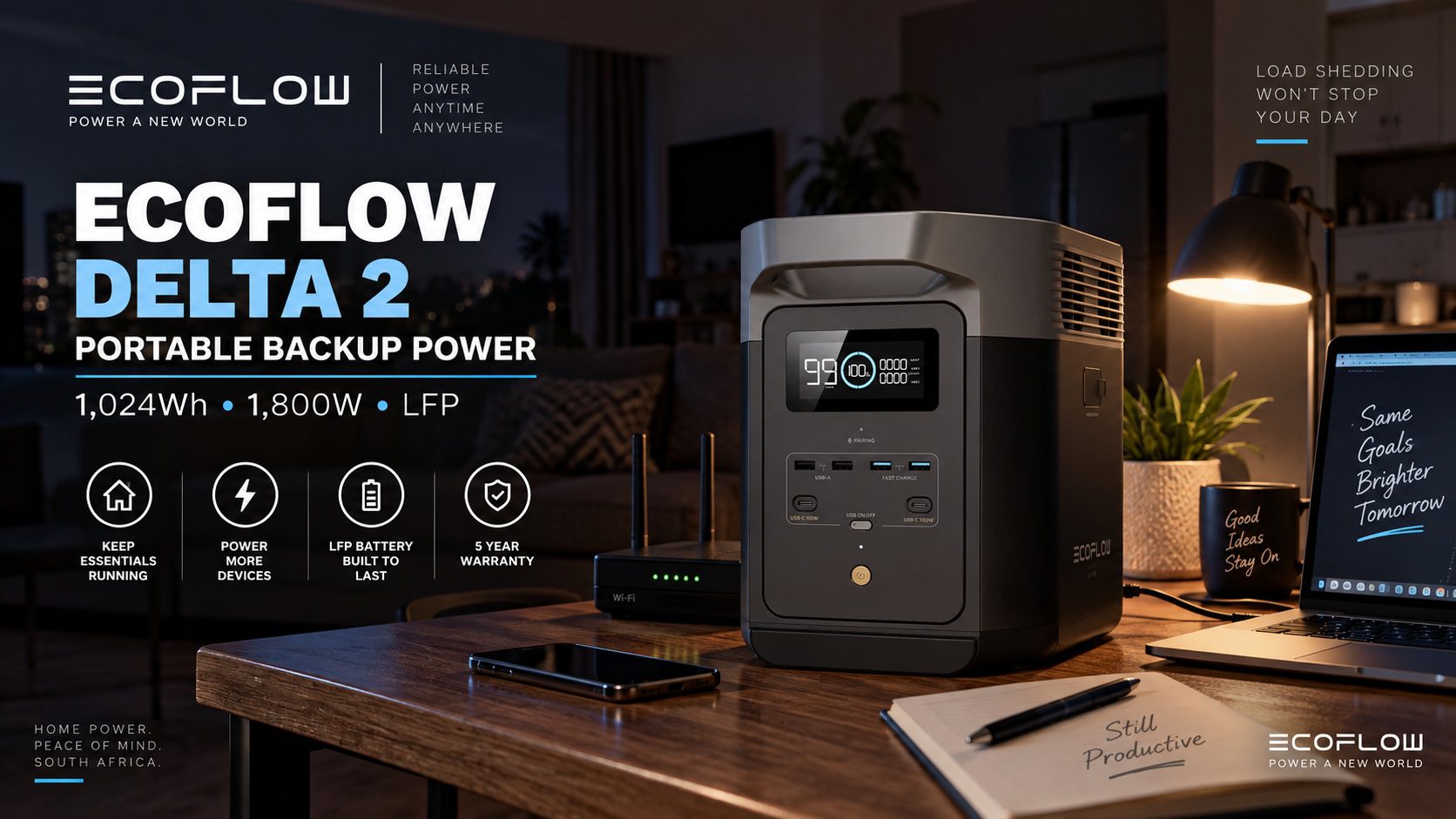
The EcoFlow DELTA 2 is a 1,024Wh portable power station built around an LFP battery and 1,800W AC inverter.
That combination gives it enough output to run considerably more than phones, routers and laptops.
EcoFlow positions the DELTA 2 for home backup, outdoor use and situations where conventional mains electricity is unavailable. Moreover, the South African version uses local-standard plugs.
Its battery capacity can also expand beyond the standard 1,024Wh.
Add an EcoFlow DELTA 2 Extra Battery and capacity reaches 2,048Wh. Alternatively, EcoFlow says a compatible DELTA Max Extra Battery can increase total capacity to 3,040Wh.
For South African households, that flexibility makes the DELTA 2 particularly interesting. Users can start with a portable backup system and expand its stored energy later if their requirements grow.
EcoFlow DELTA 2 starts with 1,024Wh
The EcoFlow DELTA 2 has a rated battery capacity of 1,024Wh.
Watt-hours describe stored energy rather than the maximum power an appliance can draw.
Therefore, capacity and output should not be confused.
A 1,024Wh battery determines roughly how much energy is available. Meanwhile, the inverter determines how much AC power the DELTA 2 can provide at a given moment.
Real runtime also depends on conversion losses, appliance behaviour and operating conditions.
Consequently, simply dividing 1,024Wh by an appliance’s wattage provides only an approximate theoretical runtime.
EcoFlow itself notes that actual runtime can vary.
1,800W AC output handles substantial appliances
The EcoFlow DELTA 2 provides 1,800W of total AC output.
EcoFlow rates surge output at 2,700W.
This gives the power station enough output for many common household devices, including televisions, computers, kitchen appliances and refrigeration equipment, provided the connected load remains within the system’s operating limits.
That last point matters.
A power station’s capacity does not mean every household appliance should be connected simultaneously.
Users need to consider both the continuous load and the starting requirements of individual devices.
X-Boost extends compatibility with demanding loads
EcoFlow also equips the DELTA 2 with X-Boost.
The South African specification lists maximum device power with X-Boost at 2,200W.
X-Boost is designed to allow the power station to operate certain higher-rated appliances by managing their supplied power.
However, this should not be interpreted as turning the DELTA 2 into a conventional 2,200W continuous-output inverter.
Its normal rated AC output remains 1,800W.
Users should therefore check appliance requirements carefully rather than assuming every 2,200W appliance will operate normally.
The DELTA 2 can power up to 13 devices
EcoFlow says users can connect as many as 13 devices simultaneously across the DELTA 2’s different outputs.
The South African specification includes six AC outlets.
It also provides two conventional USB-A ports, two USB-A fast-charge ports and two USB-C ports capable of up to 100W each.
DC options include a 126W car-power outlet and two DC5521 outputs.
That mixture makes the DELTA 2 useful for a workstation or temporary backup setup where several lower-power devices need electricity simultaneously.
Again, the combined load still needs to remain within the system’s output limits.
Two 100W USB-C ports can power laptops directly
The EcoFlow DELTA 2 provides two USB-C outputs capable of delivering up to 100W each.
That can be particularly useful for compatible laptops.
Instead of connecting the laptop’s AC charger to the inverter, a compatible device can draw power directly from USB-C.
The same ports can support phones, tablets and other USB-C electronics.
Direct DC charging can also avoid unnecessary AC conversion in suitable situations.
For a home office during an outage, the combination of AC outlets and high-power USB-C therefore gives users several ways to configure their equipment.
LFP battery chemistry targets longer service life
The EcoFlow DELTA 2 uses an LFP, or lithium iron phosphate, battery.
EcoFlow rates the battery for 3,000 complete charge-and-discharge cycles before capacity declines to 80% or more of its original level.
That does not mean the battery stops working after cycle 3,000.
Instead, it describes a point in the battery’s gradual ageing process.
For equipment intended to provide regular backup power, cycle life matters.
A power station that gets used frequently during outages can accumulate cycles much faster than a battery reserved for occasional camping trips.
A battery management system watches operating conditions
EcoFlow equips the DELTA 2 with a built-in battery management system.
A BMS monitors important battery operating conditions and provides protective controls.
This is especially important with a portable power station because the same battery may experience very different loads and charging conditions throughout its life.
Users should still follow EcoFlow’s operating and storage instructions.
A battery management system adds protection, but it does not make the product immune to inappropriate use, extreme environmental conditions or physical damage.
Capacity can grow to 3,040Wh
One of the strongest features of the EcoFlow DELTA 2 is expandability.
The standard unit provides 1,024Wh.
Connecting the DELTA 2 Extra Battery increases total capacity to 2,048Wh.
EcoFlow also supports a DELTA Max Extra Battery, taking the system to 3,040Wh.
That allows buyers to separate their initial purchase from future capacity requirements.
Someone who initially needs backup power for networking, a computer and a few essentials may find the standard battery sufficient.
If longer outages later become the priority, additional battery capacity can extend runtime without replacing the main DELTA 2.
Fast AC charging reduces turnaround time
The DELTA 2 supports 1,200W AC charging.
Fast charging matters because backup batteries are only useful during repeated outages if users have enough time to recharge them between interruptions.
EcoFlow markets the DELTA 2 around substantially faster AC charging than many traditional portable battery systems.
However, charging time depends on the starting battery level, settings and operating conditions.
The broader advantage remains straightforward: high AC input allows the battery to replenish quickly when mains electricity is available.
Solar input reaches 500W
The EcoFlow DELTA 2 supports up to 500W of solar input.
Its solar input specification is 11–60V at up to 15A.
EcoFlow says suitable solar configurations can recharge the DELTA 2 in approximately three to six hours under appropriate conditions.
Solar performance is highly dependent on the environment.
Panel orientation, weather, temperature, shading and available sunlight can all affect generation.
Therefore, the three-to-six-hour figure should be treated as an EcoFlow estimate under suitable conditions rather than a guaranteed South African charging time.
MPPT manages solar charging
EcoFlow uses an MPPT, or Maximum Power Point Tracking, controller for solar charging.
An MPPT system continuously works to find an efficient operating point for the connected solar array as conditions change.
That matters because solar-panel output does not remain constant throughout the day.
Cloud cover, sunlight angle and temperature can alter voltage and current.
EcoFlow claims its MPPT algorithm can achieve greater than 98% tracking efficiency.
TechnologyBlog has not independently tested that figure.
Car charging adds another option
The EcoFlow DELTA 2 can also charge from a 12V or 24V vehicle electrical system.
The standard car-charging specification is 8A.
That provides another way to replenish the battery while travelling.
It also strengthens the DELTA 2’s usefulness beyond the home.
A portable power station that can recharge from AC, solar or a vehicle gives users several options depending on where they are and what energy source is available.
Wi-Fi and Bluetooth connect the EcoFlow App
The EcoFlow DELTA 2 supports both Wi-Fi and Bluetooth.
Wi-Fi allows remote access when an appropriate network connection is available.
Bluetooth provides local connectivity, including situations where users are away from their normal network.
The EcoFlow App can display charging information and operating data.
Users can also adjust settings and change charging behaviour.
This is a practical example of connected technology because the app exposes information about the battery and gives users control over how the power station operates.
DELTA 2 can operate as an emergency power supply
EcoFlow supports EPS functionality on the DELTA 2.
This allows connected equipment to move onto battery power when the mains supply fails.
For South African users, that obviously has practical relevance during unexpected power interruptions.
However, an EPS should not automatically be described as identical to a dedicated online UPS.
Equipment can vary in its tolerance for transfer times and power interruptions.
Users with highly sensitive systems should therefore check their equipment requirements before depending on any portable power station as a UPS replacement.
Home backup is possible with a transfer switch
EcoFlow South Africa also documents using compatible portable power stations with a transfer switch for selected household circuits.
This creates a more integrated home-backup setup than running extension cables from the DELTA 2.
However, this is not a DIY connection.
EcoFlow South Africa specifically says transfer-switch installation should be performed by a licensed electrician or qualified professional.
The company also recommends receiving a Certificate of Compliance after installation.
An electrician should determine which circuits can safely run from the available power station capacity.
High-demand loads may need to remain excluded.
Selecting the right backup loads is essential
The EcoFlow DELTA 2 provides 1,800W of normal AC output.
That means home-backup planning should prioritise essential loads rather than treating the unit as a replacement for the entire electrical supply.
Networking equipment, lights, televisions, computers and some refrigeration equipment may form sensible backup loads depending on their consumption.
High-demand appliances require considerably more attention.
A geyser, stove, heater, pool pump or other substantial load can quickly exceed the available output or consume the stored energy.
EcoFlow itself advises users considering a transfer-switch installation to discuss excluded circuits with their electrician.
EcoFlow publishes example runtimes
EcoFlow provides estimated runtime examples for numerous devices.
For example, its South African page estimates around 58 hours for a 10W Wi-Fi router, 7.9 hours for a 110W television and roughly 1.8 hours for a 500W desktop PC.
A 120W refrigerator is estimated at seven to 14 hours.
These figures are EcoFlow calculations rather than TechnologyBlog test results.
Real equipment can also behave differently.
A refrigerator compressor cycles on and off, for example, while a computer’s consumption changes with workload.
The figures are therefore useful for planning, but they should not be treated as guaranteed runtimes.
Portability distinguishes DELTA 2 from fixed backup systems
The EcoFlow DELTA 2 measures approximately 400 × 211 × 281mm and weighs 12kg.
That is heavy enough to feel substantial, but still portable compared with permanently installed battery systems.
Portability changes how the product can be used.
It can serve a home office during an outage and later move to another part of the house.
It can also travel for outdoor activities or work where mains electricity is unavailable.
A fixed inverter-and-battery installation cannot provide that same flexibility without considerably more effort.
EcoFlow DELTA 2 specifications
| Specification | EcoFlow DELTA 2 |
|---|---|
| Product type | Portable power station |
| Battery capacity | 1,024Wh |
| Battery chemistry | LFP / LiFePO4 |
| Cycle life | 3,000 cycles to 80%+ capacity |
| AC output | 1,800W total |
| AC surge output | 2,700W |
| X-Boost maximum device power | 2,200W |
| AC outlets | 6 |
| USB-A | 2 × 12W |
| USB-A Fast Charge | 2 × 18W |
| USB-C | 2 × 100W |
| Car output | 126W |
| DC5521 outputs | 2 |
| AC charging | Up to 1,200W |
| Solar input | Up to 500W |
| Solar input range | 11–60V, 15A |
| Car charging | 12V/24V, 8A |
| Wi-Fi | Yes |
| Bluetooth | Yes |
| Expandable capacity | Up to 3,040Wh |
| Dimensions | 400 × 211 × 281mm |
| Weight | 12kg |
| South African plugs | Yes |
| South African availability | Confirmed |
Why the EcoFlow DELTA 2 makes sense in South Africa
The EcoFlow DELTA 2 occupies an interesting position between small portable batteries and permanently installed backup systems.
Its 1,024Wh capacity can keep essential electronics operating through an interruption.
Meanwhile, 1,800W AC output expands the range of equipment that can run from it.
LFP battery chemistry makes frequent cycling more practical, while fast AC charging helps the system recover when mains electricity returns.
Solar support adds another charging route.
Most importantly, EcoFlow officially sells this version with South African-standard plugs.
That removes one of the uncertainties frequently associated with imported portable power equipment.
EcoFlow DELTA 2 can grow with changing power needs
The strongest argument for the EcoFlow DELTA 2 may ultimately be flexibility.
At its simplest, it is a 1,024Wh portable battery with a 1,800W inverter.
That already makes it useful for computers, connectivity, entertainment and selected household appliances during an outage.
However, the system does not have to remain at that level.
Extra batteries can expand capacity. Solar panels can add renewable charging. App connectivity provides monitoring and control.
A professionally installed transfer switch can even integrate the power station with selected home circuits.
That gives South African users several ways to build around the same core device rather than deciding on the complete system from day one.