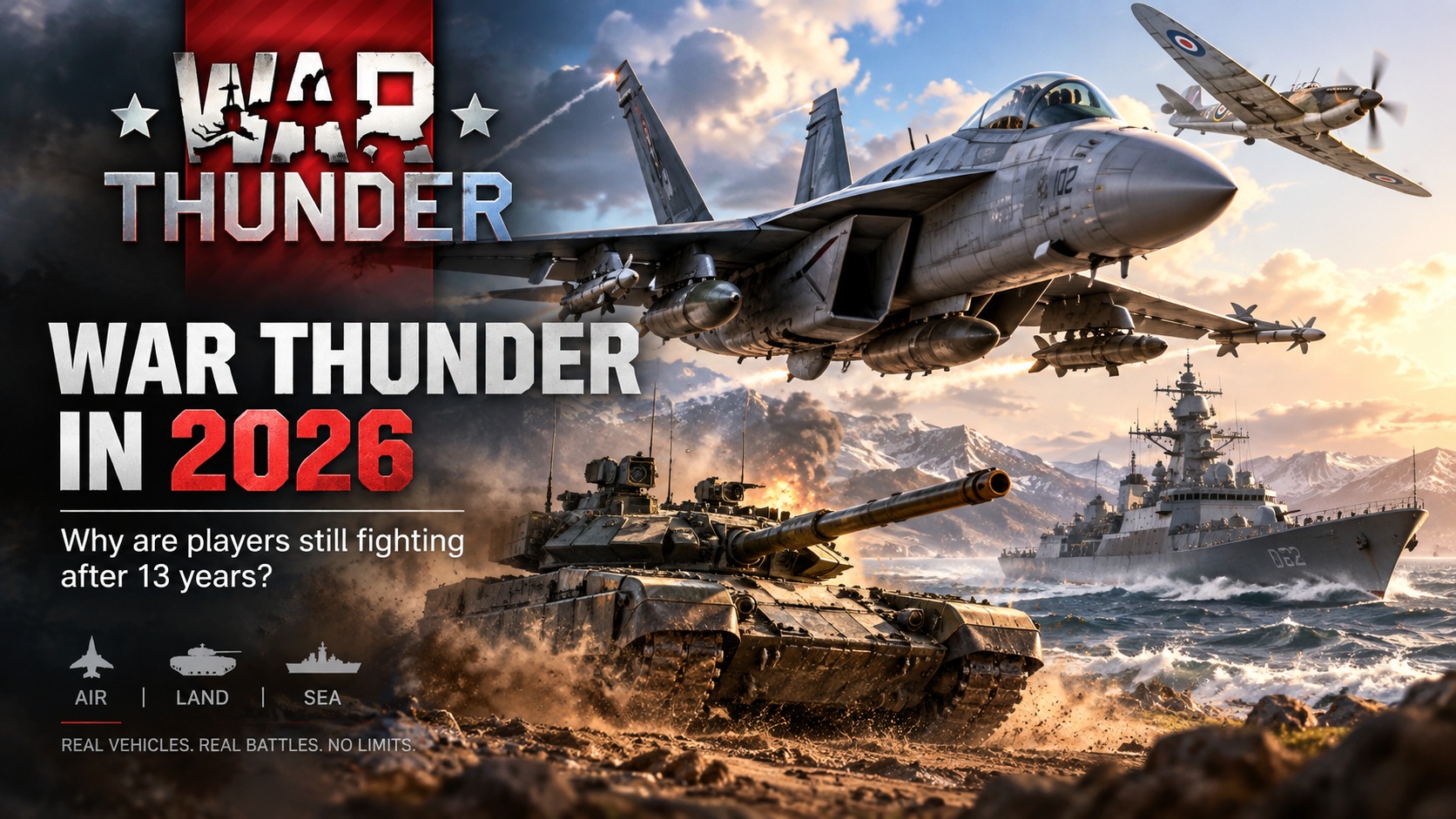
War Thunder in 2026: Why players are still fighting after 13 years
War Thunder in 2026 is one of the more remarkable longevity stories on Steam.
Gaijin Entertainment’s military combat game arrived on the platform in August 2013. Thirteen years later, it is still receiving major updates, adding new aircraft and armoured vehicles, expanding its naval forces and attracting tens of thousands of simultaneous Steam players.
That is not the normal life cycle of a multiplayer game.
Most online titles lose a large part of their audience after the first few years. Some continue through smaller communities. Others eventually enter maintenance mode.
War Thunder has done something different.
It has continued expanding.
The result is a game that now looks radically different from the one players encountered in 2013.
War Thunder in 2026 is much bigger than the original game
The earliest identity of War Thunder centred heavily on military aviation.
Aircraft remain one of its most important pillars, but the game now extends far beyond them.
Players can operate:
- propeller aircraft
- jet fighters
- bombers
- helicopters
- light tanks
- main battle tanks
- anti-aircraft systems
- armoured vehicles
- small naval craft
- major warships
That range gives War Thunder an unusually broad identity.
Calling it a flight game is no longer enough.
Calling it a tank game is equally incomplete.
It has evolved into a large military-vehicle platform.
The aircraft progression changes the nature of combat
One of War Thunder’s biggest strengths is that progression does not merely unlock slightly stronger versions of the same machine.
The technology itself changes.
Early aviation is dominated by propeller aircraft.
Players rely heavily on energy management, manoeuvring, gun positioning and altitude.
Then early jets appear.
Speeds increase.
Combat distances change.
Radar becomes more important.
Guided missiles enter the picture.
Eventually, modern aircraft introduce increasingly sophisticated sensors, countermeasures and long-range weapons.
A player moving from early propeller fighters into modern jet combat is almost learning another game.
That gives progression more meaning than a simple numerical increase.
Tanks transformed the scale of War Thunder
Ground Forces expanded the game considerably.
Armoured combat introduced another layer of military knowledge.
Tank battles are not simply about reducing an enemy’s health bar.
War Thunder models armour, penetration, crew, internal components and ammunition.
A projectile can penetrate one part of a vehicle while failing against another.
The angle of the armour matters.
The ammunition type matters.
The target’s internal layout matters.
A hit may destroy an engine.
Another may disable a gun.
A well-placed shot can eliminate a crew or ignite ammunition.
This makes knowledge one of the game’s most powerful weapons.
Learning weak points becomes part of progression
A new player may encounter a vehicle that appears almost impossible to destroy.
Over time, that changes.
The player learns where armour is thinner.
They recognise turret shapes.
They understand which ammunition performs better.
They know when to shoot a barrel, track or engine rather than trying to destroy the whole vehicle immediately.
This creates progression that exists outside the research tree.
The player’s knowledge grows alongside the vehicle collection.
That is one reason experienced players can remain engaged for years.
Arcade, Realistic and Simulator serve different audiences
War Thunder also gives players several levels of realism.
Arcade Battles provide more assistance and a faster introduction.
Realistic Battles remove some of those aids and place greater emphasis on vehicle knowledge and identification.
Simulator Battles move further towards a simulation-style experience.
This gives the game a wider audience than a hardcore simulator alone would attract.
Someone interested in military vehicles can start with a more accessible mode.
More experienced players can move towards systems that demand additional knowledge.
That structure helps explain some of the game’s longevity.
Combined battles make the battlefield more complicated
War Thunder becomes especially distinctive when different vehicle types interact.
A ground player may be fighting another tank while aircraft operate overhead.
Anti-aircraft vehicles need to watch the sky.
Helicopters can attack from different angles.
Guided weapons create threats at longer distances.
A battlefield therefore contains several overlapping systems.
A player cannot focus only on what is directly in front of them.
That complexity can be frustrating.
It can also create memorable moments that a simpler tank-only game cannot reproduce.
Helicopters introduced another combat layer
Attack helicopters behave very differently from fixed-wing aircraft.
They can use terrain as protection.
Some rely heavily on guided missiles.
Countermeasures matter.
Anti-aircraft systems become more important.
Helicopters therefore added another class of threat to combined battles.
This is a recurring pattern in War Thunder.
Gaijin does not simply add another vehicle model.
New categories can introduce new tactical problems.
That helps keep the game from becoming static.
Naval Forces expanded the game again
War Thunder eventually moved onto the water.
Naval combat introduced small vessels and larger warships.
The scale and pacing are completely different from aircraft or tanks.
Engagement distances change.
Weapon systems change.
Movement becomes slower and more deliberate.
Damage modelling becomes another technical challenge.
The naval side may not attract the same visibility as aircraft and tanks, but it shows how broad Gaijin’s ambition has become.
Few military games attempt to support this many different types of combat inside one ecosystem.
More than 3,000 vehicles create enormous depth
War Thunder now contains more than 3,000 aircraft, helicopters, tanks, ships and other vehicles.
That scale gives players enormous freedom.
Someone can specialise almost entirely in aviation.
Another player may focus on ground combat.
Another can spend most of their time with naval forces.
Then the national technology trees create another layer.
Different countries developed military equipment with different priorities.
Aircraft characteristics differ.
Tank design philosophies differ.
Armour strategies vary.
Weapon systems change.
Completing one tree does not mean the player has seen everything.
Different nations change the experience
Starting another nation can feel like beginning a new progression campaign.
Some vehicle trees emphasise mobility.
Others offer strong armour.
Aircraft performance differs.
Weapons and ammunition change.
Certain eras may be stronger or weaker for specific nations.
That variation gives players reasons to begin another line even after hundreds of hours.
The progression system therefore creates a massive amount of potential playtime.
The grind is also one of War Thunder’s biggest criticisms
The same system that gives the game longevity can create frustration.
Thousands of vehicles mean thousands of unlocks.
Research takes time.
In-game currency matters.
Reaching advanced equipment can require a significant commitment.
War Thunder is free-to-play, so its progression systems are closely tied to its business model.
Players can install the game without paying.
However, premium accounts, premium vehicles and other purchases can accelerate or alter progression.
That balance has been debated throughout the game’s life.
Some players enjoy the long-term progression.
Others see it as too demanding.
War Thunder in 2026 still has a huge Steam audience
The current player population makes the game’s age particularly impressive.
Steam activity continues to reach tens of thousands of simultaneous players.
A September 2026 SteamDB snapshot placed the number well above 70,000 players in-game on Steam at one point.
That figure changes constantly.
It is a concurrent snapshot rather than a count of unique players.
It also represents Steam only.
War Thunder operates across multiple platforms, so the total cross-platform audience is larger than the Steam figure alone.
Even with that qualification, the Steam population is substantial for a game released there in 2013.
Player activity does not mean everyone is happy
The review picture is more complicated.
Longer-term Steam sentiment is stronger than the latest recent-review period.
Recent reviews are more divided.
That contrast is useful.
A game can have a large active population while still receiving criticism.
Players may love the underlying combat but dislike parts of the progression.
They may enjoy a specific technology tier but disagree with balancing changes.
They may continue playing while criticising monetisation or update decisions.
Popularity and satisfaction are related, but they are not the same measurement.
Free-to-play makes returning easy
War Thunder benefits enormously from having no upfront purchase price.
A former player can reinstall it easily.
A new player can try it without buying a full-price game.
Someone curious about tanks or military aviation can download it and see whether the combat systems appeal to them.
This reduces the risk normally associated with trying an older title.
The bigger investment comes later.
Time.
Learning War Thunder can take far longer than installing it.
The historical range keeps expanding
Another reason for its longevity is that military history gives Gaijin an extraordinary amount of source material.
War Thunder began with earlier aircraft and vehicles.
Modern content now includes equipment with advanced radar, missiles, thermal imaging, countermeasures and sophisticated electronic systems.
That means the technological ceiling keeps moving.
The game has effectively grown from Second World War-style vehicle combat into a platform covering much of the 20th century and increasingly modern military hardware.
That creates a near-endless development pipeline.
Modern vehicles create major balancing problems
Real military equipment was never designed to provide fair multiplayer matches.
A weapon system may exist specifically to attack an opponent from a range where retaliation is difficult.
One country’s technology may advance faster in a particular area.
Some vehicles were designed for highly specialised roles.
Gaijin therefore needs to translate real-world military capability into a competitive multiplayer structure.
The Battle Rating system is one of the main tools used for that purpose.
It is also one of the game’s most frequently debated systems.
Battle Rating matters more than the calendar
Two vehicles being built during similar historical periods does not automatically make them equal opponents.
War Thunder therefore organises much of its matchmaking around capability rather than strict historical dates.
This can produce unusual combinations.
However, completely historical matchmaking could create even larger balance problems.
Battle Ratings are adjusted as new vehicles arrive and as performance data changes.
That gives Gaijin a permanent balancing challenge.
The more vehicles the game adds, the harder that challenge becomes.
Heavy Cavalry showed that major development is continuing
The June 2026 Heavy Cavalry update showed that Gaijin is not treating War Thunder as a finished game.
The update introduced new vehicles and revised existing content.
Maps received visual changes.
Gameplay systems continued evolving.
The important point is the scale of the work.
War Thunder is more than a decade old, yet Gaijin continues producing releases that resemble full-scale live-service expansions rather than occasional maintenance patches.
That is a major reason players continue returning.
Sky Odyssey is the next major step
The next major update is Sky Odyssey.
Its development server opened in September 2026.
Because the content is still being tested, details can change before release.
That caveat is important.
Dev-server statistics should never be treated as final.
Vehicles can be adjusted.
Battle Ratings can change.
Weapons can change.
Some content may move to a different release.
Still, the initial test gives a clear indication of where War Thunder is going next.
Greece is entering through Israel
One of Sky Odyssey’s most interesting additions is Greece.
Greek aircraft and ground vehicles are being introduced as sub-trees connected to Israel.
This gives Gaijin another way to expand military representation without creating a completely separate full technology tree.
The Greek aircraft line includes machines from different historical periods, eventually reaching modern fighters.
That adds depth to the Israeli tree while also bringing another country’s equipment into the game.
New jets continue pushing the game forward
The Sky Odyssey test build includes more advanced combat aircraft.
The MiG-35 is one of the most notable additions.
China is also receiving the J-16.
Greek aviation adds aircraft including the Rafale EG and Mirage 2000-5EG.
American aviation gains another F-14D variant.
These additions show how far War Thunder has moved from its earliest aviation focus.
Top-tier combat increasingly involves information systems rather than just flight performance.
Radar.
Missiles.
Countermeasures.
Target detection.
Electronic systems.
Modern War Thunder can feel completely different from its early tiers.
Ground Forces continue expanding at the same time
Sky Odyssey is not only an aviation update.
The initial development-server lineup also includes new tanks, self-propelled artillery, anti-aircraft systems and other ground vehicles.
This simultaneous expansion is one of War Thunder’s defining features.
A major update may need to support:
- aviation players
- ground players
- helicopter players
- naval players
Each group expects meaningful additions.
That gives Gaijin a complicated development problem.
It also means major updates usually contain something for several different parts of the community.
New maps matter as much as new vehicles
The Sky Odyssey test also includes a new Ground Battles location.
Maps can have a major impact on vehicle balance.
Long sight lines favour certain guns and optics.
Urban environments create close-range combat.
Elevation provides hull-down positions.
Open terrain creates vulnerability.
Aircraft interact with those same battlefields from above.
A new map therefore adds more than visual variety.
Players need to learn another tactical environment.
Old battlefields continue changing
Gaijin also revisits existing maps.
That is valuable in a game where veteran players may know particular locations almost instinctively.
Changing terrain, routes or sight lines can disrupt established habits.
It prevents every battlefield from becoming completely solved.
Those adjustments are less marketable than a famous new fighter jet.
However, they can have a large effect on day-to-day gameplay.
Experience becomes one of the most important advantages
A veteran War Thunder player has knowledge that cannot simply be bought.
They recognise vehicles by silhouette.
They know common weak points.
They understand map routes.
They know which ammunition is likely to work.
They understand what an opposing aircraft can carry.
They recognise dangerous anti-aircraft systems.
They know when an opponent is vulnerable.
That accumulated knowledge creates a powerful reason to keep playing.
The more time someone invests, the more useful their experience becomes.
The same depth can intimidate newcomers
A new player enters a game containing thousands of vehicles, several combat modes and years of accumulated systems.
That can be overwhelming.
Ammunition types differ.
Controls change between aircraft and tanks.
Radar introduces another layer.
Modern aircraft require more technical knowledge.
Vehicle weaknesses are not always obvious.
The easiest mistake is trying to understand everything immediately.
War Thunder is better approached gradually.
The early ranks teach fundamentals that remain useful later.
Top tier is not the only reason to play
Modern jets and tanks naturally dominate promotional material.
They look impressive.
They involve advanced systems.
However, many players prefer earlier technology.
Propeller aircraft create intense dogfights.
Second World War tanks offer a very different armoured-combat experience.
Early jets occupy another distinct period.
War Thunder’s enormous historical range means the journey itself can be more interesting than simply rushing towards the newest equipment.
A player does not need to reach top tier to find the game worthwhile.
South African vehicles give the game a local connection
South African players also have a genuine reason to recognise part of their own military history in War Thunder.
South African vehicles appear through a sub-tree within the British Ground Forces line.
That provides more than a flag or cosmetic reference.
South African military equipment forms part of the actual progression path.
For a global military game, that is a meaningful local connection.
It also gives TechnologyBlog a much stronger South African angle than simply discussing servers or regional availability.
The South African sub-tree has its own identity
South African armoured vehicles often developed around mobility and local operational requirements.
That gives them a distinct character inside the broader British tree.
It also demonstrates why sub-trees are useful.
Some countries have important military vehicles but not enough equipment across every historical period to create a full standalone technology tree.
A sub-tree allows those machines to appear without Gaijin having to fill large historical gaps artificially.
The Greek addition in Sky Odyssey follows a similar idea.
War Thunder is not a pure military simulator
The game’s realism should still be kept in perspective.
War Thunder models armour, ballistics, flight performance, radar, sensors and damage with far more detail than an arcade action game.
However, it remains a competitive multiplayer title.
Real warfare is not balanced.
Real armies do not spawn equal teams on opposite sides of a map.
Real vehicles do not have Battle Ratings.
Gaijin therefore compromises between authenticity, gameplay and competitive balance.
That balance is one of the reasons War Thunder appeals to a wider audience than a strict simulator.
Its community cares deeply about technical accuracy
Military-game audiences tend to notice details.
Players study armour.
They compare ammunition.
They research aircraft performance.
They examine historical documents.
They submit reports when something appears inaccurate.
That gives Gaijin access to an unusually knowledgeable community.
It also means mistakes can become highly visible.
The relationship between developer and players can become argumentative precisely because both sides care about technical detail.
War Thunder keeps changing because updates never really stop
One of the strongest reasons for the game’s longevity is its update rhythm.
A major patch arrives.
Smaller changes follow.
Vehicles are rebalanced.
Maps change.
Bugs are fixed.
Events appear.
More vehicles are announced.
Another major update enters testing.
Players returning after a long break may find that systems they once knew have changed significantly.
War Thunder therefore does not feel like a preserved 2013 game.
It feels like a platform that has been continuously rebuilt around its existing foundation.
Why is War Thunder still popular in 2026?
Several factors reinforce one another.
It is free-to-play.
The vehicle catalogue is enormous.
There are several combat modes.
Cross-platform support broadens the available player population.
New content continues arriving.
Military history gives Gaijin years of possible additions.
Most importantly, the core combat rewards skill and knowledge.
A player can still improve after hundreds of hours.
Games that continue teaching players something new often retain them for a very long time.
The game has grown alongside its community
Someone who started War Thunder in 2013 could have watched the game change almost continuously.
Aircraft were joined by tanks.
Ships arrived.
Helicopters expanded combined combat.
Modern jets appeared.
Radar systems became more advanced.
Guided missiles became increasingly common.
New nations and sub-trees entered the game.
The technological range expanded while the real game aged.
That gives veteran players a sense that they have watched the project evolve rather than simply replaying the same old release.
Its age has become one of its strengths
Age normally works against multiplayer games.
Here, it has also created a competitive advantage.
More than a decade of development produced thousands of vehicles, dozens of maps and an enormous amount of accumulated balance work.
A new competitor would not simply need strong tank combat or good aircraft physics.
It would need years of content to match War Thunder’s breadth.
That accumulated scale makes the game increasingly difficult to replicate.
Is War Thunder worth starting in 2026?
For players interested in military vehicles, there is little risk in trying it because the game is free.
The real question is whether its progression structure suits you.
A new player should expect a learning curve.
They should also expect a long progression path.
Someone who enjoys researching vehicles, learning armour, understanding ballistics and gradually mastering different machines can find an enormous amount of depth.
A player who wants immediate access to modern equipment may find the grind frustrating.
That difference matters more than the game’s age.
War Thunder in 2026 is still moving forward
War Thunder in 2026 is not surviving because Gaijin keeps an old game online.
It survives because the game continues expanding.
Its roster now contains thousands of military vehicles.
New nations and sub-trees still arrive.
Modern technology keeps moving the upper tiers forward.
Major updates remain part of the development cycle.
Tens of thousands of Steam players still appear online simultaneously.
Sky Odyssey is preparing another wave of content.
Thirteen years after its Steam launch, War Thunder remains active enough that its age has become part of the achievement.
Players are still learning vehicles.
Still arguing about balance.
Still unlocking new technology.
Still getting into tanks, aircraft and ships.
And Gaijin is still giving them more reasons to return.


