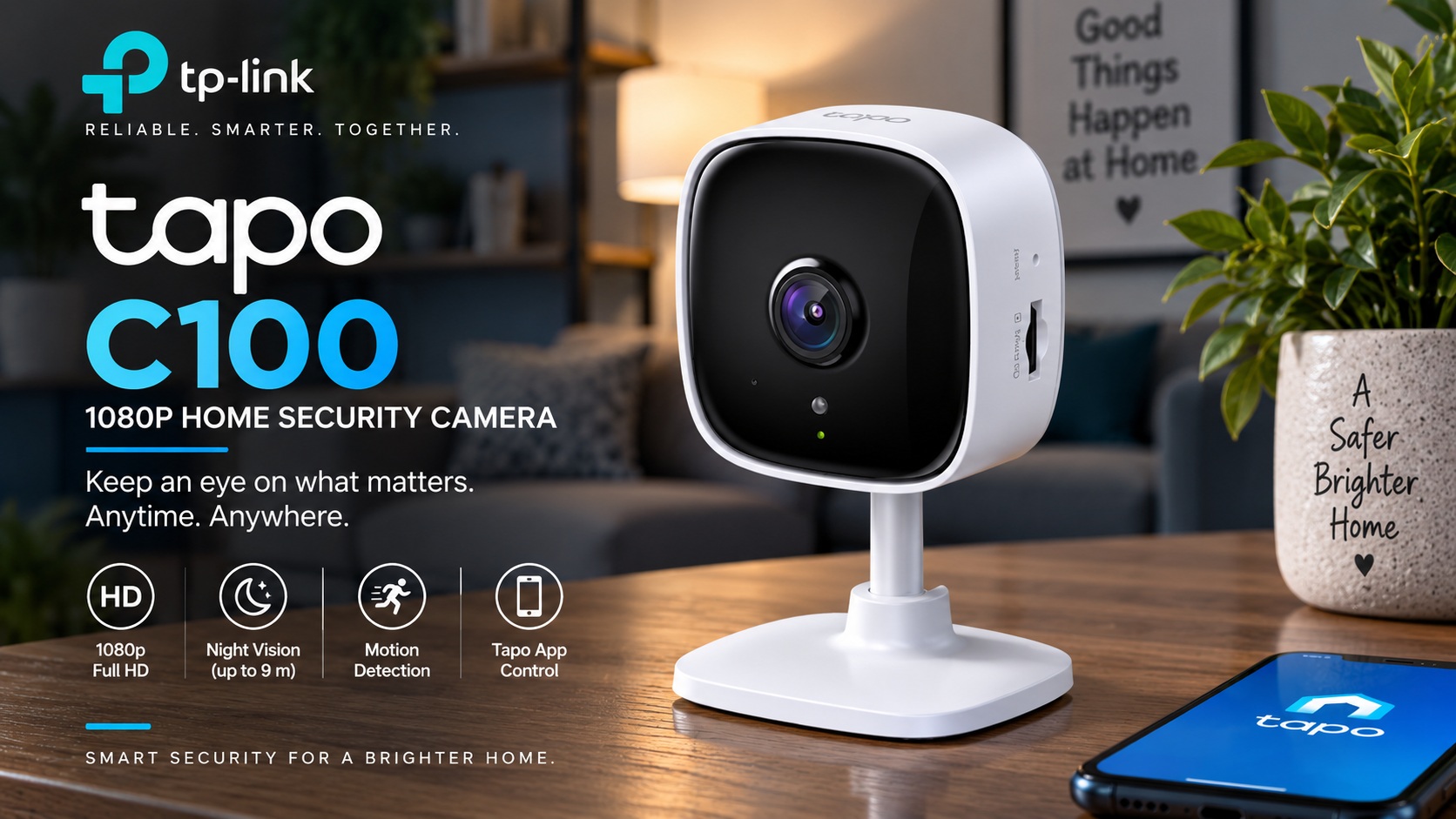
TP-Link Tapo C100 brings simple 1080p monitoring to the smart home
The TP-Link Tapo C100 is built around a straightforward idea: give users indoor video monitoring without turning the setup into a complicated security system.
It records at 1920 × 1080 resolution, connects directly to 2.4GHz Wi-Fi and works through the Tapo app. Meanwhile, its current South African specification includes motion detection, person detection, baby-cry detection, two-way audio and infrared night vision.
That combination makes the C100 useful for several roles.
It can watch an entrance or living area, help keep an eye on pets, or function as a basic indoor baby-monitoring camera. At the same time, local microSD storage means users do not necessarily need a cloud subscription to record footage.
TP-Link Tapo C100 records in 1080p
The TP-Link Tapo C100 records video at 1920 × 1080 Full HD.
That is not the highest resolution available on modern home-security cameras, but it remains enough for general indoor monitoring, particularly across a single room.
TP-Link lists support for 15, 20, 25 and 30fps, with 15fps as the default setting on the current V5.6 specification.
Higher frame rates can produce smoother movement, although they may also increase storage and network requirements.
For everyday monitoring, the more important question is whether the camera captures enough detail for the intended room.
A compact indoor camera covering a lounge or doorway has different requirements from an outdoor camera trying to identify someone across a driveway.
The current model has a wide field of view
TP-Link specifies a 117-degree diagonal field of view, with approximately 98.8 degrees horizontally and 53.5 degrees vertically.
That relatively wide view helps a stationary camera cover more of a room.
As a result, users may not need a motorised pan-and-tilt system when the main goal is to watch one defined area.
Placement still matters.
Mounting the camera too close to a wall or large object can waste part of that wide angle. Therefore, positioning it in a corner or slightly elevated location may provide a more useful overview.
Night vision reaches up to 12 metres on V5.6
The current South African V5.6 listing uses an 850nm infrared LED and specifies night vision up to 12 metres, or 40 feet.
This allows the camera to continue monitoring a dark room without visible lighting.
However, hardware version matters here.
TP-Link’s older V4.2 South African page lists night vision up to 30 feet instead.
Therefore, buyers should check the hardware revision on the product packaging rather than assuming every C100 has exactly the same night-vision specification.
That distinction is especially important because the C100 name has remained the same across several revisions.
Motion and person detection reduce unnecessary alerts
The Tapo C100 supports both motion detection and person detection on the current specification.
Basic motion detection reacts whenever movement appears in the scene.
Person detection adds another layer by attempting to distinguish people from other movement.
That can reduce the number of irrelevant alerts caused by changing light, pets or objects moving in the camera’s field of view.
Users can also create activity zones.
These zones allow the camera to focus detection on specific parts of the image.
For example, someone could monitor a doorway while ignoring movement from a television on the opposite side of the room.
Baby-cry detection broadens its role
TP-Link also includes baby-cry detection on the current C100 hardware.
That gives the camera another possible use beyond general security.
Parents can use it as a basic video monitor while receiving alerts when the system detects crying.
However, it is important not to treat the feature as medical monitoring.
The camera detects sound patterns; it does not monitor breathing, heart rate or any other health indicator.
Consequently, baby-cry detection should be viewed as a convenience feature rather than a safety or medical device.
Two-way audio lets users respond remotely
A built-in microphone and speaker provide two-way audio.
That means users can hear what is happening near the camera and speak through it using the Tapo app.
For home security, this can allow someone to respond to an unexpected visitor inside a monitored area.
For pet owners, it offers a way to speak to an animal while away from home.
It can also be useful in a family setting where someone needs to communicate quickly without making a phone call.
TP-Link lists noise cancellation as part of the two-way audio system on the current version.
A built-in alarm can draw attention to movement
The C100 also includes a sound and light alarm.
Users can trigger audio and visual effects intended to discourage unwanted visitors.
TP-Link specifies a siren level of approximately 91dB measured at 10cm on the V5.6 specification.
That measurement distance matters.
A siren will sound quieter as the listener moves farther away, so the 91dB figure should not be interpreted as the volume someone will experience across a room.
Nevertheless, the feature gives the small indoor camera an active response option rather than limiting it to passive recording.
Local storage reaches 512GB
One of the C100’s most useful features is its microSD card slot.
The current South African V5.6 model supports cards up to 512GB.
The card is sold separately.
Local recording means users can keep footage on the camera rather than relying exclusively on an online subscription.
That can reduce recurring costs and keep video recording available even when a user does not subscribe to Tapo Care.
However, local storage has its own limitation.
If someone steals or damages the camera, footage stored on the microSD card could disappear with it.
Cloud storage and local storage therefore solve slightly different problems.
Tapo Care adds optional cloud storage
TP-Link also supports Tapo Care cloud storage.
The service requires a subscription and can provide cloud-based video storage and enhanced notification features.
This gives users a choice.
Someone who wants to avoid recurring fees can use a microSD card.
Another user may prefer cloud storage because recordings remain available even if the camera itself disappears.
For some households, using both forms of storage may provide the most resilience.
The key point is that cloud storage is optional rather than a requirement for the C100’s basic local-recording capability.
Privacy zones can block parts of the image
Indoor cameras create legitimate privacy concerns because they operate inside living spaces.
TP-Link addresses part of that problem with customisable privacy zones.
Users can block selected areas of the camera’s view so those sections are excluded from recording.
For example, the camera could monitor an entrance while blocking another part of the room.
This is particularly useful in shared living areas.
However, good camera placement remains important.
A software privacy zone should complement sensible positioning rather than becoming the only privacy measure.
The C100 can share access with other users
Tapo also supports device sharing.
That allows family members or other authorised users to access the camera through the Tapo ecosystem.
Shared access can be useful when several members of a household need to monitor the same property.
However, security becomes more important as access expands.
Users should protect their Tapo accounts with strong unique passwords and should review who still needs access when household circumstances change.
A smart camera is only as useful as the security surrounding the account controlling it.
2.4GHz Wi-Fi keeps compatibility broad
The Tapo C100 connects using 2.4GHz 802.11b/g/n Wi-Fi.
There is no Ethernet port.
The lack of 5GHz Wi-Fi is not necessarily a major disadvantage for this type of camera.
2.4GHz networks generally provide better range through walls than higher-frequency 5GHz connections, while 1080p video does not require the bandwidth associated with modern Wi-Fi 6 or Wi-Fi 7 equipment.
However, users need a reliable 2.4GHz signal where the camera will be installed.
Poor wireless coverage can still cause delayed video, connection failures or unreliable notifications.
The camera supports RTSP and ONVIF
One specification that makes the C100 particularly interesting is support for RTSP and ONVIF on the current version.
Those standards can allow the camera to work with compatible third-party video systems and network video recorders.
That gives technically inclined users more flexibility than an ecosystem that works only through the manufacturer’s mobile application.
Compatibility still depends on the third-party platform, firmware and configuration.
Nevertheless, RTSP and ONVIF support make the C100 potentially useful beyond a basic Tapo-only setup.
Google Assistant and Alexa are supported
TP-Link lists Google Assistant and Amazon Alexa integration for the C100.
That can allow compatible smart displays to show the camera feed through supported voice commands.
It also gives the C100 a place in broader smart-home setups.
However, voice assistant support should not be confused with Matter support.
TP-Link does not list Matter as a C100 feature on the current South African specification.
Therefore, the camera should be evaluated around its existing Tapo, Google and Alexa integrations rather than assuming newer smart-home standards are available.
There is no smart-home hub requirement
The C100 connects directly to Wi-Fi.
As a result, users do not need a separate Tapo hub simply to operate the camera.
That lowers the entry cost for someone adding a single camera.
Install the Tapo app, connect the camera to the wireless network and complete the setup process.
The lack of a hub also makes it easier to expand gradually.
Someone can start with one camera and add more Tapo devices later without first investing in a central controller.
The power adapter works with South African mains voltage
TP-Link lists the supplied adapter input as 100–240V AC at 50/60Hz, with a 9V DC output for the camera.
That voltage range covers South Africa’s mains supply.
However, buyers should still confirm that locally sold units include the appropriate plug for their market rather than assuming an imported package will contain the same adapter fitting.
The camera uses a 3-metre power cable, which gives users some flexibility when positioning it away from a wall socket.
Unlike a battery-powered security camera, however, the C100 requires continuous external power.
Tabletop or ceiling mounting adds flexibility
The Tapo C100 can sit on a surface or mount to a ceiling.
TP-Link includes mounting screws and a mounting template in the package.
The camera measures approximately 67.6 × 54.6 × 98.9mm, making it relatively compact.
Ceiling mounting can provide a better room overview while also placing the camera farther out of reach.
A tabletop position, meanwhile, makes installation easier and allows the camera to move between rooms when necessary.
It is an indoor camera
One limitation should be clear.
TP-Link does not list weather resistance for the C100.
Therefore, it should be treated as an indoor camera.
It is not designed as an outdoor replacement for a weather-sealed security camera.
Placing it under an awning or near an open window does not give it an official weather-resistance rating.
For exterior surveillance, users should choose a camera specifically designed and certified for outdoor conditions.
The Tapo C100 fits below the Tapo D225 in the security ecosystem
TechnologyBlog has already looked at the TP-Link Tapo D225, which tackles security from a different angle.
The D225 focuses on the front door, while the C100 is designed to watch indoor spaces.
That makes the two products complementary rather than competing devices.
A household could use a video doorbell to monitor visitors at the entrance and an indoor camera for selected interior areas.
This also starts to show the broader strategy behind Tapo.
Instead of relying on one smart-security device, users can gradually build a connected system around cameras, doorbells, plugs, sensors and other compatible products.
Who is the TP-Link Tapo C100 for?
The TP-Link Tapo C100 makes the strongest case for someone who wants simple indoor monitoring without buying a larger surveillance system.
Its 1080p resolution suits normal room monitoring.
Person and motion detection make alerts more useful, while baby-cry detection expands its role for family use.
Meanwhile, two-way audio allows remote communication.
Local microSD storage is another major advantage for buyers who want recording without automatically committing to a subscription.
The camera also suits more advanced users because RTSP and ONVIF support open the door to compatible third-party systems.
Is the TP-Link Tapo C100 still worth considering?
The TP-Link Tapo C100 is not trying to compete with premium multi-camera surveillance systems.
Instead, it concentrates on the features most households actually use.
It records in 1080p, detects movement and people, works in darkness, stores footage locally and lets users communicate through the camera.
The current V5.6 model also supports up to 512GB microSD storage, RTSP and ONVIF.
Most importantly, users can start with one camera and a Wi-Fi connection without purchasing a separate hub.
There are limitations.
It is indoor-only, relies on wired power and uses 2.4GHz Wi-Fi. Hardware revisions also mean buyers should check exactly which C100 version they are purchasing.
Nevertheless, the C100 remains a straightforward entry point into indoor smart-home monitoring.
For a household that wants to watch a room, receive useful alerts and keep footage locally, simplicity may be its strongest feature.
TP-Link Tapo C100 specifications
| Specification | TP-Link Tapo C100 V5.6 |
|---|---|
| Type | Indoor Wi-Fi security camera |
| Maximum resolution | 1920 × 1080 |
| Frame rate | 15/20/25/30fps |
| Default frame rate | 15fps |
| Sensor | 1/3-inch progressive scan CMOS |
| Lens | 3.15mm |
| Aperture | F2.0 |
| Diagonal field of view | 117° |
| Horizontal field of view | 98.8° |
| Vertical field of view | 53.5° |
| Night vision | 850nm infrared |
| Night-vision distance | Up to 12m / 40ft on V5.6 |
| Motion detection | Yes |
| Person detection | Yes |
| Baby-cry detection | Yes |
| Activity zones | Yes |
| Privacy zones | Yes |
| Two-way audio | Yes |
| Microphone | Built in |
| Speaker | Built in |
| Alarm | Sound and light |
| Local storage | microSD up to 512GB |
| Cloud storage | Tapo Care, subscription required |
| Wi-Fi | 2.4GHz 802.11b/g/n |
| Ethernet | No |
| RTSP | Yes |
| ONVIF | Yes |
| Google Assistant | Yes |
| Amazon Alexa | Yes |
| Matter | Not listed |
| Hub required | No |
| Power | 9V DC |
| Adapter input | 100–240V, 50/60Hz |
| Power cable | 3m |
| Mounting | Tabletop or ceiling |
| Dimensions | Approx. 67.6 × 54.6 × 98.9mm |
| Weather resistance | None listed |
| Operating temperature | 0°C to 40°C |


