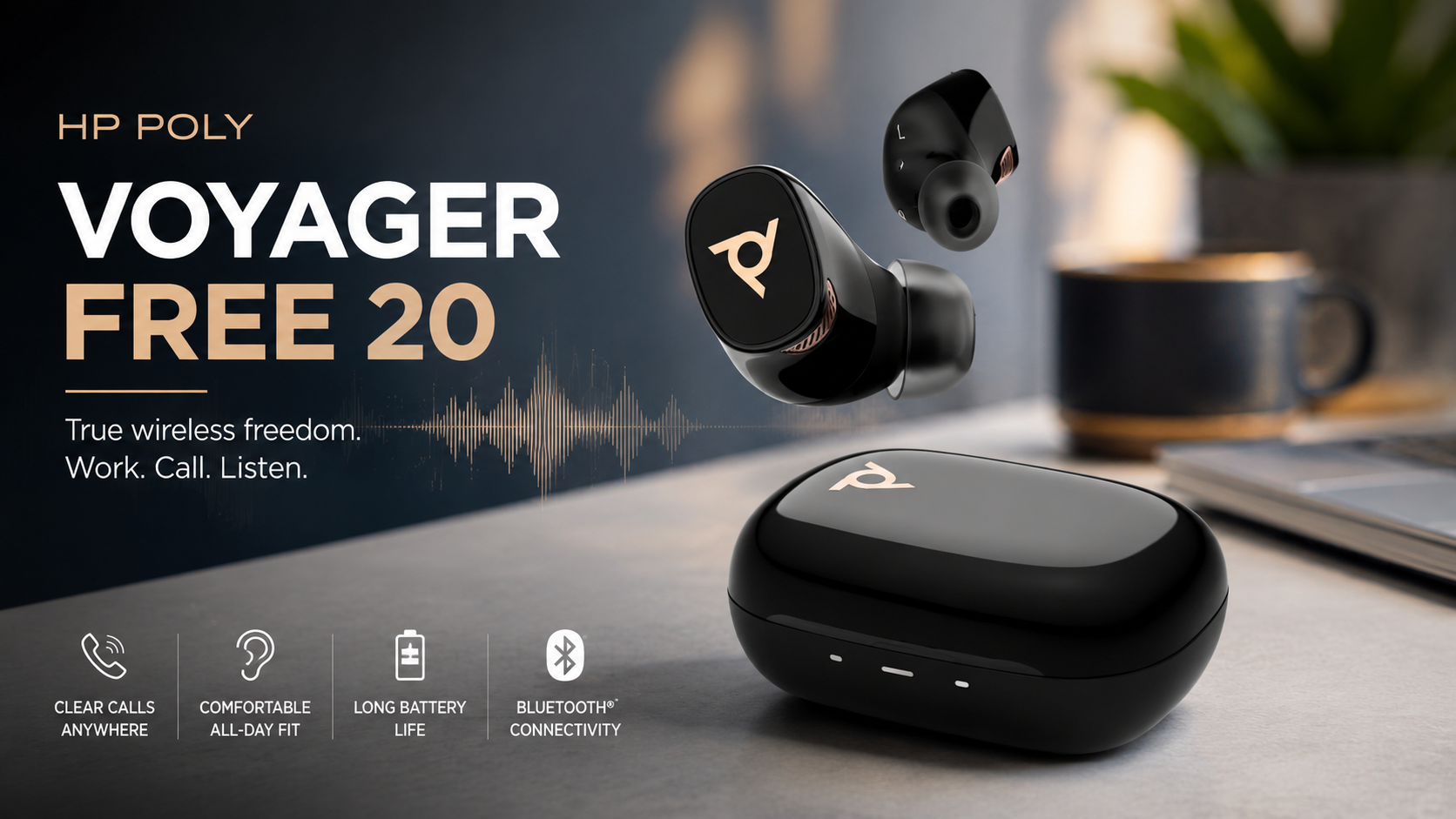
HP Poly Voyager Free 20 earbuds target calls and hybrid work
The HP Poly Voyager Free 20 combines six microphones, adaptive noise cancellation, multipoint Bluetooth and up to 12 hours of listening, but South African pricing and retail availability remain unconfirmed.
The HP Poly Voyager Free 20 is a pair of true wireless earbuds designed for people who move between work calls, music, commuting and multiple devices.
Its main features include adaptive active noise cancellation, six microphones, transparency mode, multipoint Bluetooth and Qi wireless charging.
The earbuds can maintain active connections to two devices, allowing a user to move between a computer and smartphone without repeatedly disconnecting and pairing them. HP rates the earbuds for up to 12 hours of listening with ANC disabled or eight hours with it enabled.
The Voyager Free 20 has a dedicated page on HP’s South African website. However, that page provides a contact-sales route rather than a rand price, retailer list or direct online checkout option. A local product listing therefore does not confirm that units are currently available from South African retailers.
Six microphones are designed to improve calls
Each Voyager Free 20 earbud contains three noise-cancelling microphones, giving the pair a total of six.
HP says a two-microphone beamforming array focuses on the wearer’s voice, while a third microphone becomes active in windy conditions. An AI-based noise-reduction system attempts to recognise and reduce background noise before it reaches the person at the other end of a call.
This addresses a different problem from active noise cancellation.
ANC is intended to reduce the environmental noise heard by the person wearing the earbuds. Microphone noise reduction instead attempts to make that person’s voice clearer to others during calls.
The listed microphone frequency range is 100 Hz to 7.8 kHz. HP positions the product primarily for calls and general communication rather than professional audio recording.
The earbuds use Qualcomm’s S3 Gen 2 Sound Platform with on-device AI. However, TechnologyBlog.co.za has not found independent comparative testing showing how effectively their microphone system performs against competing earbuds in noisy environments.
Adaptive ANC responds to changing surroundings
HP describes the Voyager Free 20 as using adaptive active noise cancellation. Its support specifications also refer to hybrid ANC.
The system is designed to adjust noise reduction as the surrounding environment changes rather than remaining at one fixed level. This may be useful when moving between a quiet room, an office and public transport without manually changing the setting each time.
A transparency mode allows more external sound to pass through the microphones. This can make it easier to hear announcements or nearby conversations without removing the earbuds.
Transparency mode should not be treated as a substitute for situational awareness. Users should remove or disable the earbuds where listening could create a safety risk.
The effectiveness of both ANC and transparency mode will depend partly on the ear-tip fit. A poor seal can weaken bass response and reduce passive isolation, which may also make the ANC system appear less effective.
Different types of noise can produce different results. Steady low-frequency sounds are generally easier for consumer ANC systems to reduce than sudden or irregular noises.
Hands-on testing would be needed to determine how the Voyager Free 20 performs in South African offices, aircraft, trains, buses, minibus taxis and other noisy environments.
Battery life reaches 12 hours with ANC disabled
HP rates the earbuds for up to:
- 12 hours of listening with ANC disabled.
- Eight hours with ANC enabled.
- 42 hours in total with the charging case and ANC disabled.
- 28 hours in total with the charging case and ANC enabled.
The totals that include the case do not represent uninterrupted listening. The earbuds must be returned to the case to recharge between sessions.
HP lists an approximate charging time of two hours for the earbuds and three hours for the case. A 10-minute fast charge is rated to provide up to two additional hours of listening.
Charging is available through USB-C or a compatible Qi wireless charging pad. HP says the case extends the available listening time by an additional 2.5 times. This should not be interpreted as a guarantee of exactly 2.5 complete battery cycles under all conditions.
Real-world endurance will vary according to volume, call duration, ANC use, wireless conditions, temperature, software configuration and battery age.
Multipoint Bluetooth connects two devices
The Voyager Free 20 can remember up to eight paired devices and maintain two active Bluetooth connections simultaneously.
This allows someone to connect the earbuds to a laptop and smartphone at the same time. A user could attend a meeting on the computer and then answer a mobile call without manually repairing the earbuds.
Multipoint connectivity is particularly useful for hybrid workers who frequently switch between personal and business devices.
HP lists a wireless range of up to 30 metres. That figure assumes suitable conditions, and walls, nearby wireless equipment, the connected device and other interference may reduce the practical range.
The earbud controls cover:
- Answering and ending calls.
- Muting the microphone.
- Music playback.
- Bluetooth pairing.
- Voice-assistant activation.
- Switching between ANC and transparency modes.
- Checking device status.
The practical value of these controls will depend on how easily they can be used without dislodging an earbud or triggering the wrong command.
HP Poly Studio Mobile manages settings and updates
HP’s South African product page refers to the companion software as the Poly Lens app. However, the mobile app has since been renamed HP Poly Studio Mobile.
The app supports device customisation, software updates, quick-start information and fit testing on compatible products. The Voyager Free 20 is listed as a supported device.
Firmware updates can address connection problems, improve stability, alter controls or add audio settings. An earlier Voyager Free 20 update, for example, added selectable and custom equaliser options through the mobile application.
HP’s product page also mentions personal wellbeing reminders. The availability of particular functions may depend on the app version, mobile operating system, device firmware or organisational settings.
Users should check the current Android or iOS requirements before purchasing, particularly when using an older phone.
Four ear-tip sizes help users find a secure fit
Each earbud weighs 5.25 g, while the charging case weighs 50.96 g.
The earbuds measure 17.83 × 23.9 × 21.06 mm. The case measures 69 × 49.9 × 29 mm.
HP includes four silicone ear-tip sizes:
- Extra small.
- Small.
- Medium.
- Large.
The quick-start guide also illustrates the four supplied sizes and the process of attaching and rotating the tips into place.
Providing four sizes gives users more scope to find a suitable seal than products supplied with only three. The correct fit affects comfort, passive isolation, bass response and ANC performance.
However, ear shapes vary considerably. Four tip sizes cannot guarantee comfort during long meetings or extended listening sessions.
HP lists black and grey versions, although the colours and product numbers available in South Africa will depend on local stock.
The earbuds have an IP56 rating
HP rates the Voyager Free 20 earbuds as IP56 dust- and water-resistant.
The rating applies to the earbuds and should not automatically be assumed to apply to the charging case.
IP56 does not make the earbuds waterproof. Users should still avoid submerging them, charging them while wet or exposing the case to moisture.
The rating may provide useful protection against dust, sweat and incidental splashes, but warranty coverage for liquid damage should be checked before purchase.
HP Poly Voyager Free 20 specifications
| Specification | HP Poly Voyager Free 20 |
|---|---|
| Product type | True wireless stereo earbuds |
| Wearing style | In-ear |
| Noise control | Adaptive ANC, hybrid ANC listing and transparency mode |
| Speaker size | 10 mm |
| Speaker frequency range | 200 Hz to 6.8 kHz in speech mode; 20 Hz to 20 kHz in media mode |
| Microphones | Three noise-cancelling microphones per earbud |
| Microphone frequency range | 100 Hz to 7.8 kHz |
| Earbud battery life | Up to 12 hours with ANC off; up to eight hours with ANC on |
| Total battery life with case | Up to 42 hours with ANC off; up to 28 hours with ANC on |
| Earbud charging time | Approximately two hours |
| Case charging time | Approximately three hours |
| Fast charging | 10 minutes for up to two hours of listening |
| Charging methods | USB-C and Qi wireless charging |
| Remembered paired devices | Up to eight |
| Simultaneous active connections | Two |
| Listed wireless range | Up to 30 metres |
| Dust and water resistance | IP56 for the earbuds |
| Earbud weight | 5.25 g each |
| Case weight | 50.96 g |
| Earbud dimensions | 17.83 × 23.9 × 21.06 mm |
| Case dimensions | 69 × 49.9 × 29 mm |
| Listed colours | Black and grey |
| Included ear tips | Extra small, small, medium and large |
| Companion mobile app | HP Poly Studio Mobile, formerly Poly Lens Mobile |
| Warranty | Poly standard one-year limited warranty |
The principal dimensions, battery estimates, audio ranges, pairing limits, wireless range and warranty information are listed in HP’s support specifications.
Who should consider the Voyager Free 20?
The Voyager Free 20 is aimed mainly at people who want one compact set of earbuds for calls and personal listening.
Its strongest features on paper are:
- Six microphones.
- Multipoint Bluetooth.
- Adaptive ANC.
- Qi wireless charging.
- Four ear-tip sizes.
- Long manufacturer battery estimates.
- IP56 resistance for the earbuds.
It may suit:
- Remote and hybrid workers.
- People who regularly switch between a laptop and smartphone.
- Commuters who want active noise cancellation.
- Users who prefer earbuds to an over-ear office headset.
- People who make frequent voice and video calls.
It may be less suitable for buyers who need a visible boom microphone, dedicated contact-centre controls or formal certification for a particular workplace communications platform.
Testing disclosure: TechnologyBlog.co.za has not tested the HP Poly Voyager Free 20. Unless otherwise stated, specifications and performance estimates in this article come from official HP product and support documentation.